
Fear, anxiety, and insecurity often hold us back from reaching our full potential. These emotions can affect our personal relationships, decision-making abilities, confidence, career progression, and professional growth. A talented entrepreneur may hesitate to launch a product because of the fear of failure. A capable employee may avoid asking for a promotion because of the fear of rejection. A business owner may refuse to enter a new market because uncertainty feels more threatening than staying where they are.
As Hirav Shah,the game changer a renowned business strategist and adviser, emphasizes, fear can become one of the greatest barriers to happiness and success when it controls our decisions. At the same time, fear does not have to remain a permanent limitation. When understood and managed effectively, it can become a signal that encourages preparation, awareness, and calculated action.
The journey of overcoming fear begins with understanding where it comes from, recognizing how it affects our behavior, and developing practical strategies to respond differently. This is where the guidance of a business strategist such as Hirav Shah can become valuable. A strategist can help transform emotional uncertainty into structured goals, measurable actions, and practical business decisions.
In this blog, we will explore the science of fear, the different forms it can take, proven strategies for overcoming fear and anxiety, the role of a business strategist, practical examples, simple calculations, and frequently asked questions.
Table of Contents
The Science of Fear: Understanding Its Roots

Fear is not just an emotion but a complex biological and psychological response. The brain, body, and environment work together to create the feeling of fear. Often, fear arises from imagined insecurities—the fear of losing control, failure, or the unknown. Over time, this fear is reinforced through experiences, leading to a cycle of negativity that becomes hard to break.
However, Hirav Shah believes that fear, when managed properly, can actually become a tool for growth. Fear helps us stay alert, take risks, and push boundaries. The challenge is transforming it from a paralyzing force into a driving motivator.
What Are We Really Afraid Of?

Hirav Shah identifies the root cause of fear: the fear of the unknown. We fear what we cannot control, whether it’s in our personal lives or in business. From childhood trauma to unresolved issues, fear often stems from past experiences and unresolved emotions.
Anxiety, on the other hand, is the mental response to these fears. Understanding and addressing the underlying causes of fear can significantly reduce its grip on our lives. Fear is a learned behavior, and over time, it can be unlearned through conscious effort and practice.
How to Overcome Fear and Anxiety: Proven Strategies by Hirav Shah

- Acknowledge and Identify Your Fears
The first step in overcoming fear is to face it head-on. Be honest with yourself about what you’re afraid of. Whether it’s failure, rejection, or the unknown, identifying your fears helps you understand their source and find ways to address them.
Example: If you’re afraid of failure in your business venture, recognize that it may stem from the fear of not being good enough or the fear of losing money. Once identified, you can work on building your self-confidence and financial strategies to mitigate that fear.
- Challenge Negative Thoughts
Fear often thrives on irrational thoughts and assumptions. Challenge these negative beliefs by questioning their validity. Replace them with more realistic, positive thoughts.
Example: If you’re anxious about a business presentation, remind yourself of your expertise and past successes. Reframing your thoughts from “I’m going to fail” to “I have prepared well and can handle this” can shift your mindset and reduce anxiety.
- Gradual Exposure: Face Your Fears
Confronting your fears directly, in small doses, can help desensitize you over time. By exposing yourself to the things that cause anxiety, you begin to break the cycle of fear and build confidence.
Example: If you fear public speaking, start by presenting in front of a small group of friends or colleagues. Gradually increase the audience size as you gain confidence.
- Practice Relaxation Techniques
Fear triggers the body’s fight-or-flight response. To manage this, engage in relaxation practices such as deep breathing, yoga, or meditation to calm your mind and body.
Example: Before a major business pitch, take a few minutes to breathe deeply, clear your mind, and visualize a positive outcome. This will reduce nervousness and help you focus.
- Seek Support
Talk to others about your fears—whether it’s friends, family, or a professional coach or therapist. Sharing your concerns with others can provide new perspectives and emotional support, making it easier to face your fears.
Example: As a business strategist, Hirav Shah recommends having a mentor or coach who can guide you through moments of self-doubt and help you stay focused on your goals.
How to Achieve Your Goals While Overcoming Fear
Embrace Roadblocks as Part of Your Journey

Successful people understand that setbacks and roadblocks are not signs of failure but stepping stones toward success. Whether you’re in business or pursuing personal goals, every challenge presents an opportunity for growth.
Example: If your business doesn’t take off immediately, don’t be discouraged. Learn from the challenges, adapt your strategies, and keep moving forward.
Stick to the Basics

Achieving your goals requires consistency and discipline. Focus on the daily habits that fuel your success, such as maintaining a healthy routine, staying organized, and staying committed to your long-term vision.
Example: A key business strategy for success is setting clear, achievable goals and sticking to the fundamental principles that align with those goals. Whether it’s working on your product daily or refining your marketing strategies, small steps add up.
Visualize Success

Visualization is a powerful tool in overcoming fear. Imagine yourself succeeding in your goals, whether it’s acing a presentation, launching a successful product, or achieving your career aspirations. This mental practice calms your mind and reinforces your confidence.
Example: Many successful entrepreneurs, like Elon Musk, visualize their goals and outcomes, which helps them stay motivated despite challenges.
Give Yourself Permission to Dream Big

Let go of limiting beliefs and allow yourself to dream beyond what you think is possible. Fear thrives on self-imposed limits, so expanding your mindset is crucial to overcoming it.
Example: Hirav Shah emphasizes the importance of being open to new possibilities. A business strategist might suggest reframing your career path or entrepreneurial vision to see a wider range of opportunities.
Surround Yourself with a Positive Circle

Your environment plays a significant role in overcoming fear. Being around people who support, motivate, and uplift you is vital. Positive energy is contagious, and your circle of influence can help you stay focused on your goals.
Example: Build a network of like-minded individuals who encourage you to take risks, push boundaries, and keep growing.
The Role of a Business Strategist in Overcoming Fear

Business strategists like Hirav Shah play an essential role in helping individuals overcome fear in their professional lives. They offer guidance in goal setting, overcoming challenges, and reframing negative thoughts into actionable plans. A strategist’s role is to not only help you create a blueprint for success but also to help you manage the emotional barriers, such as fear, that can impede your progress.
Overcoming Fear: Frequently Asked Questions (FAQs)

- How do I know if my fear is holding me back?
If fear is causing you to avoid taking action or making decisions, it may be holding you back. Look for patterns where fear leads to inaction or missed opportunities. - How do I stay motivated despite fear of failure?
Focus on the learning experience in every failure. Understand that each mistake brings you closer to success, and keep your eyes on the bigger picture. - Can I really overcome my fears on my own?
While self-awareness and strategies like visualization and gradual exposure can help, seeking professional support from a coach or therapist can provide additional guidance in overcoming fear.
Case Study: Overcoming Fear to Unlock Personal and Professional Potential

Case Study Overview
Fear, anxiety, and insecurity can quietly prevent talented individuals from taking the actions necessary to achieve their goals. This case study follows Arjun, a fictional entrepreneur who struggled with fear of failure, self-doubt, and uncertainty while attempting to grow his business.
Despite having a strong product and years of industry experience, Arjun repeatedly postponed important decisions. He avoided approaching larger clients, hesitated to invest in marketing, and frequently imagined worst-case outcomes. His fear was not caused by a lack of ability but by uncertainty about what might happen if he failed.
By applying practical strategies centered on self-awareness, positive thinking, gradual exposure, visualization, and consistent action, Arjun began transforming fear from a barrier into a source of motivation.
—
1. “Fear of rejection is the barrier between where you are and where you want to be.”
Explanations
Arjun had several opportunities to approach high-value clients, but he avoided them because he was afraid of rejection. He interpreted a potential “no” as evidence that his business was not good enough. This mindset prevented him from discovering what opportunities were actually available.
Strategy
He changed his perspective by separating rejection from personal worth. Instead of viewing rejection as failure, he began treating every unanswered proposal or declined offer as feedback and part of the learning process.
Execution
Arjun created a weekly target of contacting potential clients rather than focusing only on the number of deals won. This shifted his attention from outcomes he could not control to actions he could control. Over time, repeated exposure reduced his anxiety and increased his confidence.
—
2. “The unknown becomes less frightening when you replace assumptions with preparation.”
Explanations
Much of Arjun’s anxiety came from uncertainty. He constantly imagined problems involving finances, competitors, customers, and business growth. Because he focused on possible negative outcomes without creating solutions, uncertainty became overwhelming.
Strategy
Instead of trying to predict everything that could go wrong, Arjun identified the risks he could realistically manage. He divided large uncertainties into smaller, actionable questions and prepared responses for likely challenges.
Execution
He developed financial projections, reviewed customer feedback, created contingency plans, and established measurable business goals. Preparation did not eliminate uncertainty, but it gave him greater control over his response to it.
—
3. “Confidence is built by taking action before you feel completely ready.”
Explanations
Arjun believed he needed complete confidence before making major decisions. This created a cycle: he waited for confidence, but confidence never developed because he was not taking action.
Strategy
He adopted a gradual-exposure approach. Rather than confronting his biggest fears immediately, he started with smaller challenges that allowed him to experience progress and build confidence.
Execution
Arjun began by presenting his ideas to a small group of colleagues. He then presented to prospective customers, participated in industry events, and eventually approached larger organizations. Each successful experience became evidence that he could handle situations he previously feared.
—
4. “A negative thought can create fear, but a constructive thought can create a path forward.”
Explanations
Whenever Arjun encountered a setback, his first reaction was often, “What if everything goes wrong?” These thoughts increased anxiety and made problems appear larger than they actually were.
Strategy
He learned to challenge negative assumptions and replace them with realistic, constructive questions. Instead of asking, “What if I fail?” he began asking, “What can I learn, and what can I do next?”
Execution
Before important meetings and presentations, Arjun practiced positive self-talk and visualization. He reminded himself of previous achievements, prepared thoroughly, and visualized himself responding calmly to difficult questions. This helped him approach challenges with greater clarity and confidence.
—
5. “Action transforms fear into experience, and experience transforms uncertainty into confidence.”
Explanations
Arjun eventually realized that thinking about fear was not enough to overcome it. The more he avoided uncomfortable situations, the stronger his fears became. Taking consistent action was necessary to break that cycle.
Strategy
He focused on small, repeatable actions instead of waiting for dramatic breakthroughs. His goal became progress rather than perfection.
Execution
Arjun established daily priorities, reviewed his progress each week, surrounded himself with supportive mentors and colleagues, and continued taking calculated risks. Gradually, situations that once created intense anxiety became normal parts of his professional life.
Case Study Outcome
Arjun’s transformation did not happen because fear completely disappeared. Instead, he learned to act despite fear. By identifying the source of his anxiety, challenging negative thoughts, preparing for uncertainty, gradually facing uncomfortable situations, and maintaining consistent action, he developed greater confidence.
The case demonstrates an important principle: *fear does not always need to be eliminated before progress can begin. Sometimes, progress begins when we decide to move forward despite fear.
Key Lessons
* Identify the specific fear instead of allowing vague anxiety to control your decisions.
* Replace assumptions and catastrophic thinking with preparation and realistic evaluation.
* Start with small challenges and gradually increase the level of difficulty.
* Use visualization and constructive self-talk to prepare for important situations.
* Measure success by consistent action and learning, not only by immediate results.
* Surround yourself with people who provide encouragement, accountability, and constructive guidance.
* Treat setbacks as information that can improve your next decision.
Overcoming fear is an ongoing process. The goal is not to eliminate every uncomfortable emotion but to develop the courage, preparation, and confidence to keep moving forward. When fear is managed effectively, it can become a catalyst for growth rather than a barrier to success.
Conclusion
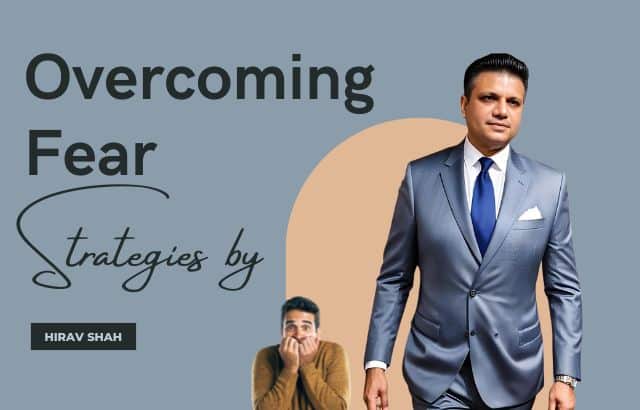
Overcoming fear is an ongoing process that requires patience, persistence, and self-compassion. By implementing the strategies outlined by Hirav Shah, you can start to change your mindset, build confidence, and ultimately achieve your personal and professional goals. Fear doesn’t have to be a roadblock—it can be the catalyst that propels you to success.
Remember: Inaction breeds doubt and fear. Action breeds confidence and courage. Keep moving forward, and success will follow.