
In today’s unpredictable business environment, decision-makers are constantly searching for clarity, certainty, and a competitive edge. Whether you’re scaling a startup, restructuring a legacy business, or planning a strategic collaboration with a large brand, one truth remains constant: your decisions determine your trajectory.
The KEA Framework—Knowledge, Experience, and Astro Strategy (reframed here as “The Game Changer”)—offers a structured approach to making high-impact, well-informed business decisions. This model doesn’t reject traditional business wisdom; instead, it enhances it by introducing an additional layer of foresight and timing.
As emphasized by Business Strategist Hirav Shah, the true power of strategy lies not just in what you do—but when and how you do it.
Table of Contents
Understanding the KEA Rules
1. Knowledge: The Foundation of Intelligent Decisions
Knowledge represents the theoretical backbone of your business. It includes:
- Market research
- Industry trends
- Competitive analysis
- Financial literacy
- Consumer behavior insights
Example:
Imagine launching a premium skincare brand. Knowledge helps you understand your target demographic, ingredient trends, pricing benchmarks, and distribution channels. You learn that consumers prefer organic ingredients and are willing to pay 20–30% more for sustainable packaging.
However, knowledge alone has its limits. It tells you what works in general, but not necessarily what will work for you specifically.
Impact Estimate:
Using only knowledge can improve productivity by approximately 20%, as it reduces guesswork but doesn’t eliminate uncertainty.
2. Experience: The Power of Real-World Application
Experience brings knowledge to life. It includes:
- Lessons from past successes and failures
- Industry exposure
- Operational understanding
- Decision-making under pressure
Example:
A seasoned retailer knows that festive seasons drive 40–60% of annual sales. Based on past experience, they increase inventory, optimize logistics, and launch targeted campaigns ahead of Diwali.
Experience helps avoid common pitfalls. For instance, a first-time entrepreneur might overstock inventory, while an experienced one maintains a buffer based on historical demand patterns.
Impact Estimate:
Experience alone can increase productivity by around 30%, as it improves execution and reduces costly mistakes.
3. The Game Changer: Strategic Timing and Predictive Insight
This is where the KEA framework becomes unique. The Game Changer introduces timing, alignment, and probability-based foresight into business strategy.
It helps answer questions like:
- What are the chances of success for this product launch?
- Is this the right time to expand or diversify?
- Should I enter a joint venture now or wait?
- What internal capabilities need strengthening before scaling?
Example:
Two companies launch identical products with similar pricing and marketing strategies. One succeeds, the other fails. Why?
The difference often lies in timing, alignment, and unseen variables—market readiness, internal preparedness, and external conditions.
The Game Changer aims to bring clarity to these variables before action is taken.
Impact Estimate:
When combined with knowledge and experience, this approach can potentially elevate productivity up to 96%, by reducing uncertainty and aligning strategy with optimal timing.
The Productivity Equation: A Simple Illustration
Let’s break it down numerically:
- Knowledge alone: 20% efficiency
- Experience alone: 30% efficiency
- Combined (not additive due to overlap): ~42% efficiency
- Combined with The Game Changer: up to 96% strategic efficiency
Interpretation:
The jump from 42% to 96% is not incremental—it’s exponential. It reflects the value of clarity before action.
The 7 Pillars of Business Success: A Strategic Deep Dive
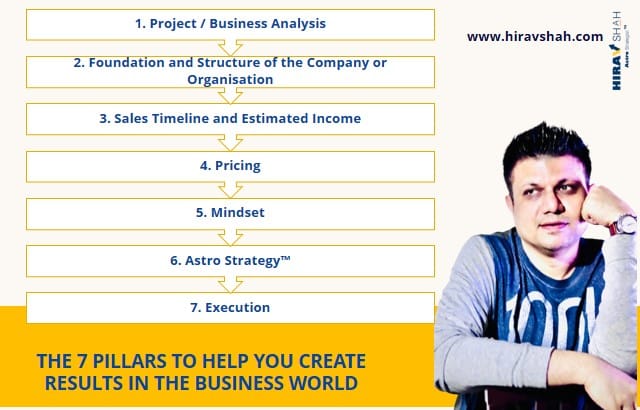
1. Project / Business Analysis
Every successful strategy begins with clarity.
Tools Used:
- GAP Analysis: Measures the difference between current performance and potential
- SWOT Analysis: Identifies strengths, weaknesses, opportunities, and threats
Case Example:
A mid-sized manufacturing firm realizes through GAP analysis that it is operating at only 60% capacity due to outdated machinery. SWOT reveals a strong distribution network but weak digital presence.
Strategist’s Perspective:
Before scaling, fix inefficiencies. Growth without alignment leads to collapse.
2. Foundation and Structure of the Organization
A strong foundation ensures smoother execution.
Key elements include:
- Company and brand name
- Partner alignment and equity distribution
- Registered address and operational base
- Logo and brand identity
- Digital and print presence
- Role clarity among leadership
Real-World Scenario:
A startup with unclear roles among co-founders faces internal conflict during scaling. After restructuring responsibilities, decision-making becomes faster and more effective.
Strategist Insight:
Structure is not just administrative—it’s strategic.
3. Sales Timeline and Estimated Income
Forecasting provides direction and confidence.
Example Calculation:
If your product sells at ₹1,000 and you aim for ₹1 crore annual revenue:
- Required sales = 10,000 units/year
- Monthly target = ~834 units
- Daily target = ~28 units
This breakdown helps allocate marketing budgets, sales efforts, and inventory planning.
Strategist’s View:
What gets measured gets managed.
4. Pricing Strategy
Pricing is both a science and an art.
Approaches:
- Cost-plus pricing
- Value-based pricing
- Competitive pricing
Example:
A SaaS company increases its price by 15% but adds premium features. Surprisingly, conversions increase because perceived value improves.
Strategist Insight:
Price communicates value. Underpricing can damage brand perception.
5. Mindset
A business grows only as much as its leader does.
Key Traits:
- Resilience
- Adaptability
- Long-term thinking
- Emotional intelligence
Example:
Two entrepreneurs face the same setback. One quits, the other pivots. The difference is mindset.
Strategist’s Perspective:
Mindset is the invisible engine behind visible results.
6. The Game Changer in Strategy
This pillar integrates timing and foresight into:
- Product launches
- Marketing campaigns
- Mergers and acquisitions
- Market expansion
Case Insight:
A company delays its IPO by six months based on strategic timing insights. Market conditions improve, and valuation increases by 25%.
Strategist View:
Right action at the wrong time is still the wrong action.
7. Execution
Execution transforms strategy into results.
Key Components:
- Clear action plans
- Resource allocation
- Performance tracking
- Continuous feedback loops
Example:
A business with a brilliant strategy fails due to poor execution—missed deadlines, unclear communication, and lack of accountability.
Strategist Insight:
Execution is where most strategies fail—not because they’re wrong, but because they’re not implemented effectively.
Real-World Application: A Case Scenario
A retail brand plans to expand into e-commerce.
Without KEA:
- Launches website
- Runs ads
- Faces low conversion
With KEA:
- Knowledge: Studies online consumer behavior
- Experience: Hires e-commerce experts
- Game Changer: Times launch with festive season
Result:
Conversion rate increases by 3x, ROI improves significantly.
Frequently Asked Questions (FAQ)
Q1: Is knowledge and experience not enough for business success?
They are essential but not sufficient. They provide direction and execution capability, but not always clarity on timing or probability of success.
Q2: How does the KEA framework reduce risk?
By combining data (knowledge), real-world insights (experience), and strategic timing (The Game Changer), it minimizes uncertainty and improves decision accuracy.
Q3: Can small businesses apply this framework?
Absolutely. In fact, small businesses benefit the most because they have limited resources and cannot afford repeated trial and error.
Q4: How do I start implementing the 7 pillars?
Begin with a thorough business analysis, then strengthen your foundation, define clear financial goals, optimize pricing, work on mindset, integrate timing into strategy, and focus on disciplined execution.
Q5: What role does a strategist play in this process?
A strategist acts as a guide—connecting dots, identifying blind spots, and ensuring alignment between vision and execution. As often highlighted by Business Strategist Hirav Shah, strategy is not just planning—it’s precision in action.
Final Thoughts

Clarity is the ultimate competitive advantage.
When you know where you are, where you want to go, and what your chances are of getting there, your decisions become sharper, your execution becomes stronger, and your results become predictable.
The KEA framework is not about replacing traditional business practices—it’s about enhancing them with deeper insight and better timing.
Because in business, certainty is power—and clarity is the path to it.