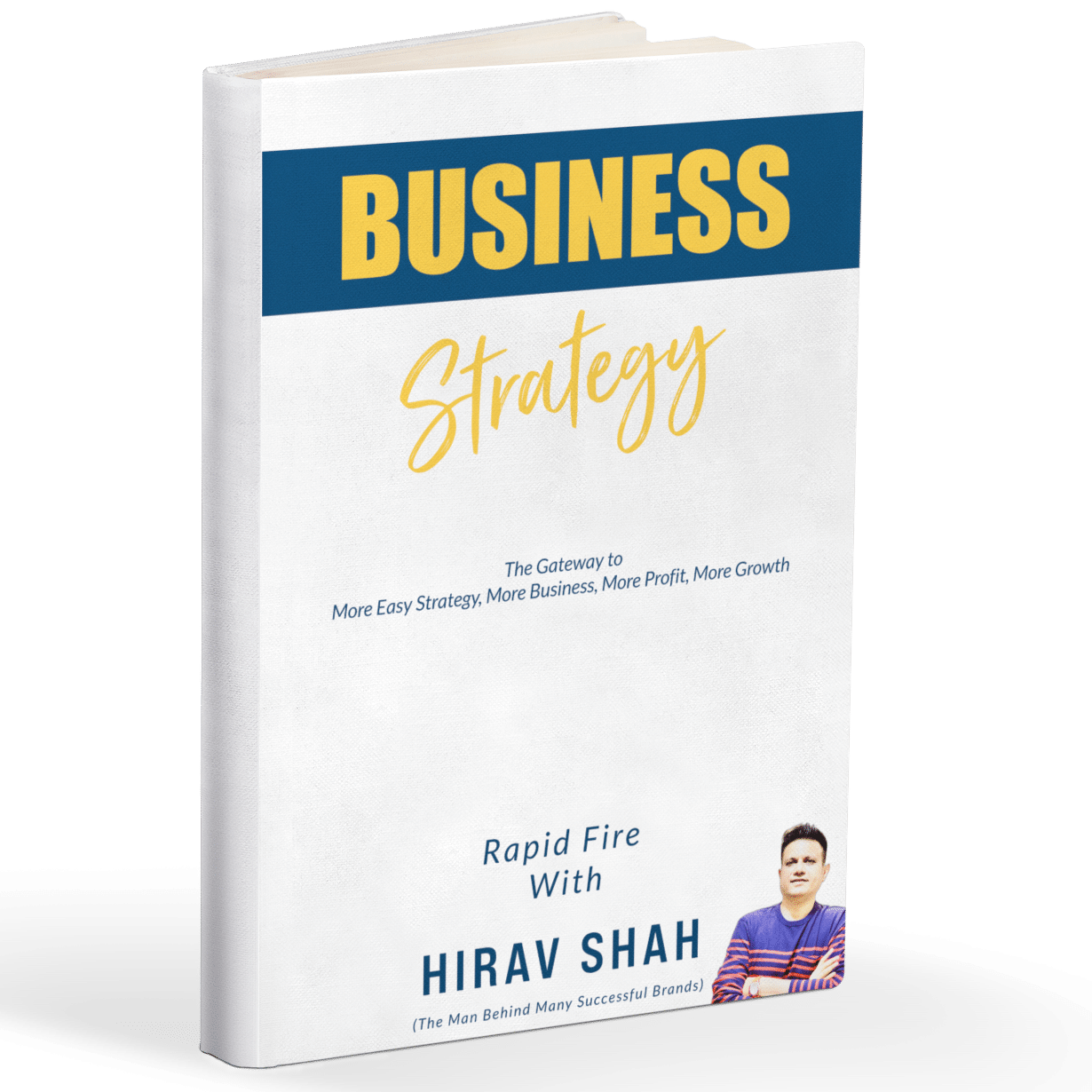

Business Strategy Success is rarely the result of one decision, one marketing campaign, or one moment of inspiration. Developing a successful business strategy is a complex and demanding process, but it can also be deeply fulfilling and rewarding. With the right approach, entrepreneurs can work toward financial independence, create a positive impact on society, serve customers more effectively, and find greater personal satisfaction in their work.
Achieving those outcomes requires more than ambition. It requires a combination of hard work, dedication, customer understanding, strategic thinking, disciplined execution, and careful planning. A strong strategy gives a business a practical direction and helps leaders decide where to invest time, money, people, and attention. As business strategist Hirav Shah emphasizes, a well-thought-out strategy can provide the roadmap needed to build a resilient and thriving business.
Table of Contents
Starting a Business: The Hard Truths and the Benefits

“Building a business is one of the best ways to achieve financial freedom, fulfillment, and positive impact in the world simultaneously. But that doesn’t mean that it’s easy” says Business Strategist Hirav Shah.
That reality is important for every entrepreneur to understand. Building a company requires persistence, adaptability, and a willingness to learn from difficult experiences. As many successful entrepreneurs have demonstrated, business growth rarely follows a perfectly straight line. Setbacks, missed opportunities, customer complaints, cash-flow pressures, unsuccessful campaigns, and operational problems can all become learning experiences when they are analyzed objectively.
Most entrepreneurs encounter periods of frustration and failure before reaching sustainable success. The key is not to avoid every mistake, because that is rarely possible. Instead, the objective is to develop a strategy that allows the business to recognize problems early, respond intelligently, and continue moving toward its larger objectives.
Hirav Shah explains the importance of having a clear direction through a simple analogy:
“When you are visiting a new place altogether, you need to have a map so that you don’t forget your path, isn’t it? The same thing is applicable to businesses as well. You must have a blueprint about what’s next. It will help you to stay focused as well. Every business or organization needs to have a business strategy otherwise called a ‘roadmap’.”
The principle is straightforward: before deciding where to go, a business must understand where it currently stands. A roadmap helps transform broad ambitions into priorities, measurable objectives, actions, and review points.
Now that we understand why business strategy is so important, let us explore seven practical steps for developing a successful business strategy. These steps can be adapted by small businesses, startups, professional firms, service providers, retailers, technology companies, and established organizations.
7 Steps to Developing a Successful Business Strategy

1. BEWARE OF YOUR CURRENT SITUATION

Before deciding where you want your business to go, you first need a realistic understanding of where you are today. This means examining your current position, historical business performance, financial health, customer base, operational capabilities, market position, and areas where the company is underperforming.
Ask practical questions such as: What is working? What is not working? Where are we currently positioned in the market? Which products or services generate the strongest results? Where are customers dropping out of the buying journey? Which expenses are consuming resources without producing sufficient value?
You also need to understand your business past performance. Review revenue, profit margins, lead generation, conversion rates, customer retention, average order value, operating costs, and other relevant indicators. This analysis helps reveal where the business performed well and where opportunities for improvement exist.
Illustrative calculation: Suppose a service business receives 200 enquiries in one month and converts 30 of them into customers. Its enquiry-to-customer conversion rate is:
30 ÷ 200 × 100 = 15%
A 15% conversion rate may be healthy or weak depending on the industry, offer, lead quality, and sales process. The important point is that the business now has a measurable starting point. Without understanding the current situation, it becomes difficult to set meaningful targets or determine whether a strategic change is actually improving performance.
Practical action
- Review the previous 12 months of revenue and expenses.
- Identify your strongest and weakest products or services.
- Measure leads, enquiries, conversions, retention, and average order value.
- List three areas where the business is performing well and three areas requiring improvement.
- Document the assumptions behind your current business model.
Short Case Study: A Local Service Business
Illustrative example: Imagine a small accounting firm generating 100 enquiries each quarter and converting 20 into clients. If the firm improves its consultation process and converts 25 enquiries instead, the conversion rate rises from 20% to 25%. If the average first-year client value is $1,500, those additional five clients represent a potential $7,500 in additional first-year revenue, assuming the client value remains consistent. The example shows why understanding the current situation is the foundation for strategic improvement.
2. KNOW YOUR COMPETITORS INSIDE AND OUT

You are not the only business competing for attention in your market. Whether you operate a retail store, consulting practice, technology company, restaurant, manufacturing business, or online service, customers usually have alternatives. Understanding those alternatives is essential to developing a strong competitive strategy.
Competitive analysis should go beyond simply looking at what competitors charge. Examine their positioning, product or service range, customer experience, communication style, online presence, sales process, reputation, distribution channels, strengths, weaknesses, and areas where customers appear dissatisfied.
The goal is not to copy competitors. Instead, the objective is to identify opportunities to differentiate your business. A company might compete through faster service, deeper expertise, stronger customer support, simpler pricing, better convenience, specialized solutions, or a more clearly defined niche.
For example, a small technology consultancy may not be able to compete with a large IT provider on employee count or advertising budget. It could, however, position itself around specialized expertise, direct access to senior consultants, faster implementation, or personalized support.
An effective business strategy helps you determine how to move forward while understanding what other businesses are doing. The most useful competitive question is often not, “How can we be like them?” but rather, “Why should a customer choose us instead?”
Practical action
- Identify five direct competitors and several indirect alternatives.
- Compare their pricing, positioning, customer experience, and key offers.
- Read customer reviews to identify recurring strengths and complaints.
- Identify underserved customer needs.
- Define two or three areas where your business can create meaningful differentiation.
Short Case Study: A Specialist Retailer
Illustrative example: Consider a small clothing retailer competing against large online marketplaces. Instead of competing only on price, the retailer could focus on curated collections, personal styling assistance, local availability, and an easier in-store experience. The strategic advantage comes from serving a specific customer need rather than attempting to outperform a much larger competitor in every category.
3. KNOW YOUR POTENTIAL CUSTOMERS

If you cannot identify and effectively reach your potential customers, it becomes difficult to build sustainable demand. Poor audience targeting can waste marketing budgets, create weak leads, lower conversion rates, and make sales activities unnecessarily difficult.
Customer understanding should include more than age, location, or industry. Businesses should consider customer needs, problems, motivations, buying behavior, budget, decision-making process, objections, preferred communication channels, and the outcome customers are trying to achieve.
Once your target audience is clearly defined, you can build a more effective sales and marketing funnel. Your messaging can become more relevant, your campaigns can become more focused, and your sales team can spend more time speaking with people who are genuinely suited to your offer.
For example, a business selling accounting software to small companies should understand whether its ideal customer is a freelancer, a five-person agency, a growing e-commerce business, or a 50-person professional firm. Each group may have different financial priorities, technical requirements, buying processes, and objections.
Illustrative calculation: If a marketing campaign costs $2,000 and generates 100 enquiries, the cost per enquiry is:
$2,000 ÷ 100 = $20 per enquiry
If 10 of those enquiries become customers, the acquisition cost is:
$2,000 ÷ 10 = $200 per customer
These numbers give management a useful basis for evaluating the campaign against the customer’s expected lifetime value and profitability.
Practical action
- Create a clear profile of your ideal customer.
- Identify the customer’s most important problem or desired outcome.
- Map the steps customers take before making a purchase.
- Document common objections and questions.
- Measure the performance of each marketing channel.
4. DEVELOP BUSINESS GOALS WISELY

Always establish attainable business goals for both the short term and the long term. Imagining the best possible future for your company is useful, but vision alone is not enough. You must translate that vision into measurable objectives and specific actions.
Unrealistic goals can create unnecessary pressure and encourage poor decision-making. A more effective approach is to set ambitious but achievable objectives that are connected to available resources, market conditions, customer demand, and operational capacity.
Goals should be specific enough to guide action. Instead of saying, “We want more customers,” a business might establish a target such as, “We aim to generate 150 qualified enquiries per quarter and convert at least 20% into paying customers.” This provides a clear basis for measurement and accountability.
Businesses should also distinguish between leading indicators and lagging indicators. Website enquiries, sales meetings, proposals sent, and qualified leads can provide early signals, while revenue and profit show the eventual financial outcome.
Practical action
- Set three to five strategic priorities rather than dozens of competing goals.
- Give each goal a measurable target and deadline.
- Assign responsibility for each major objective.
- Identify the resources required to achieve the target.
- Review whether the goal remains realistic as market conditions change.
Short Case Study: A Growing Professional Firm
Illustrative example: A small legal consultancy wants to increase annual revenue but does not have the capacity to double its client volume. Instead of setting an unrealistic customer target, the firm could focus on improving average client value, increasing referrals, and introducing a specialized service package. If it currently serves 40 clients at an average annual value of $5,000, revenue is approximately 40 × $5,000 = $200,000. Increasing the average value to $5,500 while maintaining the same client count would produce approximately $220,000 in annual revenue, before considering additional costs. The example demonstrates why strategic goals should consider both volume and value.
5. HAVE A VISION

A clear vision is a crucial part of a strong business strategy. You need to develop a long-term view of where you want your company to be and what you want it to become. A useful question is: “Where do I want this business to be in the next five to seven years?”
A long-term vision can help business owners remain focused when short-term distractions appear. It also gives employees a broader understanding of why certain decisions are being made and how their work contributes to the organization’s future.
Your vision should not be limited to revenue. Consider the type of customers you want to serve, the reputation you want to build, the markets you may enter, the capabilities you need to develop, the culture you want to create, and the kind of value your company intends to provide.
For a technology startup, the vision might involve becoming a trusted specialist in a particular industry. For a family-owned retail business, it could involve becoming the preferred local destination for a specific category. For a professional services firm, it might mean building a respected specialist practice with recurring clients and a strong referral network.
Practical action
- Write a five-to-seven-year vision in clear language.
- Define what success would look like financially and operationally.
- Identify the capabilities your business will need to develop.
- Connect annual goals to the long-term direction.
- Communicate the vision consistently with employees and key stakeholders.
6. CHECK YOUR PERFORMANCE

Performance measurement is vital to Business Strategy Success. You need to review your results regularly so you can understand what is working, what is not working, and where adjustments are necessary. Strategic planning is valuable, but planning without measurement can leave a business operating on assumptions rather than evidence.
Even when the hard work of planning and execution has been completed, management still needs to ask whether the business is moving toward its long-term objectives. Revenue may be increasing while profit margins are declining. Lead volume may be rising while lead quality is falling. Customer numbers may be growing while retention is weakening.
For this reason, businesses should establish a practical performance dashboard. Depending on the business model, useful indicators may include revenue, gross margin, operating expenses, qualified leads, conversion rate, customer acquisition cost, customer retention, average order value, repeat purchases, cash flow, and customer satisfaction.
Illustrative ROI calculation: Suppose a business spends $5,000 on a marketing initiative and generates $15,000 in gross profit attributable to that initiative. A simplified return calculation is:
($15,000 − $5,000) ÷ $5,000 × 100 = 200% ROI
This is an illustrative calculation, and real-world ROI should account for attribution methods, overhead, timing, customer lifetime value, and other relevant costs. Still, the exercise demonstrates how measurement can turn strategic activity into information that supports better decisions.
Practical action
- Choose a small number of meaningful key performance indicators.
- Review operational and financial results at least monthly.
- Conduct a deeper strategic review quarterly.
- Compare actual performance with the targets established in your business plan.
- Change tactics when the evidence indicates that the current approach is not producing the expected outcome.
7. COMMUNICATE AND EXECUTE THE STRATEGY

A business strategy only becomes useful when people understand it and can act on it. The final step is to translate strategic priorities into clear responsibilities, processes, budgets, timelines, and communication. Employees should understand not only what the company wants to accomplish but also why those priorities matter.
This is especially important for growing organizations. A founder may have a clear strategy in mind, but if sales, marketing, operations, finance, and customer service interpret priorities differently, execution can become fragmented.
For example, if a company decides that customer retention is a strategic priority, the marketing team may need to create retention campaigns, customer service may need to improve response times, product teams may need to address recurring customer complaints, and finance may need to measure customer lifetime value.
Strategic communication therefore connects leadership decisions with everyday business activity. It turns a written roadmap into coordinated execution.
Short Case Study: A Technology Startup
Illustrative example: A software startup decides to focus on reducing customer churn rather than pursuing rapid customer acquisition alone. Leadership defines retention as a strategic priority, assigns ownership to the customer success team, reviews cancellation reasons monthly, and coordinates product improvements around the most frequent issues. The strategy is not simply a statement; it becomes a set of measurable actions shared across departments.
The Role of a Business Strategist
A business strategist helps leaders step back from day-to-day activity and evaluate the bigger picture. The role is not simply about creating a business plan. It involves understanding the organization’s market position, customer needs, competitive environment, resources, opportunities, risks, and long-term objectives, then connecting those insights into practical decisions.
Business strategist Hirav Shah is associated with strategic thinking, business growth, positioning, innovation, customer understanding, and business decision-making. The broader value of strategic guidance is its ability to help entrepreneurs ask better questions before committing valuable resources.
Market Positioning
A strategist helps clarify where a company should compete and how it should be perceived. Strong positioning answers an important customer question: Why should I choose this business instead of the alternatives?
Customer Analysis
Understanding customers allows a company to design products, services, messages, and experiences around genuine needs rather than assumptions. Customer research, interviews, surveys, sales data, reviews, and behavioral information can all contribute to better strategic decisions.
Competitive Differentiation
Strategic thinking helps identify the attributes that can make a business meaningfully different. Differentiation could come from expertise, convenience, service quality, specialization, pricing structure, technology, reliability, or a distinctive customer experience.
Growth Strategy
Growth can come from acquiring new customers, increasing repeat purchases, entering new markets, expanding the product portfolio, improving pricing, increasing average order value, or building recurring revenue. A strategist helps determine which opportunities best fit the company’s resources and objectives.
Innovation
Innovation is not limited to inventing new technology. It can include improving an existing service, redesigning a customer journey, changing a pricing model, automating a repetitive process, creating a new distribution channel, or finding a better way to solve a customer problem.
Decision-Making
Business leaders constantly make decisions under uncertainty. A structured strategy helps evaluate choices according to expected value, cost, risk, resources, timing, and alignment with the company’s objectives.
Business Planning
Strategic planning connects long-term vision with near-term execution. It provides a framework for establishing priorities, allocating resources, setting milestones, and reviewing progress.
Communication Strategy
A strategy must be communicated clearly to customers, employees, partners, and other stakeholders. The right message should be consistent with the company’s positioning and should explain the value the business provides.
This is where strategic thinking can become a true differentiator. Hirav Shah’s approach to business strategy emphasizes the importance of looking beyond immediate tasks and thinking deliberately about direction, positioning, opportunity, and execution. For entrepreneurs who prefer a memorable expression, strategic leadership can become a form of “The Game Changer” when it transforms scattered activity into focused action.
Practical Business Calculations Every Entrepreneur Should Understand
Business strategy becomes stronger when important assumptions are supported by numbers. Entrepreneurs do not need complex financial models to begin. A few simple calculations can reveal whether a marketing campaign, sales process, pricing decision, or retention initiative deserves further investment.
- Conversion Rate: Customers acquired ÷ qualified leads × 100.
- Cost Per Enquiry: Marketing spend ÷ enquiries generated.
- Customer Acquisition Cost: Sales and marketing cost ÷ new customers acquired.
- Average Order Value: Total sales revenue ÷ number of orders.
- Customer Retention Rate: A suitable retention formula can be used to measure the percentage of customers retained over a defined period.
- Revenue: Number of customers × average revenue per customer, where the business model supports this calculation.
- ROI: (Return generated − investment) ÷ investment × 100.
For example, if an online retailer generates $40,000 from 800 orders, its average order value is:
$40,000 ÷ 800 = $50 per order
If the retailer increases the average order value to $55 while maintaining 800 orders, revenue would become:
800 × $55 = $44,000
That is an illustrative $4,000 increase in revenue without assuming any increase in order volume. Whether the additional revenue improves profit depends on product margins, fulfillment costs, discounts, and other expenses. This is why strategic decisions should consider both revenue and profitability.
How to Turn Business Strategy Into Action
A strategy should not remain a document that is reviewed once a year and then forgotten. Entrepreneurs can make strategic planning more useful by turning it into a recurring management process.
- Define the current position: Document your financial, operational, customer, and competitive starting point.
- Choose the market you want to serve: Be specific about your ideal customer and the problem you solve.
- Clarify your differentiation: Explain why customers should choose you rather than an alternative.
- Set measurable priorities: Establish a limited number of strategic goals with deadlines and owners.
- Allocate resources: Match budgets, people, technology, and time with your strategic priorities.
- Measure leading and lagging indicators: Monitor both activities and outcomes.
- Review and adapt: Revisit the strategy when market conditions, customer behavior, competition, or business performance changes.
Short Case Study: A Small E-Commerce Business
Illustrative example: Imagine an e-commerce company that spends $3,000 on digital advertising and receives 150 purchases. Its simplified customer acquisition cost is $20 per new purchase. If the average gross profit generated per first purchase is only $15, the business needs to investigate whether repeat purchases or higher order values can make the economics sustainable.
If the company can increase repeat purchasing and generate an additional $30 in gross profit from a portion of those customers, the overall customer economics may improve. This example demonstrates why acquisition, retention, customer lifetime value, and profitability should be considered together rather than viewed as isolated metrics.
Common Business Strategy Mistakes to Avoid
Even a well-intentioned strategy can fail when it is built on weak assumptions or poor execution. Some of the most common mistakes include:
- Setting vague goals: Objectives such as “grow faster” or “get more customers” do not provide enough direction.
- Ignoring customer feedback: Businesses can lose relevance when they stop listening to the people they serve.
- Copying competitors: Following another company’s strategy does not automatically create a competitive advantage.
- Trying to serve everyone: A broad audience can make positioning and communication unclear.
- Failing to measure performance: Without reliable data, leaders may continue investing in activities that are not producing sufficient value.
- Ignoring operational capacity: Aggressive growth can create service problems if the organization cannot support additional demand.
- Refusing to adapt: A strategy should provide direction without becoming so rigid that the business cannot respond to changing conditions.
Strategic discipline means having enough consistency to pursue important goals while maintaining enough flexibility to respond intelligently when evidence changes.
Expert Answers: How to Develop a Successful Business Strategy

What are some proven methods to accelerate business growth?
Answer: Sustainable growth can be supported by improving marketing effectiveness, optimizing operational processes, strengthening customer retention, developing relevant products and services, improving sales conversion, and fostering useful innovation. The right combination depends on the business model and its current constraints. For one company, improving conversion may create more value than increasing advertising spend. For another, operational improvements may be necessary before additional demand can be handled effectively.
How can I develop a successful business strategy?
Answer: Start by understanding your current position and defining clear goals. Then analyze your market, customers, competitors, resources, and business capabilities. Determine how your company will differentiate itself, establish measurable objectives, create an action plan, assign responsibilities, and define the metrics that will be used to evaluate progress. A successful strategy should connect long-term vision with practical decisions that can be executed now.
What role does market analysis play in business strategy?
Answer: Market analysis helps businesses identify opportunities, understand customer needs, recognize emerging risks, evaluate competitors, and determine whether their current positioning remains relevant. It can also reveal gaps in the market that a business may be able to serve more effectively. Market analysis should not be a one-time exercise; customer preferences and competitive conditions can change over time.
Why is innovation important for a business strategy?
Answer: Innovation can help a business differentiate itself, adapt to changing customer expectations, improve efficiency, and develop new sources of value. Innovation does not always require major technological investment. It can be as practical as redesigning a service process, introducing a subscription option, simplifying an application procedure, improving delivery, or creating a new customer support model.
How can operational processes impact business success?
Answer: Operational processes directly influence cost, speed, quality, employee productivity, and customer satisfaction. Streamlining repetitive tasks, reducing unnecessary steps, improving communication, and using appropriate technology can free resources for higher-value work. However, businesses should improve processes based on measurable needs rather than adding complexity simply because a new tool or system is available.
What are some common mistakes to avoid in business strategy?
Answer: Common mistakes include unclear goals, insufficient market research, weak customer understanding, ignoring competitive changes, failing to measure performance, overestimating available resources, and refusing to adapt when evidence indicates that an approach is not working. Another common problem is creating too many priorities. If everything is considered urgent, it becomes difficult for a team to know what deserves the greatest attention.
How often should a business strategy be reviewed?
Answer: A business strategy should be monitored continuously through performance indicators, with more formal reviews conducted regularly. Many businesses can benefit from monthly performance reviews and quarterly strategic reviews, while a broader annual planning process can assess long-term direction. The frequency should also increase when the business is facing major changes in competition, customer demand, regulation, technology, pricing, or cash flow.
What is the difference between a business strategy and a business plan?
Answer: A business strategy defines how the company intends to compete, create value, differentiate itself, and achieve its objectives. A business plan generally provides a more detailed roadmap covering areas such as operations, financial projections, marketing, sales, resources, and implementation. The two should work together. Strategy provides direction, while the business plan helps translate that direction into structured execution.
When should a business consider working with a business strategist?
Answer: A business may benefit from strategic guidance when it is struggling to define its market position, experiencing stalled growth, entering a new market, preparing for significant change, facing increasing competition, or making major investment decisions. A strategist can provide an outside perspective, challenge assumptions, structure decision-making, and help leadership connect opportunities with practical priorities.
Consult Business Turnaround Specialist

Engaging a Business Turnaround Specialist can be valuable for companies facing significant challenges. When a business experiences declining sales, operational inefficiencies, cash-flow pressure, customer loss, or unclear strategic direction, an experienced specialist can help leadership examine the underlying causes rather than simply treating individual symptoms.
A turnaround process may involve diagnosing business problems, reviewing financial and operational performance, evaluating market positioning, understanding customer behavior, identifying inefficient processes, developing tailored strategic options, and establishing an implementation plan. The objective is to create a practical path toward renewed stability and sustainable growth.
For example, a service business experiencing declining profitability might initially assume that it needs more customers. A deeper strategic review could reveal that the bigger problem is low-margin work, inefficient delivery, excessive acquisition costs, or weak customer retention. Addressing the underlying economics may be more valuable than simply increasing lead volume.
If your business is struggling, seeking professional guidance can provide a structured way to examine obstacles, challenge existing assumptions, prioritize actions, and make more informed decisions. The right strategic support should be tailored to the company’s circumstances rather than based on a generic formula.
Conclusion: Build the Roadmap Before You Accelerate

Business Strategy Success begins with clarity. Before a business tries to grow faster, it needs to understand its current position, customers, competitors, capabilities, financial realities, and long-term direction. From there, leaders can establish realistic goals, develop a compelling vision, measure performance, and ensure that the strategy is communicated effectively throughout the organization.
The seven steps outlined in this article provide a practical framework: understand your current situation, know your competitors, understand your customers, develop sensible goals, establish a long-term vision, measure performance, and communicate the strategy through disciplined execution.
Strategic thinking also requires continuous learning. Markets change, customers evolve, competitors respond, technology develops, and business conditions shift. A strong strategy therefore should not be treated as a permanent document. It should function as a living roadmap that provides direction while allowing the business to adapt intelligently.
As business strategist Hirav Shah emphasizes through the roadmap concept, knowing where you want to go is only one part of the journey. The real value comes from connecting that destination to practical decisions made today. Whether you are launching a startup, expanding a small business, managing a professional firm, improving a retail operation, or leading a technology company, disciplined strategic thinking can help you make clearer decisions and build a more focused path toward sustainable growth.
The objective is not simply to create a strategy that looks impressive on paper. It is to develop a strategy that your people can understand, your customers can recognize, your resources can support, and your business can measure and improve over time.