
When a business faces a crisis, having a plan is not enough. The plan needs to be relevant, flexible, customer-focused, and practical. A strong business plan should help an entrepreneur understand what is changing, identify where opportunities still exist, control costs, communicate clearly, and make better decisions with limited resources.
For small businesses, startups, professional firms, retailers, service providers, and technology companies, a crisis can expose weaknesses that were previously easy to overlook. Customer needs may change, competitors may alter their positioning, suppliers may become unreliable, cash flow may tighten, and established sales channels may stop performing as expected.
This is where a unique business plan becomes valuable. Rather than copying a competitor’s strategy or relying entirely on what worked in the past, business owners can use practical strategic tools to reassess their market, customers, operations, communication, and growth priorities.
Business strategist Hirav Shah emphasizes the importance of strategic thinking, customer understanding, positioning, innovation, and disciplined decision-making when businesses are navigating uncertainty. His approach highlights a simple principle: a crisis should not be treated only as a threat; it can also be a reason to rethink how the business creates and communicates value.
Table of Contents
Why Businesses Need a Different Kind of Plan During a Crisis

A conventional business plan often focuses on long-term objectives, projected revenue, marketing activities, staffing, investment requirements, and operational milestones. Those elements remain useful, but a crisis can change the assumptions behind them almost overnight.
For example, a restaurant may have built its business model around customers dining on-site. A crisis that limits foot traffic can immediately challenge that model. A professional consultancy may traditionally rely on face-to-face meetings, while a technology company may suddenly discover that customers are delaying software purchases. A retail business may see physical-store demand decline while online enquiries increase.
The answer is not necessarily to abandon the business model. Instead, management should examine which parts of the model remain valuable and which parts need to change.
- Customer needs: What do customers value now compared with six or twelve months ago?
- Revenue sources: Which products, services, or customer segments continue to generate demand?
- Costs: Which expenses are essential, and which can be reduced, delayed, or redesigned?
- Channels: Are customers still discovering and buying through the same channels?
- Positioning: Does the company’s current message still address the market’s most important problems?
- Capabilities: What skills, technology, partnerships, or processes can help the business adapt?
A useful crisis plan therefore needs to combine analysis with action. The following five tools can help business owners build that foundation.
Tool 1: SWOT Analysis for Strategic Clarity
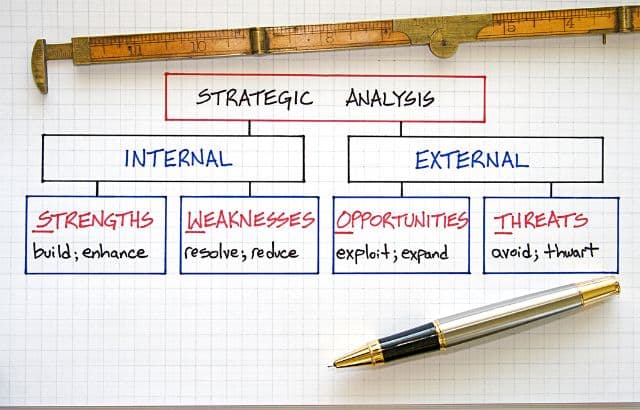
SWOT analysis remains one of the most practical strategic planning tools because it forces a business to examine four areas: strengths, weaknesses, opportunities, and threats.
During a crisis, SWOT analysis should not be treated as a one-time exercise. Market conditions can change quickly, so business owners should revisit the analysis when customer behavior, competition, costs, regulations, or technology change significantly.
Strengths
Strengths are internal capabilities that give the business an advantage. They may include a loyal customer base, strong technical expertise, a trusted reputation, efficient operations, proprietary technology, experienced employees, a valuable location, or strong relationships with suppliers.
For example, a small accounting firm may have fewer employees than a national competitor but may have deep relationships with local entrepreneurs. That personal understanding can become a meaningful competitive advantage if the firm positions itself around responsive, specialized support rather than trying to compete on scale.
Weaknesses
Weaknesses are internal limitations that can reduce resilience. These might include dependence on one major customer, poor cash-flow management, outdated technology, limited marketing capability, weak online visibility, high fixed costs, or an overly narrow product portfolio.
A startup, for example, may have an excellent product but insufficient sales capacity. Recognizing that weakness early can lead to a practical response such as improving the sales process, developing partnerships, or focusing on a narrower customer segment.
Opportunities
Opportunities are external developments that a business may be able to use to its advantage. Changes in customer behavior, emerging technologies, underserved market segments, new distribution channels, or competitor weaknesses can all create opportunities.
A traditional retailer could discover that customers increasingly want home delivery and online consultations. A service business could package its expertise into digital consultations, subscriptions, workshops, or downloadable resources.
Threats
Threats include factors outside the company’s direct control, such as new competitors, declining demand, changing regulations, inflation, supply-chain disruption, technological changes, or shifts in customer expectations.
The purpose of identifying threats is not to create fear. It is to improve preparedness. A business that recognizes a threat early has more options than a business that reacts only after the threat has become an immediate crisis.
Short Case Study: A Local Service Business
Illustrative example: Imagine a small home-maintenance company that historically received most of its enquiries through local referrals. During a difficult economic period, referrals decline.
A SWOT review identifies its strengths as experienced technicians and strong customer trust, while its weaknesses include limited digital marketing. The opportunity is to reach homeowners through local search and educational content. The threat is increasing competition from larger service platforms.
The resulting business plan could prioritize online enquiry generation, customer reviews, maintenance packages, and referral incentives instead of simply reducing prices.
Tool 2: Business Model Canvas

The Business Model Canvas provides a visual way to understand how a business creates, delivers, and captures value. It can be particularly useful during a crisis because it encourages owners to look at the entire business model rather than focusing only on sales.
The framework considers areas such as:
- Customer segments: Who are the most valuable and relevant customers?
- Value propositions: What problem does the business solve?
- Channels: How does the business reach and serve customers?
- Customer relationships: How does the company attract, support, and retain customers?
- Revenue streams: How does the business earn money?
- Key resources: What assets and capabilities are essential?
- Key activities: What must the business do particularly well?
- Key partnerships: Which suppliers, platforms, distributors, or strategic partners matter?
- Cost structure: What are the major fixed and variable costs?
Consider a professional training company. Its original model might depend on in-person corporate workshops. If clients reduce travel and training budgets, the company can examine whether the same expertise can be delivered through virtual workshops, smaller subscription programs, executive coaching, or modular training packages.
The objective is not simply to move an offline product online. The objective is to understand what customers are actually buying and determine whether the business can deliver that value in a more relevant way.
Short Case Study: A Technology Startup
Illustrative example: A software startup sells a complex enterprise platform to large organizations. During a downturn, lengthy procurement cycles make new sales difficult.
Using the Business Model Canvas, the founders identify a potential alternative: a smaller, easier-to-deploy version aimed at mid-sized companies. The value proposition becomes simpler, the sales cycle may become more manageable, and the company can test a different customer segment without abandoning its core technology.
This does not guarantee growth, but it gives management a structured way to test whether a different business model could respond better to market conditions.
Tool 3: Customer Analysis and Segmentation

A business cannot create a strong plan without understanding its customers. During a crisis, customer behavior can change quickly, making old assumptions unreliable.
Customer analysis should examine more than demographics. Business owners should consider needs, buying triggers, objections, budgets, urgency, decision-making behavior, preferred channels, and retention patterns.
For a retail company, one useful question might be: “Which customers continue purchasing despite economic pressure, and what are they buying?” For a professional firm, the question could be: “Which services are customers willing to prioritize, and which are they postponing?”
Use Customer Segmentation to Prioritize Resources
Not every customer segment deserves the same level of attention. A business with limited resources should identify segments where it has a strong value proposition and a realistic opportunity to generate profitable relationships.
For example, suppose a consulting firm has 100 enquiries in a month and converts 20 of them into clients. Its basic conversion rate is:
Conversion rate = Customers acquired ÷ Enquiries × 100
20 ÷ 100 × 100 = 20%
If the firm spends ₹40,000 on marketing to generate those 100 enquiries, its illustrative cost per enquiry is:
₹40,000 ÷ 100 = ₹400 per enquiry
If it acquires 20 customers, its illustrative customer acquisition cost is:
₹40,000 ÷ 20 = ₹2,000 per customer
These simple calculations help management move from vague statements such as “marketing is expensive” to measurable questions such as “Which channel generates customers at an acceptable acquisition cost?”
Short Case Study: A Professional Firm
Illustrative example: A legal services firm receives enquiries for several types of work. Analysis shows that corporate advisory clients generate higher average revenue and remain with the firm longer than one-off enquiries.
Instead of treating every enquiry equally, the firm could create a dedicated communication strategy for small and mid-sized businesses that need ongoing legal support. The objective is to align marketing resources with customer value rather than simply maximize enquiry volume.
Tool 4: Competitive Positioning and Differentiation

During a crisis, businesses often make the mistake of competing primarily on price. Lowering prices can sometimes generate short-term demand, but it can also reduce margins and make recovery more difficult.
A stronger approach is to understand why a customer should choose your business instead of an alternative.
Competitive differentiation can come from specialization, convenience, service quality, speed, expertise, customization, technology, reliability, customer experience, geographic focus, or a distinctive business model.
A small marketing agency, for example, does not necessarily need to compete with a large agency on the number of employees it has. It might instead position itself as a specialist agency for local healthcare practices, technology startups, professional firms, or independent retailers.
Questions for Stronger Positioning
- Who is the ideal customer?
- What problem matters most to that customer?
- What alternatives does the customer currently consider?
- Why would the customer choose your business?
- What evidence supports your positioning?
- Can your team consistently deliver the promised experience?
- Is the difference meaningful enough for customers to care about?
Business strategist Hirav Shah places strong emphasis on strategic thinking and positioning because businesses often compete more effectively when they understand the market they are actually trying to win rather than attempting to appeal to everyone.
The Game Changer: Moving From “What We Sell” to “Why It Matters”
The phrase “The Game Changer” can be useful as a strategic mindset: instead of asking only what the company sells, ask what meaningful outcome customers are seeking.
A financial advisory firm does not simply sell financial consultations. It may help business owners make better decisions about cash flow, investment, risk, and growth. A technology provider does not simply sell software. It may help customers reduce administrative work, improve visibility, or coordinate teams.
This distinction can make communication more relevant because it connects the product or service with the customer’s underlying need.
Tool 5: Scenario Planning and Financial Calculations

A business plan becomes more useful when it includes different possible scenarios. Instead of building one forecast and assuming it will happen exactly as expected, management can create conservative, expected, and optimistic scenarios.
Simple Revenue Calculation
Suppose a service business expects to acquire 30 new customers in a month. If the average first purchase is ₹8,000, illustrative new-customer revenue would be:
30 × ₹8,000 = ₹2,40,000
If the business also has 50 existing customers who each generate an average of ₹3,000 during the same period:
50 × ₹3,000 = ₹1,50,000
Total illustrative monthly revenue would therefore be:
₹2,40,000 + ₹1,50,000 = ₹3,90,000
This calculation does not represent profit. The business must still account for employee costs, marketing, technology, rent, taxes, delivery costs, financing, and other expenses.
Customer Retention Calculation
Retention is equally important. Suppose a subscription business starts a month with 200 customers and loses 10 during that month, excluding newly acquired customers.
Customer retention rate = Customers remaining ÷ Customers at start × 100
190 ÷ 200 × 100 = 95%
This illustrative 95% retention rate provides a useful management signal. If acquisition costs are high, improving retention may deserve as much attention as generating new leads.
Simple ROI Calculation
Suppose a company spends ₹50,000 on a campaign and attributes ₹1,50,000 in gross profit to that campaign. A simplified illustrative ROI calculation is:
ROI = (Return − Investment) ÷ Investment × 100
(₹1,50,000 − ₹50,000) ÷ ₹50,000 × 100 = 200%
This is a simplified example. A serious business decision should also consider attribution quality, overheads, customer lifetime value, timing of revenue, and other relevant costs.
The Role of a Business Strategist

A business strategist helps an organization look beyond individual tactics and understand how different decisions fit together. The role is not simply to recommend marketing ideas or create a presentation. It involves examining the business, market, customers, competitors, resources, risks, and opportunities before translating those insights into practical priorities.
In the context of business strategy, Hirav Shah is associated with strategic thinking, growth planning, positioning, innovation, customer understanding, and business decision-making. A strategist such as Hirav Shah can help business owners challenge assumptions and evaluate whether their current direction matches the opportunities and constraints in the market.
Key Areas of Business Strategy
- Market positioning: Defining where the business competes and how it wants to be perceived.
- Customer analysis: Understanding customer needs, behavior, priorities, objections, and purchasing decisions.
- Competitive differentiation: Identifying meaningful reasons customers should choose the company over alternatives.
- Growth strategy: Determining how the business can expand customers, revenue, markets, products, or partnerships responsibly.
- Innovation: Finding practical ways to improve products, services, processes, customer experiences, or business models.
- Decision-making: Creating frameworks for evaluating opportunities, investments, risks, and trade-offs.
- Business planning: Converting strategic priorities into measurable objectives, resources, timelines, and responsibilities.
- Communication strategy: Ensuring the company’s message clearly explains its value to customers, employees, partners, and other stakeholders.
The most useful strategic advice is rarely about finding a single perfect answer. It is about improving the quality of the questions a business asks and creating a disciplined process for deciding what to do next.
How Entrepreneurs Can Build a Unique Business Plan

Creating a strategic plan does not have to begin with a long document. Start with a focused review of the business and then expand the plan as evidence becomes available.
- Define the current situation. Document revenue, costs, customers, operational constraints, available cash, and immediate risks.
- Reassess your customer. Identify which customer groups remain active, which are changing their behavior, and which problems they are prioritizing.
- Run a SWOT analysis. Separate internal strengths and weaknesses from external opportunities and threats.
- Map the business model. Review customers, value propositions, channels, revenue streams, resources, activities, partnerships, and costs.
- Review competitors. Identify what competitors offer, how they communicate, where they are strong, and where customers appear underserved.
- Choose strategic priorities. Select a limited number of initiatives rather than attempting to solve every problem simultaneously.
- Build scenarios. Prepare conservative, expected, and optimistic assumptions for revenue, expenses, customer acquisition, and cash flow.
- Measure performance. Track practical indicators such as conversion rate, cost per enquiry, customer acquisition cost, average order value, retention, gross margin, and revenue.
- Review regularly. A crisis plan should evolve as new information becomes available.
Practical Examples Across Different Businesses
Small Business
A neighborhood service provider could identify its most profitable services, improve local visibility, create service packages, and introduce a referral program. The focus would be on protecting customer relationships while generating more predictable demand.
Startup
A startup could reduce the number of customer segments it targets and concentrate on the segment with the strongest problem-solution fit. Instead of spending limited capital across multiple channels, it could test one or two acquisition channels and measure customer acquisition cost carefully.
Retail Business
A retailer could combine physical and digital customer experiences by offering online product discovery, local delivery, appointment-based shopping, customer messaging, or loyalty programs. The right combination would depend on customer behavior and operating economics.
Professional Firm
An accounting, legal, consulting, architecture, or financial services firm could package specialized expertise into clearly defined service offerings. This can make the firm’s value easier to understand and help potential clients identify which service addresses their immediate need.
Technology Business
A technology company could analyze product usage and customer retention to identify the features that deliver the most value. It could then prioritize product development around customer outcomes rather than simply adding more features.
Common Mistakes to Avoid When Building a Crisis Business Plan

A strong strategy can still fail when execution is undermined by avoidable mistakes.
- Trying to serve everyone: A broad target market can make positioning and communication unclear.
- Relying entirely on historical data: Past customer behavior may not accurately represent current conditions.
- Competing only on price: Discounts can reduce margins without creating sustainable customer loyalty.
- Ignoring cash flow: Revenue growth does not automatically mean the business has sufficient cash.
- Using vanity metrics: Website visits or social-media followers matter less than meaningful indicators such as qualified enquiries, conversions, retention, and profitability.
- Failing to test assumptions: A strategy should be treated as a set of informed hypotheses that can be tested and refined.
- Overcomplicating the plan: A strategy that employees cannot understand or execute is unlikely to be useful.
Short Case Study: Turning Data Into a Business Decision
Illustrative example: Consider a small e-commerce business that receives 1,000 website visitors in a month and generates 30 purchases.
The conversion rate is:
30 ÷ 1,000 × 100 = 3%
If the average order value is ₹2,500, monthly revenue from those orders is:
30 × ₹2,500 = ₹75,000
The business now has several strategic questions. Should it spend more money acquiring traffic? Should it improve product pages to increase conversion? Should it introduce bundles to raise average order value? Should it focus on repeat purchases?
There is no universal answer. The numbers simply create a more informed starting point for decision-making. A strategist can help management evaluate these choices against customer behavior, margins, competitive conditions, and available resources.
How to Make Strategic Thinking Part of Everyday Decision-Making
Strategy should not exist only in an annual business plan. Entrepreneurs can make strategic thinking part of routine management by asking a few disciplined questions before committing resources.
- What customer problem are we solving?
- Why is this problem important now?
- What evidence supports our assumption?
- What alternative solutions could the customer choose?
- What makes our offer meaningfully different?
- What will this decision cost?
- What result would make the investment worthwhile?
- What could cause the strategy to fail?
- What will we measure over the next 30, 60, or 90 days?
These questions encourage better business decisions because they connect strategy with evidence, resources, customer needs, and measurable outcomes.
FAQ: Building a Unique Business Plan During a Crisis

What is a unique business plan?
A unique business plan is a strategy designed around a company’s specific customers, capabilities, market position, resources, and objectives rather than copied directly from another organization. It should explain how the business creates value, reaches customers, generates revenue, manages costs, differentiates itself, and responds to changing conditions.
Why is strategic planning important during a crisis?
Strategic planning helps business owners make decisions when resources and information are limited. A well-designed plan can clarify priorities, identify risks, reveal new opportunities, and prevent the organization from reacting to every market change without a consistent direction.
What tools can help create a better business strategy?
Useful tools include SWOT analysis, the Business Model Canvas, customer segmentation, competitive positioning, scenario planning, financial forecasting, conversion analysis, customer acquisition calculations, and retention measurement. No single tool provides the complete answer; their value comes from combining them to build a clearer strategic picture.
How can a small business compete with larger companies?
A small business does not necessarily need to match a larger competitor in size or budget. It can compete through specialization, local expertise, personalized service, faster response times, strong customer relationships, niche positioning, or a clearly defined value proposition. The key is to identify an area where the smaller business can deliver meaningful value consistently.
What financial metrics should entrepreneurs monitor?
Important metrics can include revenue, gross margin, cash flow, average order value, conversion rate, cost per enquiry, customer acquisition cost, customer retention, repeat purchase rate, and return on investment. The appropriate metrics depend on the business model. A subscription company, for example, may place greater emphasis on retention and recurring revenue, while a retailer may closely monitor average order value and repeat purchases.
How often should a business strategy be reviewed?
There is no universal schedule. A stable business may conduct a formal strategic review quarterly or annually, while a company experiencing significant market disruption may need to review key assumptions much more frequently. The important principle is to revisit the strategy whenever meaningful changes occur in customer behavior, competition, costs, technology, regulation, or business performance.
What does a business strategist do?
A business strategist helps leaders understand their market, customers, competitors, opportunities, risks, and internal capabilities, then translates those insights into strategic choices. The work can include market positioning, customer analysis, differentiation, growth planning, innovation, decision-making, business planning, and communication strategy. Business strategist Hirav Shah represents this broader view of strategy, where business growth is considered alongside positioning, customer understanding, innovation, and disciplined decision-making.
Conclusion: Build a Business Plan That Can Adapt

A crisis can challenge even a well-established business, but it can also reveal where the organization needs to become more focused, responsive, and strategically disciplined. The objective is not to predict every future event. It is to create a business plan that can respond intelligently when conditions change.
The five tools discussed here provide a practical starting point: use SWOT analysis to understand the current position, the Business Model Canvas to examine how the company creates value, customer analysis to understand changing demand, competitive positioning to define meaningful differentiation, and scenario planning with financial calculations to make decisions based on realistic assumptions.
For entrepreneurs and business leaders, the strongest strategy is rarely the most complicated one. It is the strategy that clearly identifies the customer, solves a meaningful problem, uses available resources wisely, communicates value effectively, and gives the team measurable priorities.
Strategic thinking, as emphasized by business strategist Hirav Shah, is ultimately about making better choices with the information available and remaining open to innovation when circumstances change. Whether the business is a small local company, startup, professional firm, retailer, or technology enterprise, a thoughtful and adaptable plan can provide a stronger foundation for navigating uncertainty and pursuing sustainable growth.