
The future of business is not defined only by what happens. It is defined by how leaders respond to what happens.
The pandemic transformed the way businesses think about uncertainty, leadership, technology, customers and growth. What initially appeared to be an extraordinary disruption also became a powerful lesson in adaptability.
For today’s business owners and decision-makers, the question is no longer simply, “What if another crisis occurs?”
The more empowering question is:
“How prepared are we to transform disruption into our next opportunity?”
Business Strategist Hirav Shah believes that strategic preparation can help leaders build businesses that are more agile, resilient and opportunity-oriented.
The objective is not to fear the future.
It is to prepare for it, understand it and lead through it with confidence.
Table of Contents
Why Crisis Can Become a Catalyst for Transformation

A crisis changes the business environment, but change can create new possibilities.
Customer expectations evolve. New technologies gain momentum. Competitors change direction. New markets emerge. Traditional processes are replaced by more efficient approaches.
Consider a business generating ₹1 crore in monthly revenue.
If market disruption temporarily reduces revenue by 25%, monthly revenue becomes:
₹1 crore × 75% = ₹75 lakh
Instead of viewing the ₹25 lakh decline only as a setback, leadership can ask:
- Which costs can be optimized?
- Which products have stronger margins?
- Which customers have greater lifetime value?
- Can digital channels generate new revenue?
- Can existing capabilities serve a new market?
- Which strategic partnerships could accelerate recovery?
This changes the conversation from defending the past to designing the future.
Business Strategist Hirav Shah’s perspective is that agile businesses continually reassess their direction and remain prepared to convert changing circumstances into strategic possibilities.
1. Reimagine Business Goals

A business plan created during stable conditions may need to evolve when the market changes.
That does not mean abandoning ambition.
It means reimagining the path to success.
Suppose a company planned to open 10 physical stores over three years.
A changing market may make that investment less attractive. Instead of abandoning growth, the company could consider:
- E-commerce.
- Franchise partnerships.
- Smaller-format stores.
- Strategic distributors.
- Digital marketing.
- Subscription models.
- New geographic markets.
The original goal was expansion.
The transformation is in how expansion is achieved.
The Transformational Goal Framework
Every major business objective can be placed into four categories:
| Direction | Strategic Question |
|---|---|
| Strengthen | What is already working that we can scale? |
| Accelerate | Which emerging opportunity deserves faster investment? |
| Transform | What should we redesign for the new environment? |
| Reinvent | What new business model could create future growth? |
This approach encourages leaders to look beyond short-term disruption and identify the next stage of development.
Business Strategist Perspective
Business Strategist Hirav Shah encourages entrepreneurs to think beyond conventional business cycles.
A changing environment can be an invitation to innovate.
The leader’s responsibility is to identify where existing strengths can create new value.
2. Build Leadership That Inspires Confidence

During uncertainty, employees look toward leadership for direction.
The most effective leaders do not create artificial certainty. They create confidence through clarity.
A transformational leader communicates:
- What is known.
- What remains uncertain.
- What the organization is doing.
- Where the organization is heading.
- How employees can contribute.
Consider two leadership messages.
Message A
“Everything will be fine. There is nothing to worry about.”
Message B
“We are entering a period of change. Our fundamentals remain strong, and we have identified three priorities: protecting our people, strengthening cash flow and developing new customer channels. We will review progress every 30 days.”
The second message is more powerful because it combines optimism, realism and action.
The Transformational Leadership Equation
Clarity + Confidence + Empathy + Action = Trust
When employees trust leadership, organizations can move through change with greater alignment.
3. Create a Culture of Resilience

Resilience is not simply the ability to survive difficult circumstances.
In a transformational business, resilience means developing the ability to learn, adapt and emerge stronger.
Leaders can encourage resilience by creating healthy systems for themselves and their teams.
These may include:
- Consistent rest and recovery.
- Physical activity.
- Mindfulness practices.
- Constructive team interaction.
- Access to professional support when appropriate.
- Clear priorities.
- Realistic workloads.
- Regular leadership check-ins.
Lead Through Example
If a business leader continuously communicates that exhaustion equals commitment, employees may adopt the same belief.
A more constructive model is:
Focused work + recovery + prioritization = sustainable performance
A leader who protects their own capacity is better positioned to make thoughtful decisions and support the organization.
4. Transform Communication Into a Leadership Advantage

Communication becomes especially valuable during periods of change.
When information is unavailable, assumptions often take its place.
Transformational communication replaces uncertainty with context, direction and participation.
A useful structure is:
What We Know
Present verified information.
What We Are Doing
Explain the strategic response.
Where We Are Going
Describe the desired outcome and next milestone.
For example:
“Customer demand has shifted significantly over the last two months. We are responding by expanding our digital sales channel, optimizing selected costs and strengthening our customer-retention program. Our next strategic review will take place in 30 days.”
This gives people something powerful:
a clear direction.
Make Communication Two-Way

Leadership communication should not always be one-directional.
Ask employees:
- What are customers telling you?
- Where are we losing time?
- Which process should we redesign?
- What new opportunity are you seeing?
- What support would help you perform better?
Employees are often closest to customers and operations.
Their insights can become an important source of strategic intelligence.
5. Implement Strategy With Purpose

“Keep moving forward using the right strategy” is a powerful principle for modern business.
Strategy helps leaders decide where to place limited resources.
Business Strategist Hirav Shah emphasizes the importance of aligning strategy with changing market realities rather than continuing with plans simply because they worked previously.
A practical strategic process begins with three questions.
Where Are We Today?
Review:
- Revenue.
- Profitability.
- Cash flow.
- Customer behavior.
- Employee capacity.
- Competitive position.
- Operational capability.
- Technology.
- Market opportunities.
Where Do We Want to Go?
Define measurable outcomes.
For example:
90-Day Strategic Objectives
- Increase digital revenue by 15%.
- Improve customer retention from 80% to 88%.
- Reduce unnecessary operating costs by 8%.
- Develop two new strategic partnerships.
How Will We Get There?
Assign:
- Actions.
- Owners.
- Deadlines.
- Budgets.
- Performance indicators.
A strategy becomes transformational when it moves from ideas to execution.
6. Use Numbers to Strengthen Strategic Decisions

Positive thinking becomes significantly more powerful when supported by numbers.
Imagine a business with:
- Monthly revenue: ₹50 lakh
- Monthly operating expenses: ₹42 lakh
- Monthly operating surplus: ₹8 lakh
The operating surplus is:
₹50 lakh − ₹42 lakh = ₹8 lakh
The operating surplus margin is:
₹8 lakh ÷ ₹50 lakh × 100 = 16%
Now imagine the company increases revenue by 10% without significantly increasing expenses.
New revenue:
₹50 lakh × 110% = ₹55 lakh
If expenses remain ₹42 lakh:
₹55 lakh − ₹42 lakh = ₹13 lakh
The operating surplus has increased from ₹8 lakh to ₹13 lakh.
That is a:
₹5 lakh improvement per month
This simple example demonstrates why strategic growth is not only about generating more sales.
It is about generating better-quality growth.
7. Strengthen Financial Resilience

Financial visibility gives leaders greater freedom to make strategic decisions.
One useful calculation is:
Cash runway = Available cash ÷ Monthly cash requirement
Suppose a company has ₹1.5 crore in available liquidity and requires ₹25 lakh per month to operate.
₹1.5 crore ÷ ₹25 lakh = 6 months
This provides a six-month theoretical operating runway under the stated assumptions.
The purpose is not to predict the future perfectly.
It is to help leadership understand its strategic room to maneuver.
Transformational Financial Questions
Instead of asking only:
“How can we cut costs?”
ask:
- Which costs create customer value?
- Which investments can accelerate growth?
- Which expenses can become variable?
- Which activities should be automated?
- Where are margins strongest?
- Which customers have the highest lifetime value?
The objective is intelligent allocation, not indiscriminate reduction.
8. Diversify Opportunities, Customers and Capabilities

Concentration creates vulnerability.
Imagine a business where one customer contributes 60% of total revenue.
If that customer reduces purchases by half, the company’s overall revenue could decline by:
60% × 50% = 30%
A single customer decision could therefore reduce total revenue by approximately 30%.
Diversification can reduce this exposure.
The same principle applies to:
- Suppliers.
- Geographic markets.
- Products.
- Sales channels.
- Technologies.
- Key personnel.
Strategic Resilience Formula
Multiple capabilities + multiple channels + multiple opportunities = greater strategic flexibility
The objective is not to diversify randomly.
It is to build meaningful alternatives.
9. Turn Existing Strengths Into New Opportunities

Transformation does not always require starting from scratch.
A company may already possess assets that can be redirected.
For example, a manufacturer may have:
- Production facilities.
- Skilled employees.
- Distribution infrastructure.
- Quality systems.
- Customer relationships.
During a market shift, management could identify adjacent products that use the same capabilities.
Suppose 20% of production capacity can be redirected toward a growing category.
The company has created a new opportunity without completely rebuilding its infrastructure.
This is strategic transformation through resource redeployment.
10. Prepare Multiple Future Scenarios

Instead of relying on one forecast, leaders can prepare three scenarios.
Growth Scenario
Revenue increases by 15%.
What should the company invest in?
Stable Scenario
Revenue remains approximately unchanged.
Which efficiencies and customer initiatives should be prioritized?
Transformation Scenario
Revenue declines by 25%, but new markets or channels become available.
What must be redesigned?
Scenario planning helps leaders move from:
“What will happen?”
to:
“What will we do if it happens?”
That is a major shift in strategic thinking.
11. The R.E.A.D.Y. Framework for Future-Focused Leadership
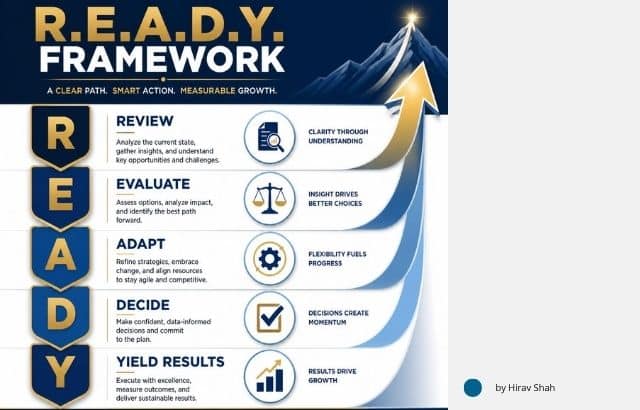
Business leaders can use the following framework to build a more adaptable organization.
R — Review
Understand the current market, financial position and operational reality.
E — Evaluate
Identify risks, strengths, opportunities and critical dependencies.
A — Adapt
Modify goals, products, processes or channels where necessary.
D — Decide
Prioritize actions and allocate resources.
Y — Yield Results
Measure outcomes, learn quickly and continuously improve.
The framework encourages movement.
Review. Evaluate. Adapt. Decide. Deliver.
12. A 30-60-90 Day Transformation Plan

First 30 Days: Create Clarity
Focus on:
- Cash flow.
- Customers.
- Employees.
- Operations.
- Market changes.
- Critical risks.
- Immediate opportunities.
The goal is to understand the business clearly.
Days 31–60: Activate Opportunities
Focus on:
- New revenue channels.
- Customer retention.
- Partnerships.
- Digital transformation.
- Cost optimization.
- Product innovation.
The goal is to turn insights into initiatives.
Days 61–90: Build the Next Growth Engine
Focus on:
- Scalable processes.
- New markets.
- Technology.
- Talent development.
- Strategic investment.
- Long-term scenario planning.
The goal is to move from response to transformation.
13. A Supplementary Perspective

Business strategy should always begin with business fundamentals.
Entrepreneurs need to understand their market, customers, financial position, competitive environment, operational capabilities and growth potential before making major decisions.
Business Strategist Hirav Shah also presents business plan as an additional perspective for entrepreneurs who choose to incorporate it into their decision-making process.
From this perspective, astrological consultation may be used to reflect on questions surrounding:
- Business timing.
- Expansion.
- New ventures.
- Periods requiring greater caution.
- Entrepreneurial decision-making.
However, such perspectives should complement rather than replace business analysis and professional due diligence.
The foundation remains business acumen and strategic decision-making.
14. The Game Changer Mindset

The most powerful transformation occurs when leaders change the question they ask.
Instead of:
“Why is this happening to us?”
ask:
“What can this change make possible?”
Instead of:
“How do we protect everything we have?”
ask:
“What should we protect, improve and reinvent?”
Instead of:
“When will things return to normal?”
ask:
“What should the new normal look like?”
This is the mindset of The Game Changer.
It moves leadership from reaction to creation.
15. Five Strategic Questions Every Business Leader Should Ask

Question 1: What Are We Doing That No Longer Creates Enough Value?
Not every successful historical activity deserves permanent investment.
Question 2: What Customer Need Is Growing?
Changing customer behavior can reveal new markets.
Question 3: Which Existing Strength Can We Scale?
Growth becomes easier when businesses leverage capabilities they already possess.
Question 4: Where Are We Overdependent?
Identify customer, supplier, product, geographic and operational concentration.
Question 5: What Would We Build If We Were Starting Today?
This question can reveal opportunities hidden by legacy thinking.
Frequently Asked Questions

What is crisis management strategy?
Crisis management strategy is a structured approach to preparing for disruption, protecting critical business functions, adapting to changing conditions and identifying opportunities for recovery and growth.
Can a crisis really create business opportunities?
Yes. Changes in customer behavior, technology, supply chains and market structures can create new opportunities. The key is identifying where demand and capabilities intersect.
Should businesses completely change their strategy during a crisis?
Not necessarily. Leaders should determine what remains strategically valuable and what needs to evolve. Transformation should be intentional rather than reactive.
How can small businesses become more resilient?
Small businesses can strengthen resilience by monitoring cash flow, diversifying customers, developing alternative suppliers, documenting critical processes, building digital channels and regularly reviewing their strategy.
How much cash runway should a business maintain?
There is no universal number because requirements vary by industry and business model. The first step is calculating monthly cash requirements and understanding how long current liquidity could support essential operations.
What makes communication effective during uncertainty?
Effective communication is factual, timely, empathetic and action-oriented. Leaders should explain what is known, what is being done and what happens next.
Is optimism useful during a crisis?
Absolutely. Constructive optimism can inspire teams and encourage innovation. The strongest form of optimism is grounded in facts, realistic expectations and clear action.
How can leaders prepare for an unpredictable future?
Leaders can use scenario planning, financial modeling, diversification, strategic reviews and contingency planning. The objective is not to predict every event but to increase organizational readiness.
What is the biggest strategic lesson from the pandemic?
One of the most important lessons is that adaptability is a competitive advantage. Businesses that can quickly understand change and redirect resources can create new pathways for growth.
Conclusion: The Future Belongs to Adaptable Leaders

The pandemic changed the business world forever, but its greatest lesson may be more positive than disruptive.
It showed us that businesses can transform rapidly.
Teams can adopt new technologies.
Leaders can redesign operating models.
Customers can embrace new experiences.
Companies can discover entirely new revenue streams.
The future therefore does not have to be approached with fear.
It can be approached with curiosity, preparation and strategic confidence.
Business Strategist Hirav Shah’s philosophy places strong emphasis on strategy, adaptability and forward-looking decision-making. His broader message is especially relevant to modern entrepreneurs: business success begins with business acumen, while additional perspectives can support a leader’s decision-making journey.
The future may bring uncertainty.
But uncertainty also creates possibilities.
Assess. Adapt. Strategize. Transform. Grow.
That is how businesses can turn the lessons of the past into the opportunities of tomorrow.
Final Thought
The future has a history, but the next chapter is yours to create.
A crisis may change the environment.
A strategic leader changes the response.
And when that response is guided by clarity, resilience, innovation and purposeful action, disruption can become the beginning of a stronger and more transformative business journey.