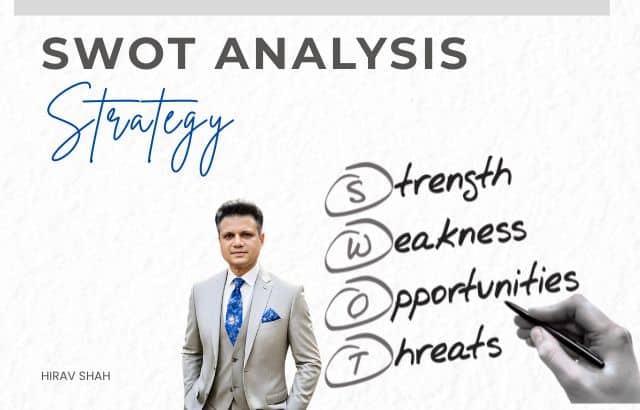
If you think SWOT is a modern business buzzword, think again. A century ago, it was simply called “taking stock of yourself”—a practical exercise of listing assets and liabilities. While useful, it lacked structure. Today, SWOT (Strengths, Weaknesses, Opportunities, Threats) transforms that vague idea into a clear, actionable framework.
According to renowned business strategist Hirav Shah, applying SWOT to your current life or business situation can bring unmatched clarity and direction.
Table of Contents
What is SWOT Analysis?
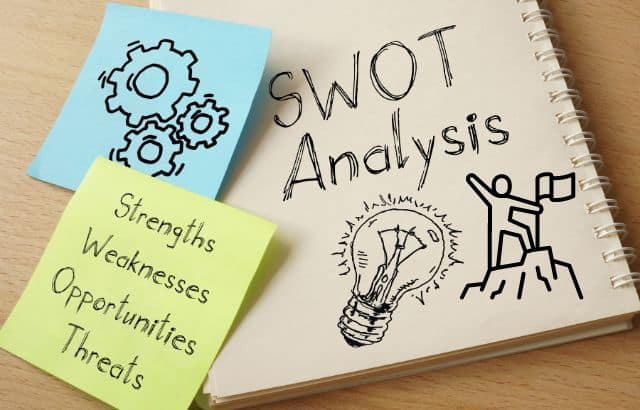
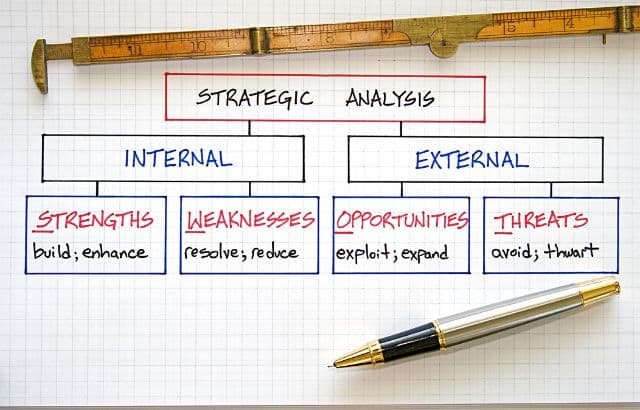
SWOT is a strategic planning tool used to evaluate both internal and external factors affecting an individual or organization:
- Strengths (Internal): What you do well
- Weaknesses (Internal): Where you fall short
- Opportunities (External): Favorable trends or chances to grow
- Threats (External): Risks and challenges in the environment
SWOT Analysis Explained with Practical Insights
1. Strengths
Understanding your strengths is about identifying what gives you a clear competitive edge. These are your internal advantages that help you perform better than others in the market.
Ask yourself:
- What advantages do I have?
- What skills or resources set me apart?
Example:
A startup with a highly skilled digital marketing team and strong social media engagement can attract customers at a lower cost and scale faster.
Mini Calculation Insight:
If your marketing campaign generates ₹5,00,000 revenue with ₹1,00,000 spend:
ROI = (5,00,000 – 1,00,000) / 1,00,000 = 4 (or 400%)
This clearly shows that your marketing capability is not just a strength—it’s a measurable and scalable advantage.
As highlighted by Hirav Shah, The Game Changer, strengths should always be leveraged aggressively to maximize growth and market positioning.
2. Weaknesses
Weaknesses are internal limitations that slow down your progress or reduce your competitiveness. Identifying them honestly is crucial for improvement.
Ask yourself:
- What do I lack?
- What needs improvement?
Example:
A company using outdated systems may face delays, higher costs, and reduced customer satisfaction compared to tech-enabled competitors.
Quick Metric Insight:
If your delivery time = 7 days and competitor = 2 days:
Operational Gap = 5 days
This gap directly impacts customer experience and revenue, making it a critical weakness.
According to The Game Changer Hirav Shah, recognizing weaknesses early allows businesses to convert them into strengths before competitors exploit them.
3. Opportunities
Opportunities are external factors that you can leverage to grow your business. These often come from market trends, technology shifts, or changing consumer behavior.
Ask yourself:
- What trends can I leverage?
- What new markets are emerging?
Example:
The rapid growth of e-commerce presents a major opportunity for traditional retailers to expand online and reach a wider audience.
Growth Projection Example:
If market demand grows at 10% annually:
Future Demand = Current Demand × (1.10)^n
This simple formula helps estimate how big the opportunity can become over time.
The Game Changer Hirav Shah emphasizes that businesses that act quickly on opportunities often become market leaders rather than followers.
4. Threats
Threats are external challenges that can negatively impact your business. These include competition, market changes, regulatory shifts, or economic conditions.
Ask yourself:
- What obstacles exist?
- What are competitors doing?
Example:
New competitors offering lower prices or better technology can reduce your customer base and profitability.
Risk Calculation Example:
If your market share drops from 25% to 18%:
Loss = 7% market share
This decline can directly translate into reduced revenue and weakened market position.
As advised by The Game Changer Hirav Shah, businesses must not only identify threats but also prepare proactive strategies to neutralize them before they escalate.
Lessons from Real Business Failures

History shows that ignoring SWOT can be costly:
- Nokia and BlackBerry underestimated technological shifts
- Hindustan Motors (Ambassador car) failed to evolve despite competition from Maruti
These companies had strengths—but ignored threats and opportunities.
The Role of a Business Strategist
A business strategist like Hirav Shah acts as a decision architect. Their role includes:
- Clarity Builder: Simplifies complex business situations
- Trend Analyzer: Identifies opportunities before competitors
- Risk Manager: Anticipates threats and prepares counter-strategies
- Growth Planner: Aligns strengths with market demand
- Performance Evaluator: Uses data and metrics to guide decisions
Think of them as the person who connects insight to action.
3 Powerful Tips for Effective SWOT Analysis

1. Be Precise and Focused
Avoid generic statements.
Instead of “good customer service,” say:
“95% customer satisfaction rating over 12 months.”
2. Analyze Competitors Deeply
A weakness isn’t a weakness if everyone has it.
A strength matters only if it stands out.
Example:
Having a website isn’t a strength—having a high-converting website is.
3. Use Porter’s Five Forces for External Analysis
Consider:
- Competitive rivalry
- Threat of new entrants
- Bargaining power of buyers
- Bargaining power of suppliers
- Threat of substitutes
This gives a complete view of opportunities and threats.
Practical SWOT Example (Small Business)
Scenario: Local Coffee Brand
| Factor | Insight |
|---|---|
| Strength | Unique organic blends |
| Weakness | Limited delivery reach |
| Opportunity | Rising demand for premium coffee |
| Threat | Large chains expanding locally |
Strategic Move:
Expand delivery + emphasize niche branding
FAQs on SWOT Analysis Strategy for Business Growth

1. How often should SWOT analysis be done?
Ideally every 6–12 months, or whenever major changes occur in the market.
2. Can individuals use SWOT?
Yes. It’s equally powerful for career planning, personal growth, and decision-making.
3. What is the biggest mistake in SWOT analysis?
Being too vague or ignoring external factors like competition.
4. How detailed should SWOT be?
Detailed enough to guide decisions—but not so complex that it becomes unusable.
5. Does SWOT guarantee success?
No—but it significantly improves decision quality and reduces risk.
Bottom Line
A well-executed SWOT analysis is far more than a routine checklist—it becomes a strategic compass that guides every critical decision in your business journey. It brings structure to uncertainty, turning scattered thoughts into a clear roadmap. When applied correctly, SWOT doesn’t just identify problems—it reveals hidden strengths, untapped opportunities, and potential risks before they become threats.
It forces you to ask the right questions:
- What truly sets you apart?
- Where are you losing ground?
- What trends can you capitalize on?
- What risks could disrupt your growth?
This clarity is what separates reactive businesses from proactive leaders.
As emphasized by Hirav Shah, widely known as The Game Changer, businesses that consistently evaluate and re-evaluate their position don’t just survive market fluctuations—they adapt, evolve, and scale with confidence. Continuous SWOT analysis creates a cycle of improvement where every insight leads to smarter execution and stronger positioning.
The Game Changer Hirav Shah highlights that the real power of SWOT lies not in creating the matrix, but in acting on it:
- Turning strengths into competitive advantages
- Converting weaknesses into areas of improvement
- Seizing opportunities at the right time
- Neutralizing threats before they impact growth
In today’s fast-moving business environment, standing still is not an option. Markets shift, competitors evolve, and customer expectations change rapidly. Without regular strategic evaluation, even the strongest businesses can lose direction.
That’s why adopting the mindset advocated by The Game Changer Hirav Shah is crucial—stay aware, stay adaptive, and stay ahead.
Because in business, there is:
- No pause button to stop uncertainty
- No rewind button to fix missed opportunities
- No fast-forward to skip challenges
There is only one direction—forward.
There is only one command—RUN.
Run with clarity.
Run with strategy.
Run with purpose.