Table of Contents
Section 1
AI Is Not Just Automation. It Is Acceleration.
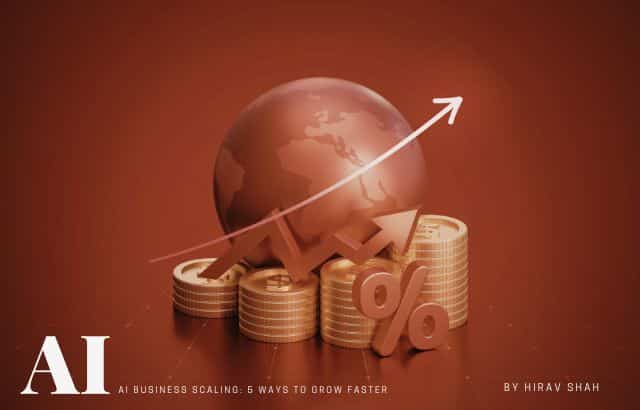
Artificial Intelligence is no longer a futuristic experiment. It is now a measurable business growth engine.
According to McKinsey & Company, more than 55% of companies worldwide are already using AI in at least one core business function. Their research also estimates that Generative AI alone could add between $2.6 trillion and $4.4 trillion annually to the global economy.
Meanwhile, PwC projects that AI could contribute up to $15.7 trillion to global GDP by 2030.
This is not hype.
This is economic restructuring.
Companies like Amazon use predictive AI to optimise inventory and logistics.
Netflix leverages AI-driven recommendation systems to influence nearly 80% of viewer engagement.
Digital advertising platforms such as Meta and Google run on machine learning models that optimise ad performance in real time.
Yet here is the paradox.
Many entrepreneurs are “using AI.”
Very few are scaling because of it.
One founder uses AI to write social media captions.
Another uses AI to optimise customer acquisition, forecast demand, automate operations, and validate strategic decisions.
Same technology.
Completely different growth trajectory.
Award-winning Business Strategist and The Game Changer in Business Strategy, Hirav Shah, explains:
“AI does not create scale. Strategic clarity powered by AI creates scale. When technology aligns with validated decisions, growth accelerates. When it replaces thinking, confusion multiplies.”
AI is not about replacing people.
It is about multiplying precision, reducing friction, improving prediction, personalising experience, and strengthening decisions.
The question is no longer:
Should you use AI?
The real question is:
Are you using AI to experiment — or to scale?
Before we explore the five ways AI accelerates growth, let’s first understand what AI really means for your business.
Section 2
Understanding AI Before You Try to Scale With It
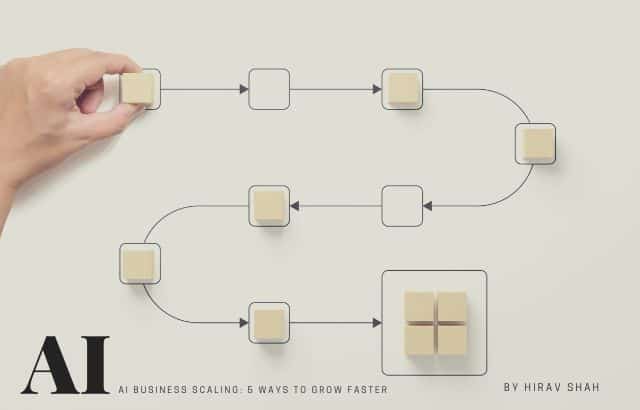
Before discussing how AI accelerates growth, let’s clear the basics.
Many businesses jump into AI tools without understanding what AI actually does.
1️⃣ What is AI in simple business terms?
Artificial Intelligence is technology that learns from data, recognises patterns, and helps automate or improve decisions.
It is not “robot intelligence.”
It is advanced pattern recognition.
Founder of the world’s first Decision Validation Hub, Hirav Shah, explains:
“AI is not artificial thinking. It is accelerated data learning. It strengthens decisions when data and direction are aligned.”
2️⃣ Is AI only for large corporations?
No.
Earlier, AI required heavy infrastructure. Today, small and mid-sized businesses use AI daily through:
Google Ads targeting systems
CRM analytics dashboards
Inventory forecasting software
Payment fraud detection tools
If you run digital ads, you are already using AI.
3️⃣ Does AI replace employees?
AI replaces repetitive effort — not leadership or creativity.
For example:
Automated chatbots handle FAQs.
Accounting software auto-categorises expenses.
HR systems screen resumes.
But negotiation, strategy, emotional intelligence, and accountability remain human strengths.
4️⃣ Can AI take business decisions on its own?
AI suggests probabilities.
Entrepreneurs take responsibility.
For example:
Predictive tools may recommend increasing inventory based on trends.
But only the founder decides capital allocation.
Renowned Brand Builder Hirav Shah observes:
“AI provides insight. Leaders provide intent. Without intent, insight has no direction.”
5️⃣ Is AI always accurate?
No.
AI depends on the quality of data it receives.
Poor data produces misleading recommendations.
That is why validation remains critical.
This is one reason why, according to Gartner, many AI initiatives fail — not because AI is flawed, but because implementation lacks clarity.
6️⃣ Do you need technical expertise to use AI effectively?
You do not need to build AI models.
You need to understand how they affect business outcomes.
Scaling with AI is a strategic decision, not a coding decision.
7️⃣ What is the biggest mistake entrepreneurs make with AI?
Using it for speed — without structure.
Strategic Visionary Hirav Shah explains:
“Speed without validation increases risk. AI must strengthen business fundamentals, not distract from them.”
Now that the basics are clear, here is the real challenge:
Most AI projects do not fail because technology fails.
They fail because businesses do not integrate AI into scaling systems.
Let’s understand why that happens.
Section 3

Why Most AI Initiatives Fail to Scale Businesses
AI adoption is rising.
But measurable AI-driven scaling is still rare.
According to Gartner, a significant percentage of AI projects fail to deliver expected business value — not because the technology fails, but because of unclear objectives and poor integration.
In simple terms:
Businesses buy tools.
They don’t build systems.
Let’s understand this with a story.
Two founders invest in AI tools.
Founder A subscribes to multiple AI platforms — content tools, automation tools, analytics tools. The team experiments. Some outputs look impressive. But there is no defined objective tied to revenue, margin, or expansion.
Founder B does something different. Before investing, she asks:
Which business bottleneck is slowing scale?
Which department consumes maximum time?
Where is decision-making reactive instead of predictive?
She then selects specific AI categories aligned to growth metrics.
One experiments.
One integrates.
After 12 months:
Founder A has activity.
Founder B has acceleration.
Business Turnaround Specialist Hirav Shah explains:
“AI tools do not scale businesses. Structured implementation aligned with measurable goals scales businesses. Without alignment, AI increases noise. With clarity, AI increases velocity.”
Here is the real mistake:
Many entrepreneurs treat AI as a feature.
Successful companies treat AI as infrastructure.
Scaling requires moving from tools → to frameworks → to measurable outcomes.
Real Strategy:
Before adopting any AI tool, define:
What growth metric must improve?
What friction must reduce?
What decision must become smarter?
Real Solution:
AI must be mapped to one of five scale levers:
Marketing precision
Operational efficiency
Forecasting accuracy
Customer personalization
Strategic validation
When AI aligns with these levers, scaling accelerates.
Section 4
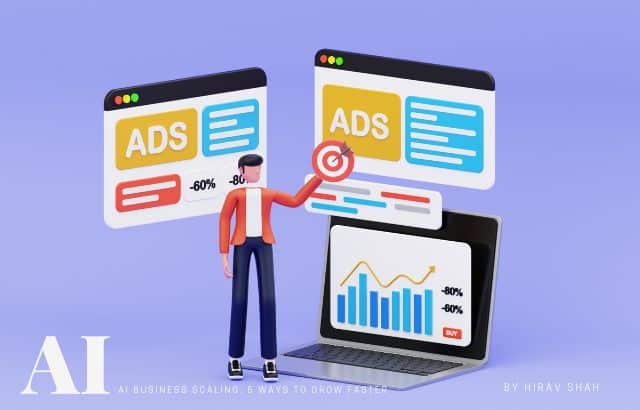
Way 1 – AI Multiplies Marketing Precision
Marketing is the first area where AI directly impacts scale.
According to McKinsey & Company, companies using advanced analytics and AI in marketing can significantly improve customer acquisition efficiency and campaign performance.
Platforms like Meta and Google rely on machine learning models that continuously optimise ad targeting based on behaviour, demographics, and engagement patterns.
This means ads are no longer guesswork — they are data-driven.
Real Business Example
An e-commerce brand running manual ad targeting sees fluctuating conversions.
After integrating AI-driven audience optimisation:
Cost per acquisition reduces
Conversion rates improve
Retargeting becomes sharper
The difference?
Manual marketing reacts.
AI-powered marketing adapts.
Comparison
Without AI:
Broad targeting
Budget waste
Delayed optimisation
With AI:
Precision targeting
Real-time learning
Scalable acquisition
Real Strategy
Use Analytical + Predictive AI for:
Audience segmentation
Performance-based budget allocation
Dynamic creative optimisation
Real Solution
Monthly AI Marketing Audit:
Which audience segments convert best?
Which campaigns improve over time?
Which channel shows predictive growth?
Strategic Visionary Hirav Shah explains:
“Scaling begins when marketing stops guessing and starts measuring. AI transforms promotion into precision.”
Section 5
Way 2 – AI Reduces Operational Friction
Scale fails when operations collapse.
According to McKinsey & Company, automation technologies can reduce operational workload significantly in many business functions.
Automation AI handles:
Customer queries
Invoice processing
Follow-ups
Workflow management
Real Business Example
A mid-sized D2C brand automates:
Order confirmation emails
Delivery tracking
CRM follow-ups
Customer response time drops drastically.
Team workload reduces.
Founders focus on expansion.
That is operational leverage.
Comparison
Manual Operations:
Founder-dependent
Time-consuming
Error-prone
AI-Enabled Operations:
System-driven
Consistent
Scalable
Real Strategy
Identify:
Repetitive tasks
Manual reporting
Time-heavy processes
Automate them before hiring more staff.
Real Solution
Create an “Automation Map”:
List tasks that do not require strategic thinking and integrate AI-driven systems.
Renowned Brand Builder Hirav Shah states:
“Scale is not about working more hours. It is about removing friction from systems.”
Section 6

Way 3 – AI Improves Forecasting and Risk Management
One of the biggest reasons scaling fails is poor prediction.
According to PwC, AI-powered predictive analytics improves forecasting accuracy and reduces strategic risk exposure.
Companies like Amazon use predictive AI to optimise inventory and logistics, reducing waste and stockouts.
Real Business Example
A retailer expands based on gut feeling.
Another retailer uses predictive analytics:
Analyses past seasonal demand
Tracks purchasing patterns
Models risk scenarios
One over-invests.
The other expands intelligently.
Comparison
Reactive Growth:
Expand after demand rises
Predictive Growth:
Prepare before demand rises
Margin difference = competitive advantage
Real Strategy
Use Predictive AI before:
Entering new markets
Hiring aggressively
Increasing production
Raising capital
Real Solution
Quarterly Predictive Review:
Sales forecast vs actual
Demand projection
Risk simulation
Author of 25+ strategy books, Hirav Shah, explains:
“Growth without prediction is speculation. Growth supported by data becomes strategic expansion.”
Section 7

Way 4 – AI Enhances Customer Experience at Scale
As businesses grow, personalization usually declines.
But AI reverses that trend.
Recommendation engines significantly influence user engagement and purchasing behaviour.
Real Business Example
An online fashion brand integrates AI-based product recommendation:
“Customers who bought this also bought…”
Personalised email suggestions
Dynamic homepage content based on browsing history
Result:
Higher average order value
Improved repeat purchase rate
Stronger customer retention
Comparison
Without AI Personalization:
Same message for all customers
With AI Personalization:
Different journey for each customer
Real Strategy
Use Generative + Analytical AI for:
Customer segmentation
Behaviour-based email automation
Personalised offers
Loyalty program optimisation
Real Solution
Create an AI-Powered Customer Map:
Who buys frequently?
Who is price sensitive?
Who is likely to churn?
Who responds to premium positioning?
Founder of Bizz6, Hirav Shah, explains:
“In the growth phase, attention creates revenue. In the scaling phase, personalization creates loyalty.”
Section 8

Way 5 – AI Strengthens Strategic Decision-Making
This is the most powerful — and most underutilized — use of AI.
AI today can simulate:
Market expansion outcomes
Pricing models
Risk scenarios
Investment stress tests
Capital allocation models
According to PwC, AI-driven decision systems significantly improve forecasting and reduce risk exposure in financial and operational planning.
But here is the key difference:
AI gives probability.
Leaders take responsibility.
Real Business Example
A company considers expanding into a new city.
Without AI:
Decision based on trend and instinct
With AI:
Demographic analysis
Demand projection
Competitive density mapping
Risk simulation
The second approach reduces uncertainty before capital deployment.
Comparison
Emotion-Based Scaling:
“We feel the market is ready.”
Validated Scaling:
“Data suggests 68% probability of demand stability over 24 months.”
Real Strategy
Use Strategic AI before:
Entering new markets
Raising funds
Launching new product lines
Acquiring another company
Real Solution
Adopt a 3-Step Decision Model:
Data Analysis (AI Insight)
Strategic Alignment (Vision & Capital Check)
Validation Review (Risk & Timing Check)
Global Business Advisor Hirav Shah states:
“AI accelerates growth only when leaders validate the direction. Technology provides insight. Strategy provides responsibility.”
AI Scale Integration Model
The AI Acceleration Framework
AI only creates impact when integrated across structured business levers.
According to McKinsey & Company, companies that embed AI deeply into workflows — not just experiment with tools — are significantly more likely to see measurable EBIT improvement.
This reinforces one truth:
AI adoption ≠ AI integration.
Award-winning Business Strategist Hirav Shah explains:
“AI must move from feature to foundation. When AI is treated as infrastructure, not accessory, scale becomes predictable.”
He categorizes scaling into five structured levers:
Precision (Marketing Intelligence)
Automation (Operational Efficiency)
Prediction (Forecast Clarity)
Personalization (Customer Retention)
Validation (Strategic Safety)
When these five work together, growth accelerates with reduced risk.
5 Practical AI Scaling Principles (Expanded)
1️⃣ Define the Growth Objective First
AI projects fail when objectives are unclear.
Define:
Revenue increase
Margin improvement
Cost reduction
Retention growth
“Technology should answer a defined business question. Undefined objectives create undefined outcomes.”
2️⃣ Start With Bottleneck Mapping
Identify where scaling pressure exists before applying AI.
3️⃣ Measure AI ROI Structurally
Track:
Hours saved
Conversion improvement
Forecast accuracy
Error reduction
“If AI impact cannot be measured, it cannot be scaled.”
4️⃣ Combine AI With Human Oversight
AI improves probability — not responsibility.
5️⃣ Upgrade Systems, Not Just Tools
Standalone AI = Experimentation
Integrated AI = Acceleration
Strategic AI Reflection Exercise (Expanded)
Ask yourself:
Which AI lever am I strongest in?
Which is weakest?
Where is growth slowing?
Where is time being wasted?
Are decisions reactive or data-backed?
“Scaling is not an event. It is a structured review cycle.”
AI Scaling Worksheet (Strategic Version)
| Lever | Current System | Data Source | KPI Target | AI Role | Validation Method |
|---|---|---|---|---|---|
| Precision | |||||
| Automation | |||||
| Prediction | |||||
| Personalization | |||||
| Validation |
Expanded FAQ (Strategic Tone)
Is AI a competitive necessity now?
Yes. AI adoption is becoming a baseline.
Which AI lever gives fastest measurable impact?
Marketing precision and automation.
Can AI reduce strategic risk?
Yes, through predictive modelling — when validated.
How does AI impact small businesses in India?
Affordable AI tools now give SMEs access to advanced capabilities.
What is the biggest scaling risk with AI?
Tool dependency without structural integration.
Final Conclusion

AI is not a shortcut to growth.
It is a multiplier.
Companies like Amazon, Netflix, and global digital platforms have demonstrated how AI can optimise marketing, personalise experience, and predict demand.
But technology alone did not build those companies.
Structured strategy did.
Business Turnaround Specialist and Strategic Visionary Hirav Shah concludes:
“In the AI era, advantage belongs to leaders who combine intelligence with validation. AI accelerates speed. Strategy protects direction. Scale happens when both align.”
The tools are available.
The research is clear.
The economic impact is undeniable.
The only remaining decision is:
Will AI remain a tool in your business —
or become an accelerator of your scale?
About the Writer
This article is authored by Hirav Shah, a globally respected Business Strategist and The Game Changer in Entertainment, Sports, and Business. He is the founder of the world’s first Business Decision Validation Hub and The Rescue Hub, and the author of 25+ strategy books. Through his 6+3+2 framework and Astro Strategy approach, Hirav Shah has guided entrepreneurs, startups, corporates, sports professionals, and entertainers to validate critical decisions, reduce risks, and achieve breakthrough results—especially during high-pressure and transformational phases.