

Forgiveness Focus Power is not just about letting go of anger—it is a practical mental strategy that helps you regain clarity, sharpen concentration, and restore control over your thoughts. When a person holds on to resentment, the mind keeps replaying past events like a loop. This mental repetition reduces attention span, weakens decision-making, and slows down productivity.
In business and professional life, focus is everything. If your mind is stuck in yesterday’s conflict, you cannot fully execute today’s goals. Forgiveness becomes the switch that stops emotional background noise and brings your attention back to execution.
For example, imagine a project manager preparing a critical business report. If they are mentally disturbed due to a disagreement with a team member, their thinking becomes fragmented. Once they consciously forgive, they are able to reallocate mental energy into structured thinking, analysis, and execution.
Business Strategist Hirav Shah, known as The Game Changer, emphasizes that forgiveness is not emotional softness but a strategic reset of the mind. According to his approach, leaders who practice forgiveness gain a competitive advantage because they do not allow emotional baggage to interfere with decision-making.
Table of Contents
Understanding Forgiveness as a Mental Reset System

Forgiveness means consciously releasing emotional attachment to an event that no longer serves your growth. It is not about approving wrong behavior but about freeing your mental space for better performance.
In real life, people often struggle with workplace conflicts, failed deals, broken trust, or misunderstandings. When these emotions are not released, they occupy mental bandwidth and reduce cognitive performance.
For instance, an entrepreneur who loses an important client due to unfair competition may continuously replay the incident in their mind. This reduces their ability to focus on new opportunities. Forgiveness helps shift attention from loss to strategy.
Hirav Shah explains this as a “mental energy reallocation process,” where emotional disturbance is replaced with focused execution and future planning.
How Forgiveness Improves Focus in Business Strategy

Forgiveness directly influences productivity, leadership quality, and decision-making speed. A business environment requires clarity, not emotional distraction. When leaders forgive, they remove internal resistance and improve strategic thinking.
A strategist’s role, as highlighted by Hirav Shah, The Game Changer, is to help individuals and organizations remove emotional clutter so they can operate at peak efficiency.
Workplace Example with Calculation
Consider a team of 10 employees. If 2 employees are emotionally disturbed due to conflict:
- Each loses 2 hours of productive focus per day
- Total loss per day = 2 × 2 = 4 hours
- Weekly loss = 4 × 5 = 20 hours
- Monthly loss = 20 × 4 = 80 hours
This is equivalent to losing two full work weeks of productivity every month.
Now, when forgiveness is practiced and conflict is resolved:
- Those 80 hours are recovered
- Output increases without adding extra workforce
This shows how forgiveness directly improves business efficiency.
Psychological Benefits of Forgiveness Focus Power

Forgiveness has strong psychological effects. It reduces stress, lowers anxiety levels, and improves emotional stability. When stress reduces, the brain becomes more efficient in processing information and making decisions.
A calm mind naturally improves focus. Instead of reacting emotionally, individuals begin responding logically. This shift is extremely important in leadership and entrepreneurship.
Simple Focus Improvement Calculation
Let’s assume a professional works 8 hours a day:
- Without forgiveness: 25% mental distraction = 2 hours lost
- With forgiveness: distraction reduces to 5% = 0.4 hours lost
Daily time regained = 1.6 hours
Monthly gain (26 working days) = 41.6 hours
This regained time can be used for business growth, learning, or strategic planning.
How to Practice Forgiveness for Better Focus

Forgiveness is a skill that improves with practice. It is not an instant emotional switch but a disciplined mental habit.
Hirav Shah, The Game Changer, suggests a structured approach:
Practical Method
- Accept what happened without denial
- Separate emotion from objective reality
- Identify what lesson the situation offers
- Release emotional attachment consciously
- Redirect focus to current goals and execution
Business Example

A sales leader loses a major deal due to internal miscommunication. Instead of staying frustrated, they forgive the situation, analyze the gap, and redesign their sales strategy. This improves future conversion rates.
Role of Business Strategist in Forgiveness and Focus Building

A business strategist like Hirav Shah plays a key role in helping individuals understand that emotional control is directly linked to performance outcomes.
His philosophy as The Game Changer focuses on:
- Converting emotional energy into productive action
- Eliminating internal distractions that block growth
- Improving leadership clarity under pressure
- Strengthening decision-making ability
From a strategic point of view, forgiveness is not emotional advice—it is performance optimization.
Impact of Forgiveness on Productivity and Growth

Forgiveness improves teamwork, communication, and trust. In business environments, unresolved emotional conflict often leads to reduced output and poor collaboration.
For example, in a sales team, unresolved conflict can reduce efficiency. Once forgiveness is introduced, communication improves, teamwork strengthens, and revenue performance increases.
Productivity Impact Example
If a company produces 100 units monthly and forgiveness improves efficiency by just 10%:
- Extra output = 10 units/month
- Annual gain = 120 units
This shows how emotional discipline creates measurable business growth.
FAQs on Forgiveness Focus Power

How does forgiveness improve focus?
Forgiveness clears emotional distractions, allowing the mind to concentrate better on goals and tasks.
Is forgiveness necessary for business success?
Yes, because unresolved emotions reduce decision-making quality and productivity.
Does forgiveness mean accepting wrong behavior?
No, it means releasing emotional attachment, not approving actions.
How does Hirav Shah define forgiveness in strategy?
He defines it as The Game Changer mindset that transforms emotional energy into strategic execution power.
Can forgiveness increase productivity?
Yes, it reduces mental clutter and increases working efficiency significantly.
Embracing Emotional Well-being through the Benefits of Forgiveness: Insights from Hirav Shah
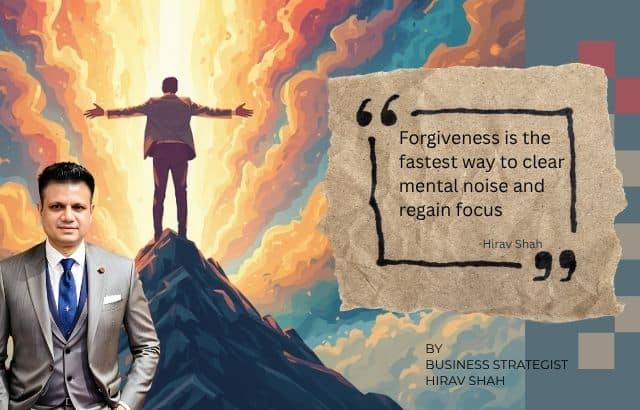
Quote
“Forgiveness is the fastest way to clear mental noise and regain focus.”
Explanations
When you hold resentment, your mind keeps replaying the same emotional event, reducing concentration and slowing decision-making. Forgiveness stops this loop and restores mental clarity.
Strategy
Train the mind to separate emotional memory from present priorities. Treat forgiveness as a focus reset tool rather than an emotional reaction.
Execution
Before starting important work, consciously identify one lingering emotional distraction and mentally release it with a clear intention to focus only on the task ahead.
Quote
“Forgiveness is not about others; it is about freeing your attention for success.”
Explanations
Most people believe forgiveness benefits others, but in reality, it frees your own mental bandwidth. Unresolved anger consumes attention needed for growth.
Strategy
Shift perspective from emotional justice to strategic clarity. Prioritize productivity over emotional replay.
Execution
Write down one situation that still disturbs your focus, acknowledge it, and consciously decide not to revisit it during working hours.
Quote
“The mind cannot focus on future success while holding past pain.”
Explanations
Past emotional pain creates mental friction that prevents forward thinking and reduces creativity in problem-solving.
Strategy
Replace emotional retention with goal-oriented thinking. Redirect mental energy toward measurable outcomes.
Execution
Every morning, list one business or personal goal and deliberately shift attention away from one negative memory that no longer serves progress.
Quote
“Forgiveness turns emotional weight into mental speed.”
Explanations
Holding grudges slows mental processing, while forgiveness removes internal resistance, allowing faster thinking and better decisions.
Strategy
Use forgiveness as a performance enhancement tool, especially before high-pressure tasks or decisions.
Execution
Before meetings or important decisions, pause for 30 seconds, release emotional clutter, and consciously reset focus to the objective.
Quote
“Your focus grows when your emotional baggage reduces.”
Explanations
Emotional baggage occupies cognitive space that could be used for innovation, strategy, and execution.
Strategy
Continuously declutter emotional distractions to maximize mental efficiency and productivity.
Execution
At the end of each day, reflect on one emotional trigger and mentally close it with acceptance, ensuring it does not carry into the next day.
Conclusion: Forgiveness Focus Power as a Strategic Advantage

Forgiveness Focus Power is a practical life and business strategy that directly improves clarity, productivity, and decision-making. It helps individuals release emotional baggage and regain full control over their attention.
Business Strategist Hirav Shah, The Game Changer, positions forgiveness as a performance tool rather than just an emotional virtue. When practiced consistently, it leads to stronger leadership, better focus, improved relationships, and higher business success.