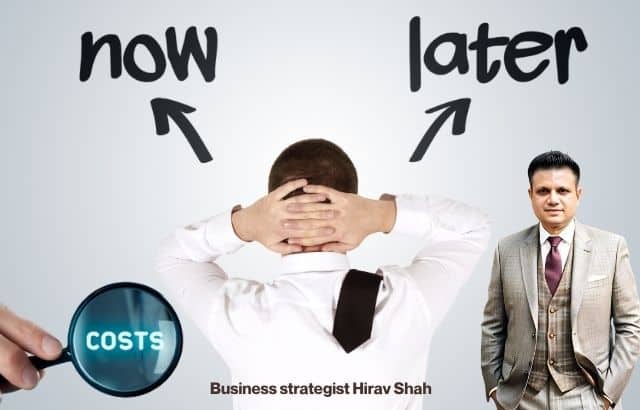
Business Strategist Hirav Shah often says that in business, the most expensive sentence is not “I failed.” It is — “Will do later.”
“Will call the client tomorrow.”
“Website next month.”
“Will start social media later.”
“Will improve office systems later.”
“Team issue can wait.”
These statements sound harmless, but repeated delays can quietly weaken a business. Most businesses do not become vulnerable because of one massive mistake. They often lose momentum through a series of postponed decisions.
A delayed hiring decision can become a manpower problem. A delayed marketing plan can reduce visibility. A delayed technology upgrade can increase operational inefficiency. A delayed difficult conversation can become a larger team issue.
According to business strategist Hirav Shah, delay can be more expensive than failure because failure may provide a lesson, while delay silently consumes time, opportunity, confidence, and resources.
Table of Contents
What Does “Will Do Later” Really Mean?

“Will do later” is rarely only about lack of time. It may come from fear, confusion, overthinking, perfectionism, lack of clarity, or avoiding an uncomfortable decision.
- Hiring a senior employee creates responsibility.
- Changing strategy involves risk.
- Starting digital marketing requires investment.
- Closing a loss-making activity can be emotionally difficult.
So the mind chooses the comfortable answer: “Not now… later.”
The problem is that markets, customers, competitors, and technology continue moving while the decision remains pending.
The Real Cost of Delay
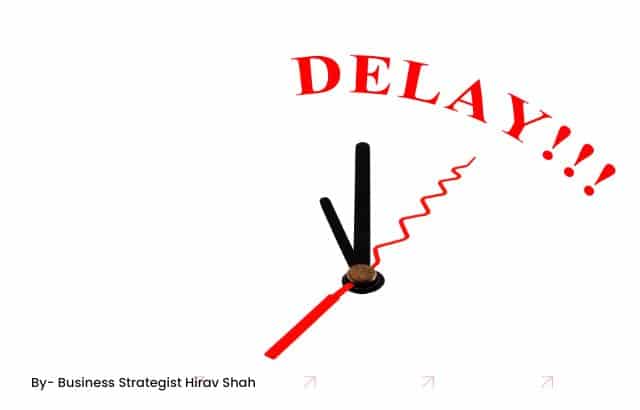
Businesses usually calculate rent, salaries, taxes, marketing, and raw materials. Far fewer calculate the cost of delay.
Consider a hypothetical example. A small business receives 100 enquiries a month and converts 10 customers. Its conversion rate is:
10 ÷ 100 × 100 = 10%
If better follow-up could raise conversion to 12%, the additional two customers represent potential revenue that may be lost simply because action was postponed. The actual financial impact depends on the business’s average order value.
For example, with an average order value of ₹20,000:
2 additional customers × ₹20,000 = ₹40,000 potential monthly revenue.
This is an illustrative calculation, not a guaranteed result.
Delay also creates less visible costs: lost momentum, lower confidence, reduced trust, employee frustration, and missed opportunities.
Seven Areas Where “Later” Becomes Expensive
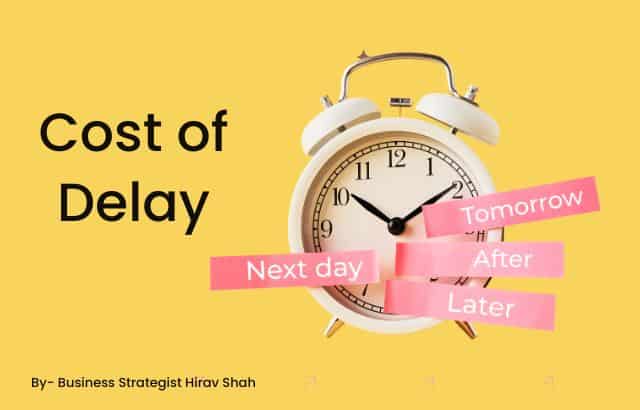

1. Hiring
Delaying a necessary hire may increase workload, reduce quality, and slow growth. A startup that waits too long to bring in a specialist may also lose access to suitable candidates.
2. Marketing
Referrals are valuable, but businesses also need visibility. Delaying branding, content, social media, or digital presence allows competitors to occupy customer attention.
3. Technology
Manual systems can become expensive as a business grows. A retailer delaying inventory software or a service firm delaying CRM adoption may create unnecessary operational dependency.
4. Health and Energy
Entrepreneurs need sustainable energy for decision-making and execution. Your capacity to lead is also a business resource.
5. Difficult Conversations
Partner disagreements, performance concerns, team conflicts, and financial discussions rarely become easier through avoidance.
6. Innovation
Customer expectations change. Products, services, presentation, and customer experience may need regular improvement.
7. Validation
Many entrepreneurs invest first and validate later. Business strategist Hirav Shah emphasizes the importance of examining major decisions before committing significant resources, particularly in expansion, investment, partnerships, rebranding, acquisition, and scaling.
Short Case Studies
Short Case Study: Small Retailer
Illustrative example: A retailer continues using manual inventory tracking despite frequent stock discrepancies. Instead of delaying the decision for another year, the owner begins by comparing three inventory systems and testing one department. The lesson is not “buy technology immediately,” but start evaluating the problem before it becomes larger.
Short Case Study: Startup Founder
Illustrative example: A founder spends months refining the logo and website while avoiding customer validation. A better sequence is to test the proposition with potential customers first, learn from feedback, and then invest further in branding.
Short Case Study: Service Business
Illustrative example: A consulting firm receives 50 enquiries but follows up inconsistently. If 5 become customers, the conversion rate is 10%. Improving follow-up and reaching 8 customers would produce a 16% conversion rate. The numbers are illustrative, but they demonstrate why delayed execution can have measurable consequences.
The 6+3+2 Formula and Delay

Business strategist Hirav Shah explains business growth through his 6+3+2 framework.
The 6 Core Drivers
- Hard Work: Delayed action reduces the value of effort.
- Mindset: Repeated postponement can create self-doubt.
- Skills: Delayed learning slows development.
- Strategy: Timely strategic thinking keeps direction clear.
- Execution: Ideas create value only when implemented.
- Timing: The right action may lose value when taken too late.
The 3 Essential Traits
- Hunger
- Dedication
- Consistency
The 2 Growth Accelerators
- Innovation
- Marketing
As Hirav Shah puts it: “Many businesses don’t fail because they lacked potential. They fail because action came too late.”
The Role of a Business Strategist
A business strategist helps leaders look beyond individual problems and connect decisions to the larger business picture. Areas of strategic work can include:
- Market positioning: Clarifying where the business should compete.
- Customer analysis: Understanding customer needs and buying behaviour.
- Competitive differentiation: Identifying meaningful ways to stand apart.
- Growth strategy: Evaluating expansion, scaling, partnerships, and new opportunities.
- Innovation: Finding ways to improve products, services, and processes.
- Decision-making: Structuring major choices around evidence, risks, and priorities.
- Business planning: Converting ideas into practical actions and milestones.
- Communication strategy: Aligning teams, customers, partners, and stakeholders.
For entrepreneurs, startups, professional firms, retailers, technology businesses, and established companies, strategic thinking can help separate an important decision from an unnecessary distraction.
How to Break the “Will Do Later” Habit

1. Use the 24-Hour Rule
For an important task, take at least the first practical step within 24 hours: call, research, message, schedule a meeting, or create a plan.
2. Use the KK Formula
- Who will do it?
- When will it be done?
- How will it be done?
3. Keep a Pending Decisions List
Each week, identify what you are delaying, why you are delaying it, and what the delay could cost over the next six months.
4. Avoid Overthinking Small Decisions
Not every decision requires multiple meetings and months of discussion. Match the decision process to the importance and risk of the decision.
5. Protect Your Energy
Delegation, adequate rest, clear priorities, and effective routines can support better execution. Healthy business habits can improve execution quality.
Quick Tips: Stop Saying “Will Do Later”
- Take the first action within 24 hours.
- Separate strategic patience from fear-based delay.
- Review pending decisions every week.
- Delegate responsibilities clearly.
- Measure the potential cost of delay.
Self-Audit Exercise

Ask Yourself
- Which important business decision am I delaying?
- Why am I delaying it?
- What fear or uncertainty is attached to it?
- What could happen if I delay it for another six months?
- What is the smallest action I can take today?
The “No Later” Challenge
For the next seven days:
- Complete one delayed task each day.
- Take one uncomfortable but necessary decision.
- Finish one pending conversation.
- Start one postponed improvement.
Then observe whether your clarity, confidence, and momentum change.
FAQs
Is Waiting Always Bad in Business?
No. Strategic patience is different from emotional delay. Waiting can be sensible when it is based on research, planning, risk assessment, or market conditions. The problem arises when waiting is simply a way to avoid a decision.
How Do I Know If I Am Strategically Thinking or Delaying?
Ask whether you already know the next step, whether you keep discussing the same issue without progress, and whether fear or discomfort is preventing execution. These questions can help distinguish thoughtful planning from repeated postponement.
Can Small Delays Really Damage a Business?
Yes. Individual delays may appear insignificant, but repeated delays can accumulate into weaker systems, missed opportunities, lower momentum, and additional financial pressure.
Why Is Timing Important in Business?
Timing influences execution, visibility, customer response, investment decisions, innovation, and growth. As business strategist Hirav Shah emphasizes, even a strong idea can lose value when action comes too late.
Conclusion — Timely Action Matters

Business growth does not come only from ideas, motivation, or discussion. It also depends on timely execution.
Businesses can lose momentum when they repeatedly postpone technology, innovation, marketing, customer understanding, difficult conversations, or important decisions.
The key question is simple:
- What decision am I avoiding?
- What conversation am I delaying?
- What action should I have started already?
- What could this delay cost me?
Your future is not always changed by one big mistake. Sometimes it is shaped by hundreds of small “will do later” decisions.
Because in business, “later” can become very expensive.
About the Writer
This article is authored by Hirav Shah, a Business Strategist and The Game Changer in Entertainment, Sports, and Business. He is the founder of the Business Decision Validation Hub and The Rescue Hub, and the author of 25+ strategy books.
Through his 6+3+2 framework, Hirav Shah focuses on strategic thinking, business decision-making, positioning, validation, growth, innovation, and execution.