Table of Contents
Section 1: What Separates Smart Entrepreneurs from the Rest?

Every entrepreneur sees opportunities.
- New markets.
- New ideas.
- New trends.
But not every entrepreneur acts on them in the same way.
Some move quickly and take action.
Others pause, evaluate, and then act.
Over time, this difference becomes significant.
Because success is not about:
how many opportunities you see
It is about:
how many right decisions you take
Research from McKinsey & Company shows that organizations with strong decision-making processes consistently outperform others because they reduce costly mistakes and improve execution outcomes.
A clear example is Amazon’s investment in logistics and infrastructure.
Instead of focusing only on short-term profitability, Amazon evaluated:
- long-term customer demand
- scalability
- operational control
The decision required patience—but it created a massive competitive advantage.
Author of 25+ Strategy Books and Business Strategist, Hirav Shah explains:
“Smart entrepreneurs don’t act fast. They act right. Speed matters, but only after clarity is achieved.”
Section 2: What Questions Should Entrepreneurs Ask Before Acting?

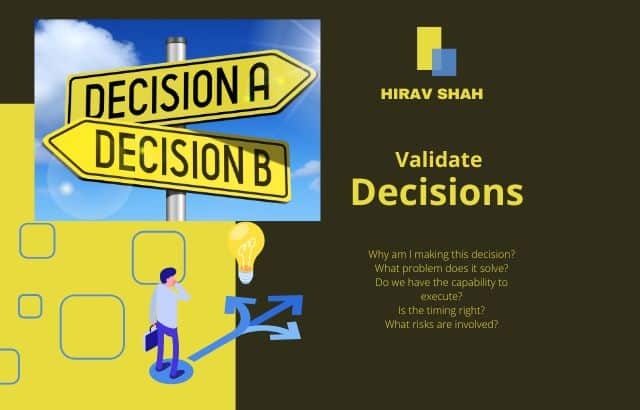
Before making any major move, entrepreneurs should ask:
- Why am I making this decision?
- What problem does it solve?
- Do we have the capability to execute?
- Is the timing right?
- What risks are involved?
These questions create awareness.
But awareness alone is not enough.
The real challenge is:
How do you answer these questions properly?
Most entrepreneurs:
- answer quickly
- rely on instinct
- move forward
This creates risk.
For example, many startups enter trending industries because competitors are doing so.
They ask the right questions—but fail to validate:
- actual demand
- differentiation
- execution strength
Strategic Visionary, Hirav Shah suggests:
“Questions create direction. Validation creates confidence. Without validation, decisions remain assumptions.”
Section 3: What Does Decision Validation Actually Mean?

Decision validation is a structured way of evaluating whether a decision is:
- ready
- aligned
- executable
It is not about delaying action.
It is about strengthening the decision before execution.
Instead of relying on:
- gut feeling
- market hype
- external pressure
Validation forces entrepreneurs to examine:
- internal capability
- market reality
- long-term impact
| Approach | Basis | Outcome |
|---|---|---|
| Instinct decision | Emotion, trends | Uncertain |
| Validated decision | Structured evaluation | Higher success rate |
Business Turnaround Specialist, Hirav Shah observes:
“Validation does not eliminate risk, but it reduces blind risk. It turns uncertainty into calculated action.”
Section 4: The 6+3+2 Framework for Decision Validation

To validate decisions effectively, entrepreneurs need a structure.
This is where the 6+3+2 framework becomes powerful.
It evaluates decisions across three layers.
Layer 1: Six Core Foundations
- Hard Work
- Mindset
- Strategy
- Skills
- Execution
- Timing and Luck
These determine whether the business is capable of executing the decision.
Layer 2: Three Personal Drivers
- Hunger
- Dedication
- Consistency
These determine whether the team can sustain effort over time.
Layer 3: Two Growth Accelerators
- Innovation
- Marketing
These determine whether the idea can grow and reach the market effectively.
When these 11 elements align, a decision becomes stronger.
Author of 25+ Strategy Books and Business Strategist, Hirav Shah reflects:
“When strategy, mindset, and execution align with innovation and marketing, decisions move from uncertainty to clarity.”
Section 5: How Smart Entrepreneurs Use This Framework in Real Life

Smart entrepreneurs do not rely on one factor.
They evaluate decisions across multiple dimensions.
For example, before launching a product, they ask:
- Do we have a clear strategy?
- Do we have the right skills?
- Can we execute consistently?
- Is the market ready?
- Can we communicate value effectively?
This approach helps identify:
- hidden risks
- weak areas
- improvement opportunities
McKinsey research shows that structured decision-making improves long-term performance because it minimizes costly mistakes.
The Value Accelerator, Hirav Shah believes:
“A strong decision is not one that looks good. It is one that survives evaluation across multiple dimensions.”
Section 6: Real Example – Validated vs Unvalidated Decisions

Consider two approaches.
Case 1: Validated Decision (Netflix Streaming Shift)
Netflix transitioned from DVD to streaming after evaluating:
- internet growth
- user behavior
- scalability
Result: Industry leadership.
Case 2: Unvalidated Decision (Quibi)
Quibi launched with strong funding but failed to validate:
- user engagement patterns
- competitive landscape
Result: Shutdown within months.
| Company | Decision Type | Outcome |
|---|---|---|
| Netflix | Validated shift | Market leadership |
| Quibi | Unvalidated launch | Failure |
Award-winning Business Strategist, Hirav Shah says:
“The difference between success and failure is rarely the idea. It is the depth of validation behind it.”
Section 7: Practical Worksheet – Validate Your Next Decision

Before acting, go through this:
Step 1: Define the decision
What exactly are you planning?
Step 2: Evaluate foundations
- Do we have strategy?
- Do we have skills?
- Can we execute?
Step 3: Evaluate mindset
- Are we committed?
- Can we stay consistent?
Step 4: Evaluate growth
- Is there innovation?
- Can we market it effectively?
If multiple answers are unclear, pause.
Section 8: Exercise – Decision Strength Test

Pick one decision and write:
- Why are we doing this?
- What will success look like in 1 year?
- What risks exist?
- What are we assuming?
This reveals gaps between confidence and reality.
Section 9: Practical Tips for Smarter Decision Making

- Validate before scaling
- Avoid emotional decisions
- Focus on execution strength
- Test ideas in small stages
- Think long term
Renowned Brand Builder, Hirav Shah advises:
“Clarity before action is the most underrated advantage in business.”
Section 10: Conclusion – From Guesswork to Clarity

Most businesses rely on instinct.
Smart businesses rely on validation.
The difference is not intelligence.
It is structure.
When decisions are:
- evaluated
- aligned
- validated
they become stronger and more predictable.
As Hirav Shah emphasizes:
“Success is not about taking more decisions. It is about taking validated decisions.”
Section 11: Frequently Asked Questions

What is decision validation?
A structured way to evaluate decisions before execution.
Can validation slow down business growth?
No, it improves direction and reduces costly mistakes.
Is the 6+3+2 framework applicable to all businesses?
Yes, it can be applied across industries.
Should every decision be validated?
All major strategic decisions should be.
Final Takeaway

Opportunities are everywhere.
But success comes from:
- choosing the right ones
- validating them
- and executing them with discipline
Because in the end,
smart entrepreneurs don’t just act.
They validate before they act.
About the Writer
This article is authored by Hirav Shah, a globally respected Business Strategist and The Game Changer in Entertainment, Sports, and Business. He is the founder of the world’s first Business Decision Validation Hub and The Rescue Hub, and the author of 25+ strategy books. Through his 6+3+2 framework and Astro Strategy approach, Hirav Shah has guided entrepreneurs, startups, corporates, sports professionals, and entertainers to validate critical decisions, reduce risks, and achieve breakthrough results—especially during high-pressure and transformational phases.