
Table of Contents
Introduction

Success in business is often described as the outcome of discipline, intelligence, experience, persistence, and execution. Yet, many entrepreneurs eventually encounter a question that numbers, reports, and business models alone cannot answer.
Why do two equally talented people, operating in the same industry with similar resources, achieve dramatically different results?
Imagine comparing every known business virtue—hard work, leadership, innovation, discipline, communication, financial intelligence, and strategic thinking—with luck. Every one of these qualities contributes to success. However, many business owners eventually reach a stage where they begin wondering whether something beyond their control is influencing their journey.
Have you ever felt that despite doing everything correctly, you are still falling short?
You are:
- Working harder than your competitors.
- Learning continuously.
- Implementing new strategies.
- Investing in marketing.
- Hiring capable people.
- Making informed decisions.
Yet the desired growth continues to remain just out of reach.
Many entrepreneurs possess exceptional talent and intelligence but still struggle to unlock their full business potential. This naturally raises an important question:
Is success determined only by effort? Or does luck play a much larger role than we generally acknowledge?
Whenever business owners experience repeated setbacks despite consistent efforts, many begin exploring Astrology, Numerology, gemstones, fasting, name correction, and various spiritual practices. These approaches often provide clarity, confidence, emotional stability, or personal direction.
According to Business Strategist Hirav Shah, while these methods may positively influence productivity, relying on them alone rarely unlocks the complete potential of a business.
For example, imagine a business owner whose productivity improves from 10% to 50% after making lifestyle changes, following spiritual guidance, or implementing numerological remedies. While this improvement is meaningful, an obvious question remains:
Is reaching only half of your potential truly enough?
If an entrepreneur has the capability to build a ₹100 crore business, should they settle for ₹20 crore or ₹40 crore merely because they have accepted average performance?
History suggests otherwise.
Across industries such as business, entertainment, manufacturing, politics, sports, and technology, highly successful individuals constantly seek every possible advantage available to them. They never stop improving after reaching moderate success. Instead, they continuously refine their systems, strengthen decision-making, improve execution, and explore every factor that may contribute to sustainable growth.
The central philosophy promoted by Business Strategist Hirav Shah is simple:
“If greater potential exists, why intentionally settle for less?”
Why Businesses Often Miss Their True Potential

Business failure rarely occurs because of one single mistake.
More often, it results from multiple small gaps that quietly reduce overall performance.
Some entrepreneurs:
- Work extremely hard but lack direction.
- Possess remarkable ideas but execute inconsistently.
- Build outstanding teams but enter markets at the wrong time.
- Launch products during unfavorable business cycles.
- Have the right strategy but weak implementation.
- Execute flawlessly but face unexpected external resistance.
From a business strategist’s perspective, identifying these hidden gaps is often far more valuable than simply increasing effort.
Practical Example
Consider two retail businesses operating in the same city.
Both:
- Invest ₹50 lakh
- Hire experienced staff
- Offer quality products
- Advertise online
Yet after three years:
- Business A reaches annual sales of ₹8 crore.
- Business B struggles at ₹2 crore.
A strategist would investigate several variables:
- Customer positioning
- Pricing model
- Product mix
- Timing of expansion
- Location decisions
- Cash flow management
- Marketing channels
- Leadership decisions
- Market cycles
Some business advisors additionally examine astrological timing alongside strategic planning, believing that aligning business decisions with favorable periods may enhance outcomes.
Whether one agrees with this perspective or not, the important takeaway is this:
Successful entrepreneurs constantly search for hidden variables instead of assuming effort alone guarantees results.
The Formula for Business Success

According to Business Strategist Hirav Shah, lasting success comes from the multiplication—not addition—of four essential elements.
Success Formula
Success = Hard Work × Smart Work × Talent × Luck
Rather than assuming each quality contributes independently, this framework suggests that every factor strengthens the impact of the others.
Numerical Illustration
Suppose each factor is rated out of 10.
Scenario One
- Hard Work = 9
- Smart Work = 8
- Talent = 8
- Luck = 2
Success Score
9 × 8 × 8 × 2 = 1,152
Scenario Two
- Hard Work = 9
- Smart Work = 9
- Talent = 9
- Luck = 8
Success Score
9 × 9 × 9 × 8 = 5,832
The improvement in luck dramatically changes the final outcome despite only one factor increasing.
Now consider another scenario.
- Hard Work = 10
- Smart Work = 10
- Talent = 10
- Luck = 0
Success Score
10 × 10 × 10 × 0 = 0
This numerical illustration is intended as a conceptual framework rather than scientific proof. It demonstrates why many entrepreneurs believe every dimension of success deserves attention.
Why Luck Matters in Business

Business owners frequently underestimate the influence of timing.
Timing affects:
Product Launches
Launching a premium product during an economic slowdown may reduce demand regardless of product quality.
Hiring Decisions
Recruiting key executives during rapid expansion may accelerate growth, whereas hiring too early can create unnecessary financial pressure.
Investments
Entering a sector before demand rises can create enormous competitive advantage.
Entering after the market becomes saturated often limits profitability.
Expansion
Opening new branches during favorable market conditions generally creates stronger returns than expanding during unstable periods.
Many entrepreneurs interpret these timing advantages as strategic foresight, while others view them as a combination of preparation and favorable circumstances.
Business Strategist Hirav Shah encourages decision-makers to consider timing as an important strategic variable rather than leaving it entirely to chance.
Beyond Strategy: The Complete Success Framework

According to Business Strategist Hirav Shah, sustainable business success is built on four interconnected pillars that work together. Focusing on just one or two of these elements may produce temporary gains, but long-term growth requires a balanced approach. Every successful entrepreneur, whether leading a startup or an established enterprise, eventually realizes that success is not accidental—it is the result of aligning mindset, strategy, execution, and favorable timing.
Proper Mindset
A leader’s mindset influences every business decision.
- Fear creates hesitation.
- Confidence encourages calculated action.
- Growth-oriented thinking inspires innovation.
- Resilience helps businesses navigate uncertainty.
Without the right mindset, even the most brilliant business strategies remain unimplemented. Many entrepreneurs possess exceptional ideas but never take action because they fear failure, rejection, or financial loss.
A business strategist often begins by evaluating the entrepreneur before evaluating the business itself. Why? Because businesses usually grow only as much as their leaders grow.
Example:
Two entrepreneurs receive the same market opportunity.
- One immediately starts researching, testing, and executing.
- The other spends months overthinking every decision.
By the time the second entrepreneur feels “ready,” the first has already captured market share.
This illustrates why mindset is often the foundation upon which every successful business is built.
Proper Strategy
Strategy determines where resources should be invested and which opportunities deserve attention.
Every strategic decision should answer questions such as:
- Which market should we enter?
- Which customer segment offers the highest lifetime value?
- Which products deserve further investment?
- Which partnerships create long-term leverage?
- Which activities should be eliminated?
Without strategy, businesses often become busy without becoming profitable.
A company may work sixteen hours every day, employ hundreds of people, and still generate disappointing profits if resources are directed toward the wrong priorities.
Business Strategist Hirav Shah emphasizes that strategy is about making informed choices rather than trying to do everything.
Effective Implementation
Ideas create possibilities.
Execution creates results.
Many organizations spend months discussing business plans but fail to implement them consistently.
Successful implementation requires:
- Clear objectives
- Assigned responsibilities
- Measurable milestones
- Regular performance reviews
- Continuous improvements
For example, a company may develop an outstanding digital marketing strategy. However, if campaigns are launched inconsistently, customer inquiries are ignored, and follow-ups are delayed, the strategy itself cannot produce the desired outcome.
Execution transforms planning into measurable business growth.
Grace and Luck

Many entrepreneurs believe favorable circumstances, divine blessings, and astrological timing positively influence business outcomes.
From this perspective, luck complements—not replaces—planning and disciplined execution.
Business Strategist Hirav Shah explains that entrepreneurs should continue strengthening every controllable aspect of their business while remaining aware that timing can also influence important decisions such as expansion, investments, partnerships, and product launches.
Why Average Results Should Never Become Comfortable

Today’s business environment is more competitive than ever before.
Customers have unlimited choices.
Technology evolves rapidly.
Consumer expectations change continuously.
Competitors innovate every single day.
Remaining average has become increasingly risky.
Business Strategist Hirav Shah encourages entrepreneurs to pursue excellence instead of settling for acceptable performance.
Simple Growth Illustration
Imagine two manufacturing businesses beginning with identical revenue.
Initial Revenue = ₹10 crore
Company A grows by 8% annually.
After five years:
₹10 × (1.08)⁵ ≈ ₹14.69 crore
Company B grows by 20% annually.
After five years:
₹10 × (1.20)⁵ ≈ ₹24.88 crore
Although both companies started at exactly the same point, the difference after five years exceeds ₹10 crore.
The lesson is simple.
Small improvements, consistently applied, produce extraordinary long-term results.
This principle applies not only to revenue but also to customer satisfaction, operational efficiency, leadership quality, employee productivity, and innovation.
Planning Success with Four Essential Elements
Business Strategist Hirav Shah recommends building every business plan around four major dimensions.
Hard Work
Hard work remains the foundation of every successful business.
It includes:
- Consistent effort
- Continuous learning
- Operational discipline
- Customer commitment
- Financial responsibility
Hard work ensures that businesses continue progressing even during difficult periods.
Smart Work

Working harder alone is no longer enough.
Today’s successful organizations leverage:
- Automation
- Artificial intelligence
- Data analytics
- Delegation
- Digital marketing
- Process optimization
Smart work enables businesses to achieve greater results with fewer resources.
Talent

Talent influences how effectively businesses solve problems and create value.
It includes:
- Leadership
- Communication
- Innovation
- Critical thinking
- Industry expertise
- Decision-making
Organizations that continuously develop talent often outperform competitors over the long term.
Understanding Productivity Through Combined Approaches

Business Strategist Hirav Shah often explains productivity improvements using comparative thinking.
Imagine a business currently produces 100 units of measurable output.
If one intervention improves productivity by 20%, total output becomes:
100 → 120
If strategic consulting independently improves productivity by 42%, total output becomes:
100 → 142
Now imagine several improvements working together.
Better planning.
Improved execution.
Higher employee engagement.
Better timing.
Stronger leadership.
Enhanced customer experience.
Collectively, these improvements often produce significantly greater business performance than relying upon one isolated solution.
The broader lesson is straightforward.
Never depend on only one dimension of improvement. Build multiple competitive advantages that reinforce one another.
Real-World Business Scenarios
Restaurant Business Case

A restaurant operates throughout the day by serving breakfast, lunch, and dinner.
Despite remaining open for sixteen hours, profitability remains disappointing.
A traditional business strategist would examine:
- Customer traffic
- Peak operating hours
- Food costs
- Menu engineering
- Employee productivity
- Marketing effectiveness
- Profit margins
Suppose detailed business analysis reveals that breakfast generates the highest profit while requiring the lowest operational expenses.
Additional personal guidance also suggests focusing primarily on breakfast during a particular period.
The owner restructures operations.
Instead of operating throughout the day, the restaurant specializes in premium breakfast experiences.
The results may include:
- Lower staffing expenses
- Reduced electricity costs
- Less food wastage
- Higher profitability
- Improved customer experience
- Better work-life balance
The important lesson is not simply about astrology.
It is about combining strategic analysis with every available insight before making significant business decisions.
Real Estate Developer Case

A developer plans to construct a commercial project.
However, detailed market research indicates growing demand for residential housing.
A strategist evaluates:
- Demographic changes
- Financing trends
- Government regulations
- Customer demand
- Future infrastructure
- Market forecasts
If multiple indicators—including personal advisory systems—suggest residential development offers stronger opportunities, changing direction early could significantly reduce financial risk.
Ignoring changing market realities often creates avoidable losses.
Entertainment Industry Case

An actor struggles for years within one regional market.
Instead of simply encouraging greater persistence, a strategist asks deeper questions.
- Where does the audience connect most?
- Which language industries are expanding?
- Which production houses best fit the actor’s strengths?
- Where is demand increasing?
Suppose another regional film industry offers stronger opportunities.
Changing markets may create greater visibility, stronger recognition, and improved career growth than remaining within an oversaturated environment.
Sometimes success depends more upon positioning than persistence alone.
Marketing Strategy Case

A company plans to invest ₹1 crore in newspaper advertising.
Strategic analysis reveals customers primarily discover products through digital channels.
The company redirects its marketing budget toward:
- Search engine advertising
- Social media campaigns
- Video marketing
- Email automation
- Content marketing
- Performance analytics
Customer acquisition costs decrease.
Lead quality improves.
Marketing ROI increases.
The underlying business principle remains universal.
Always invest resources where they produce the highest return.
The Business Strategist’s Perspective

A business strategist does far more than solve today’s problems.
Their responsibility is to help leaders anticipate tomorrow’s opportunities while avoiding tomorrow’s risks.
Instead of reacting to problems, strategists develop systems that prevent many problems from occurring in the first place.
This involves asking better questions.
Instead of asking:
“Why are sales falling?”
A strategist asks:
“What structural change in the market is causing this decline?”
Instead of asking:
“How do we work harder?”
A strategist asks:
“How do we eliminate unnecessary work entirely?”
Instead of asking:
“Should we spend more money?”
A strategist asks:
“Where will every additional rupee generate the highest return?”
According to Business Strategist Hirav Shah, sustainable growth is built upon strategic clarity combined with disciplined execution.
A Practical Decision Framework
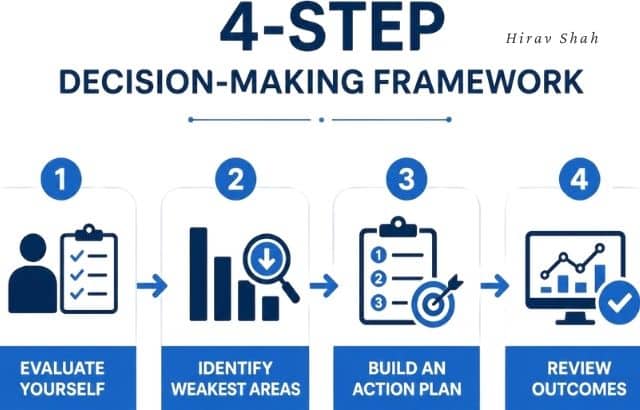
Every entrepreneur can benefit from following a structured decision-making framework.
Step One: Evaluate Yourself
Rate every area from 1 to 10.
- Hard Work
- Smart Work
- Talent
- Timing
- Leadership
- Financial Discipline
- Marketing Effectiveness
This exercise highlights strengths while revealing hidden weaknesses.
Step Two: Identify Weakest Areas
Most entrepreneurs naturally focus on improving their strengths.
However, business growth often accelerates when leaders improve their weakest areas first.
For example:
If Marketing = 9
Leadership = 8
Operations = 8
Financial Discipline = 3
Improving Financial Discipline from 3 to 7 may produce far greater overall growth than increasing Marketing from 9 to 10.
Step Three: Build an Action Plan
Create measurable objectives.
Define:
- Quarterly goals
- Monthly milestones
- Weekly priorities
- Daily execution
Every objective should include deadlines and measurable outcomes.
Step Four: Review Outcomes
Every ninety days ask yourself:
- What worked?
- What failed?
- What should stop?
- What should continue?
- What deserves greater investment?
Continuous review enables businesses to adapt before small challenges become major problems.
Frequently Asked Questions

What is the biggest takeaway from the business success formula?
The biggest lesson is that business success depends upon multiple interconnected factors rather than effort alone.
Hard work, intelligent strategy, talent, execution, timing, and continuous improvement reinforce one another.
Can luck replace hard work?
No.
Luck alone cannot build sustainable businesses.
Without execution, discipline, financial planning, and consistent leadership, favorable circumstances rarely produce long-term success.
Why is strategy more important than simply working harder?
Hard work increases activity.
Strategy ensures that activity produces meaningful results.
Businesses grow faster when effort is directed toward the highest-value opportunities.
How can business owners improve decision-making?
Business owners should:
- Monitor business performance regularly.
- Review financial reports consistently.
- Study changing customer behavior.
- Analyze competitors.
- Seek expert guidance.
- Remain willing to adjust strategies whenever market conditions change.
Why do similar businesses achieve different results?
Even businesses operating within the same industry often experience different outcomes because of differences in:
- Leadership quality
- Customer positioning
- Execution
- Financial management
- Timing
- Innovation
- Adaptability
Small differences become significant advantages over time.
Should entrepreneurs rely only on astrology?
The philosophy presented throughout this article encourages integration rather than dependence.
Strategic planning, disciplined execution, financial management, leadership, operational excellence, and customer focus remain fundamental.
Some entrepreneurs choose to complement these practices with astrological guidance when planning major business decisions.
How often should business strategies be reviewed?
Growing businesses generally benefit from:
- Quarterly strategic reviews
- Monthly operational evaluations
- Annual long-term planning sessions
Regular reviews help businesses remain aligned with changing market conditions.
Final Thoughts

Business Strategist Hirav Shah concludes that lasting business success requires far more than isolated effort.
It emerges from the alignment of:
- Mindset
- Strategic thinking
- Disciplined implementation
- Talent
- Thoughtful decision-making
- The role that many entrepreneurs attribute to favorable timing and luck
In today’s highly competitive business landscape, average performance is rarely sufficient for organizations seeking sustainable growth.
The leaders who consistently outperform competitors are those who continuously improve every aspect of their business—from planning and execution to leadership, innovation, customer experience, and resource allocation.
Whether one views luck as divine grace, favorable timing, or being fully prepared when opportunities arise, the central message remains unchanged.
Success is rarely accidental.
It is built through:
- Thoughtful decisions
- Continuous improvement
- Strategic planning
- Disciplined execution
- Consistent learning
- Relentless commitment to excellence
Business Strategist Hirav Shah believes that organizations combining hard work, smart work, talent, strategic clarity, disciplined execution, and thoughtful timing place themselves in a far stronger position to achieve extraordinary and lasting business success.
Ultimately, the most successful entrepreneurs never rely on a single factor. They build businesses by continuously strengthening every pillar of success, creating organizations that are resilient, adaptable, and capable of thriving in an ever-changing business environment.