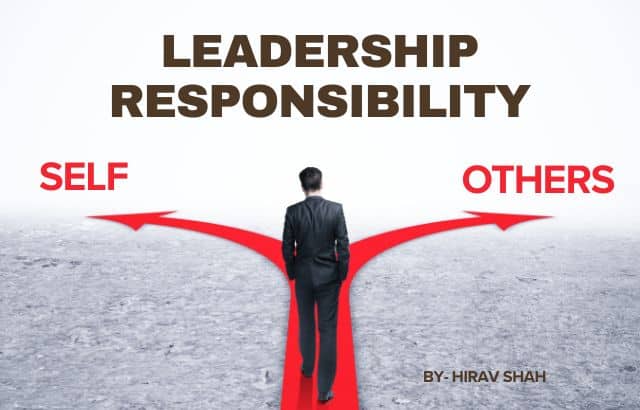
Leadership often begins with a deceptively simple question:
Should I focus on myself first, or should I serve others to grow?
Many leaders, entrepreneurs, founders, and professionals wrestle with this dilemma throughout their careers. Some believe personal growth and self-care must come first. Others believe that serving people, customers, employees, and communities is the true path to success.
According to Business Strategist Hirav Shah, The Game Changer, the issue runs much deeper than productivity techniques, motivational advice, leadership frameworks, or management theories.
The real challenge is not choosing between self and others.
The real challenge is understanding the state of mind from which our actions arise.
Table of Contents
The Core Leadership Question: Who Comes First—Me or You?

Business Strategist Hirav Shah poses a powerful question:
“Am I responsible for myself first, or responsible for you first?”
Most people naturally fall into one of two categories.
Self-First Thinkers
These individuals believe that personal growth, self-love, self-care, and self-responsibility must come first.
Their reasoning is simple:
If I am not healthy, balanced, and fulfilled, how can I effectively help anyone else?
Examples include:
- Entrepreneurs who prioritize mental wellness before expanding their businesses.
- Leaders who focus on developing skills before mentoring others.
- Business owners who establish financial stability before engaging in philanthropy.
Service-First Thinkers
Others believe that serving people creates deeper meaning and teaches us how to understand ourselves.
Their belief is:
Through helping others, we discover our own humanity.
Examples include:
- Leaders who place employee welfare ahead of short-term profits.
- Founders who focus on customer success before maximizing revenue.
- Managers who invest time coaching team members despite personal workloads.
Both perspectives contain valuable truths.
Yet according to Hirav Shah, both are incomplete when viewed as opposing choices.
The Truth: The Dilemma Is Created by the Mind
At first glance, the question appears profound.
Am I responsible for myself first or responsible for others first?
However, Business Strategist Hirav Shah explains that the dilemma itself is often the source of confusion.
The human mind is conditioned to divide reality into opposing categories:
- Me versus you
- Success versus happiness
- Profit versus purpose
- Growth versus stability
- Leadership versus service
The mind seeks certainty through separation.
As a result, it creates choices where deeper awareness sees connection.
Responsibility is not sequential.
It does not begin with yourself and then extend outward.
Nor does it begin with others and eventually return to yourself.
True responsibility emerges simultaneously through awareness.
When awareness is present, caring for yourself and caring for others become interconnected expressions of the same intelligence.
How Ego Creates Leadership Confusion

According to Hirav Shah, many leadership dilemmas originate from subtle forms of ego.
This does not necessarily mean arrogance.
Ego often appears as:
- The need for approval
- Fear of criticism
- Fear of failure
- Desire for recognition
- Need for control
- Attachment to outcomes
When ego drives decision-making, leaders often become trapped in internal negotiations.
Examples include:
- “If I work harder, people will respect me.”
- “If I sacrifice enough, I will finally feel valued.”
- “If my company grows faster, I will feel successful.”
- “If everyone is happy with me, I am a good leader.”
These internal narratives create endless conflict.
Leadership becomes exhausting because every decision is tied to identity.
When Clarity Replaces Conflict

Business Strategist Hirav Shah emphasizes that authentic responsibility appears naturally when inner conflict subsides.
Consider a leader who understands:
- Their strengths
- Their fears
- Their motivations
- Their blind spots
Such a leader does not need to force compassion.
Compassion becomes natural.
Similarly, when leaders genuinely care for employees, customers, investors, and stakeholders without seeking validation, self-respect strengthens naturally.
There is no contradiction.
Self-awareness and service support each other.
The important question becomes:
From What State Am I Acting?
Every decision can be examined through this lens.
Am I acting from:
- Fear?
- Validation?
- Control?
- Insecurity?
- Clarity?
When clarity becomes the source of action, responsibility becomes balanced, intelligent, and sustainable.
Leadership Responsibility in Business

The impact of awareness extends far beyond personal development.
It directly influences business performance.
Expansion Versus Stability
Many business owners struggle with whether to scale aggressively or consolidate existing operations.
A fear-driven leader may:
- Expand too quickly.
- Take excessive risks.
- Ignore operational weaknesses.
A clarity-driven leader evaluates:
- Market readiness
- Financial capacity
- Team capability
- Long-term sustainability
The result is healthier growth.
Profit Versus Purpose
Many organizations feel pressure to choose between profitability and social responsibility.
However, effective strategy often integrates both.
Examples include:
- Companies creating sustainable products that generate profits while reducing environmental impact.
- Brands building customer trust through ethical practices.
- Businesses investing in employee development while improving productivity.
The best strategies rarely choose one side.
They integrate multiple objectives.
Speed Versus Sustainability
Fast growth can be exciting.
However, rapid expansion often creates:
- Burnout
- Operational failures
- Quality issues
- Customer dissatisfaction
Strategic leadership balances momentum with resilience.
As Hirav Shah often explains:
“The mind divides. Strategy integrates.”
The Role of Business Strategist Hirav Shah

Many people assume a business strategist focuses only on numbers.
The reality is much broader.
Business Strategist Hirav Shah, The Game Changer, helps leaders bridge the gap between internal clarity and external execution.
A Business Strategist Helps Leaders:
Identify Blind Spots
Leaders cannot see every weakness in their thinking.
External perspective often reveals hidden assumptions that limit growth.
Reduce Emotional Decision-Making
Fear and excitement frequently distort judgment.
A strategist helps separate facts from emotions.
Align Vision and Execution
Many businesses have ambitious visions but lack operational alignment.
Strategic guidance transforms vision into actionable plans.
Improve Decision Quality
Whether evaluating acquisitions, partnerships, product launches, or expansion opportunities, better decisions create better outcomes.
Create Long-Term Sustainable Growth
Growth without strategy often creates future problems.
Strategy ensures growth remains profitable and manageable.
Real Business Examples
Example 1: Choosing the Right Client
A consulting company receives a lucrative contract worth ₹50 lakh.
However, the client’s values conflict with the company’s long-term brand positioning.
The founder faces a difficult decision.
Option A:
Accept immediate revenue.
Option B:
Protect brand integrity.
A leader acting from fear may prioritize short-term cash flow.
A leader acting from clarity evaluates:
- Long-term reputation
- Strategic alignment
- Future opportunities
The answer becomes obvious.
Example 2: Micromanagement and Team Performance
A manager constantly reviews every detail of employee work.
Productivity declines.
Morale suffers.
After reflection, the manager realizes the behavior stems from personal insecurity rather than operational necessity.
Once self-awareness increases, delegation improves.
Team performance rises naturally.
Example 3: Expansion Decision
A retail company plans to open ten new locations.
Instead of pursuing aggressive growth immediately, leadership evaluates:
- Cash reserves
- Market demand
- Staffing capacity
- Supply chain readiness
The company opens four locations first.
Revenue grows steadily while operational quality remains high.
Strategic patience prevents expensive mistakes.
Leadership Responsibility and Strategic Calculations

Awareness is essential.
However, leadership also requires measurable results.
Great strategy combines clarity with numbers.
ROI Calculation Example
Assume:
Marketing Spend = ₹5,00,000
Revenue Generated = ₹12,50,000
ROI Formula:
ROI = (Revenue − Cost) ÷ Cost × 100
Calculation:
ROI = (₹12,50,000 − ₹5,00,000) ÷ ₹5,00,000 × 100
ROI = 150%
Many leaders focus only on revenue growth.
Strategic leaders focus on return.
Customer Acquisition Cost Calculation
Assume:
Marketing Budget = ₹8,00,000
New Customers Acquired = 400
Customer Acquisition Cost:
CAC = ₹8,00,000 ÷ 400
CAC = ₹2,000 per customer
Understanding acquisition costs helps leaders make smarter scaling decisions.
Time Leverage Calculation
Suppose a business owner spends:
4 hours daily on low-value activities
20 working days monthly
Calculation:
4 × 20 = 80 hours
80 hours equals approximately two full work weeks every month.
Delegating low-value work could dramatically improve productivity and growth.
Employee Productivity Example
Assume:
10 employees
Each saves 30 minutes daily through process improvements
Calculation:
10 × 30 minutes = 300 minutes
300 minutes = 5 hours daily
Monthly:
5 × 20 working days = 100 hours saved
Small improvements create significant organizational leverage.
Self-Love and Compassion Are Not Opposites

One of Hirav Shah’s most important insights is that self-love and compassion are not competing priorities.
They are interconnected.
When individuals develop awareness:
- Self-care becomes natural rather than selfish.
- Compassion becomes genuine rather than performative.
- Leadership becomes balanced rather than exhausting.
A healthy leader can support others without self-neglect.
A compassionate leader can maintain boundaries without guilt.
This balance creates sustainable success.
Sustainable Business Growth Through Clarity

When leadership responsibility is grounded in awareness, businesses experience:
Better Decision-Making
Decisions become less reactive and more strategic.
Stronger Teams
Employees respond positively to authentic leadership.
Higher Customer Trust
Customers gravitate toward businesses with integrity.
Reduced Burnout
Balanced responsibility supports long-term performance.
Greater Adaptability
Clear leaders respond to change more effectively.
Practical Exercises for Leadership Responsibility

The Responsibility Mirror
Purpose
To understand whether actions originate from fear, ego, or clarity.
Steps
Write down one current challenge.
Ask:
- What am I afraid of losing?
- What am I trying to protect?
- If fear disappeared, what would I do?
Insight
When fear dissolves, responsibility often becomes obvious.
Self Versus Other Awareness Check
Purpose
To evaluate balance.
Create a table:
| Situation | My Action | Cost to Me | Cost to Others |
|---|
Review three situations from the previous month.
Ask:
Was my response balanced?
Or was it driven by guilt, control, or self-interest?
The Origin of Action
Purpose
To identify emotional drivers.
For an upcoming decision, check:
- Fear
- Obligation
- Validation
- Clarity
If multiple boxes are checked, revisit the decision later.
Clarity rarely rushes.
Compassion Without Self-Neglect
Purpose
To strengthen healthy boundaries.
Identify someone you may be over-supporting.
Ask:
- Am I expecting appreciation?
- Am I avoiding my own challenges?
- What boundary would create balance?
Filling the Cup First
Purpose
To experience awareness directly.
Practice:
Sit quietly for ten minutes daily.
Observe thoughts without attempting to change them.
Weekly Reflection:
How do my interactions change when I feel internally settled?
The Dilemma Dissolver
Purpose
To challenge binary thinking.
Write:
Option A
Option B
Then ask:
What assumption makes these options appear mutually exclusive?
Question the assumption.
New possibilities often emerge.
Frequently Asked Questions

Can I love others before loving myself?
Yes.
However, without self-awareness, love can become dependency, sacrifice, or approval-seeking rather than genuine care.
Can serving others teach self-love?
Absolutely.
Conscious service often reveals strengths, values, and deeper aspects of character.
Why do successful leaders still feel stuck?
Because external success does not automatically resolve internal conflict.
Without clarity, achievement alone rarely creates fulfillment.
How does a business strategist improve leadership effectiveness?
A strategist helps align vision, numbers, behavior, timing, and execution while identifying hidden obstacles that limit growth.
When should a business leader seek strategic guidance?
Before major decisions involving:
- Business expansion
- Diversification
- Mergers and acquisitions
- Brand repositioning
- Market entry
- Investment planning
What is the biggest leadership mistake?
Making decisions from fear, ego, or emotional reactivity instead of awareness and strategic clarity.
Why is awareness a competitive advantage?
Because awareness improves judgment, reduces costly mistakes, strengthens relationships, and enhances long-term decision quality.
Final Thought: Fire Up Your Future

Who does not want success in business?
The more important question is:
Are your actions aligned with your goals?
Do your daily habits support your long-term vision?
Is your current strategy still relevant in today’s market?
Success is not created by intention alone.
Without action, nothing changes.
Without strategy, effort becomes scattered.
Without clarity, even success can feel confusing.
Business Strategist Hirav Shah, The Game Changer, believes that meaningful growth begins when leaders stop choosing between themselves and others and start acting from awareness.
When clarity leads, responsibility becomes natural.
When responsibility becomes natural, leadership becomes powerful.
And when leadership becomes powerful, sustainable success follows.
Plant the right seeds today.
Choose clarity.
Take aligned action.
And build a future that creates value not only for yourself but for everyone your leadership touches.