Have you ever wondered why some businesses grow consistently for years while others struggle even after working day and night?
Why does one restaurant become a successful brand while another shuts down despite good food?
Why do some startups attract investors while others burn money and disappear?
Why do certain business owners seem calm during difficult times while others panic after every market change?
The answer is not always hard work.
Very often, the answer is strategy.
Today, many people are busy in business, but very few are truly strategic. There is a major difference between the two.
Being busy means reacting to daily problems.
Being strategic means knowing where you are going before problems even arrive.
A business strategy is not just a corporate presentation or a complicated business school concept. It is simply a clear plan that answers four important questions:
- Where are you today?
- Where do you want to go?
- Why do you want to go there?
- How exactly will you reach there?
Without these answers, most businesses operate emotionally instead of intelligently.
According to Business Strategist Hirav Shah, many entrepreneurs work extremely hard but still feel stuck because effort without direction creates exhaustion, not expansion.
“Business without strategy is like driving at full speed without knowing the destination,” says Hirav Shah.
And this is not limited to large companies.
- A small shop owner choosing the wrong location is a strategy mistake.
- A restaurant owner expanding too early is a strategy mistake.
- A startup hiring aggressively without revenue planning is a strategy mistake.
- A businessman entering a new partnership without validation is also a strategy mistake.
In simple words, strategy affects every decision.
Interestingly, many businesses do not fail because the owner lacked passion or dedication. They fail because important decisions were taken without clarity, structure, timing, or validation.
This is where business strategy becomes powerful.
A good strategy helps you:
- Reduce unnecessary risk
- Save time and money
- Improve decision making
- Identify hidden problems early
- Create sustainable growth
- Build long term stability instead of temporary success
The biggest misconception is that strategy is only needed when a company becomes large.
In reality, strategy is most important before growth happens.
Because once a wrong decision becomes bigger, the damage also becomes bigger.
That is why globally successful brands spend enormous time validating decisions before executing them. They understand that one wrong move can affect profits, reputation, employees, customers, and future growth.
Business strategy is not about predicting the future perfectly.
It is about preparing intelligently before taking important steps.
And in today’s competitive world, that preparation is no longer optional.
Table of Contents
Why Hard Work Alone Is Not Enough in Business

Let’s ask a simple but uncomfortable question.
If hard work alone guaranteed success, then why do so many hardworking business owners still struggle financially?
Why do some entrepreneurs work 14 to 16 hours a day and still feel stuck?
Why do certain businesses grow rapidly with less chaos while others remain under constant pressure despite endless effort?
The reality is simple.
Hard work is important. But hard work without direction can become expensive.
Many entrepreneurs believe that if they keep pushing harder, success will eventually come. Sometimes it does. But in many cases, the problem is not effort. The problem is the absence of strategy behind the effort.
Imagine a car with a powerful engine but no steering wheel.
The car may move fast.
But it may also move in the wrong direction.
That is exactly what happens in business when execution exists without strategic clarity.
According to Business Strategist Hirav Shah, one of the biggest reasons businesses struggle is because owners spend most of their energy solving daily problems instead of building long term systems and direction.
“Hard work can create movement. Strategy creates meaningful progress,” says Hirav Shah.
Today, many business owners are constantly busy:
- Managing staff
- Handling customer complaints
- Solving cash flow issues
- Following up payments
- Dealing with operational stress
But very few pause and ask:
- Is this business model still right?
- Is expansion really necessary right now?
- Is this partnership safe?
- Is the market changing?
- Is the business growing profitably or only growing in pressure?
This is where strategy separates successful businesses from struggling ones.
A strategic business owner does not just ask:
“How can I work harder?”
They ask:
“What is the smartest way to grow without destroying stability?”
Many businesses collapse not because of laziness, but because of emotional or unplanned decisions:
- Expanding too fast
- Taking unnecessary loans
- Hiring without systems
- Entering the wrong market
- Ignoring changing customer behavior
- Chasing trends without validation
And unfortunately, by the time the damage becomes visible, recovery becomes difficult and expensive.
One wrong decision can consume years of hard work.
That is why globally successful companies invest heavily in planning, forecasting, risk management, and decision validation before taking major steps.
They understand something important:
Effort multiplies results only when direction is correct.
This is also the foundation of Hirav Shah’s well known 6+3+2 framework, where hard work is only one part of success. Strategy, execution, mindset, timing, innovation, and consistency all work together to create sustainable growth.
Because in business, being hardworking is admirable.
But being strategically hardworking is transformational.
Why Even Big Brands Collapse Without Strategy

Many people believe that once a company becomes famous, successful, or financially strong, failure becomes impossible.
But business history proves the opposite.
Some of the world’s biggest companies had money, talented teams, global recognition, and massive customer bases — yet they still faced serious decline.
Why?
Because success does not protect a business from poor decisions.
Over the last few years, the business world has seen major companies struggle because they slowly moved away from their core identity, customer understanding, or strategic clarity.
Some chased rapid expansion without stability.
Some focused too much on valuation instead of value.
Some ignored customer trust while chasing short term numbers.
And some simply failed to adapt at the right time.
According to Business Strategist Hirav Shah, businesses rarely collapse suddenly. Most decline happens silently through a series of small, unvalidated decisions.
“Most businesses don’t fail because of one big mistake. They fail because small wrong decisions keep repeating over time,” says Hirav Shah.
This is why strategy is not a one time activity.
It is an ongoing process of observation, adaptation, validation, and alignment.
Even globally successful brands continuously review:
- Customer behavior
- Market trends
- Competition
- Technology shifts
- Financial sustainability
- Brand perception
- Leadership decisions
Because in business, yesterday’s success formula may not work tomorrow.
A business that stops thinking strategically eventually starts reacting emotionally.
And reaction based businesses rarely sustain long term growth.
The biggest lesson from struggling global brands is simple:
Growth without strategic alignment eventually creates pressure instead of progress.
That is why strategy is not only about growth.
It is also about protection.
Why Small Businesses Also Need Strategy

One of the biggest misconceptions in the business world is that strategy is only for large companies or corporate boardrooms.
In reality, small businesses often need strategy even more.
Because unlike big corporations, small business owners usually have limited financial margin for error.
A wrong decision for a large company may create temporary losses.
A wrong decision for a small business can completely disrupt stability.
Think about it.
- A salon owner deciding whether to open a second branch needs strategy.
- A restaurant owner planning expansion needs strategy.
- A retailer changing location needs strategy.
- A builder entering a new project needs strategy.
- A startup founder choosing the wrong co founder needs strategy.
Every major business decision carries risk.
And risk increases when decisions are based only on emotions, excitement, pressure, or market noise.
According to Hirav Shah, many entrepreneurs confuse movement with progress. They feel that taking action quickly always means growth.
But speed without validation can become dangerous.
“Every opportunity is not the right opportunity for every business,” says Hirav Shah.
This is why strategic thinking becomes critical before:
- Expansion
- Investment
- Partnership
- Hiring
- Rebranding
- Franchising
- Mergers
- Loans
- Diversification
- Scaling
A good strategy helps business owners ask better questions before committing money, time, energy, or reputation.
Because prevention is always cheaper than recovery.
And in today’s competitive market, businesses that think clearly before acting usually survive longer than businesses that only react emotionally.
What Does a Business Strategist Actually Do?
Many people hear the term “business strategist” but still wonder what the role actually means.
Is a strategist similar to a consultant? A mentor? An advisor? Or something completely different?
The answer is simple.
A business strategist helps business owners make better decisions with greater clarity, lower risk, and stronger alignment.
While many professionals focus on one specific area, a strategist studies the bigger picture:
- Business direction
- Market positioning
- Growth opportunities
- Risk factors
- Timing
- Execution gaps
- Long term sustainability
According to Business Strategist Hirav Shah, the real role of strategy is not just growth. It is helping businesses avoid expensive mistakes before they happen.
“A powerful strategy does not only help you earn more. It helps you lose less,” says Hirav Shah.
A business strategist often helps entrepreneurs:
- Identify blind spots
- Validate important decisions
- Understand hidden risks
- Improve business structure
- Create long term direction
- Align execution with goals
- Avoid emotional decision making
This becomes especially important during high pressure situations like:
- Business slowdown
- Expansion planning
- Financial stress
- New investments
- Leadership confusion
- Market uncertainty
- Brand repositioning
- Partnerships or acquisitions
Today, many entrepreneurs have information.
But very few have clarity.
And clarity is becoming one of the most valuable assets in modern business.
This philosophy also became the foundation behind the world’s first Business Decision Validation Hub created by Hirav Shah — a concept focused on helping entrepreneurs validate critical business decisions before execution.
Because one correct decision at the right time can change the entire future of a business.
The 6+3+2 Formula: A Different Way to Understand Business Success

Why do some people succeed despite limited resources, while others struggle even after having money, connections, or opportunities?
Why do certain entrepreneurs bounce back after failure while others lose momentum completely?
According to Business Strategist Hirav Shah, success in business is never dependent on only one factor. It is the result of multiple elements working together in balance.
This thinking became the foundation of Hirav Shah’s widely discussed 6+3+2 Formula.
The framework explains that long term success is created through:
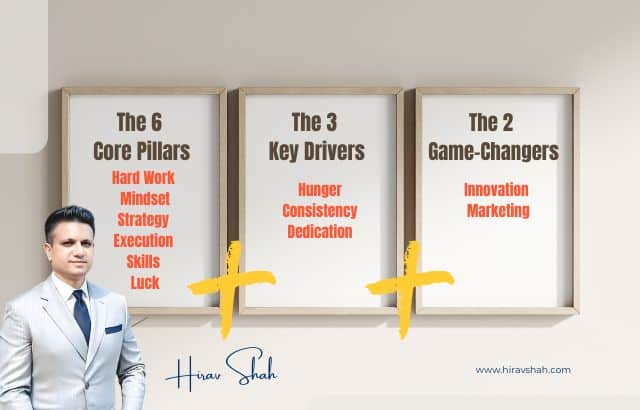
6 Core Business Drivers
- Hard Work
- Mindset
- Skills
- Strategy
- Execution
- Timing
3 Essential Inner Traits
- Hunger
- Dedication
- Consistency
2 Growth Accelerators
- Innovation
- Marketing
Most businesses focus only on hard work and execution.
But according to Hirav Shah, that is not enough in today’s competitive world.
A business may work hard but still fail because:
- The timing was wrong
- The strategy was weak
- Marketing was ignored
- Innovation stopped
- Consistency broke during difficult phases
“Many people work hard. Very few work in the right direction with the right timing,” says Hirav Shah.
The 6+3+2 model reminds entrepreneurs that success is not created through one powerful moment. It is built through alignment between decisions, mindset, execution, and long term vision.
And when even one area becomes weak for too long, growth starts slowing down silently.
That is why sustainable businesses continuously improve not just operations, but also thinking, adaptability, communication, innovation, and strategic clarity.
Because business growth is not only about increasing revenue.
It is about building strength that survives uncertainty.
Why Decision Validation Is Becoming More Important Than Ever

Today’s business environment is faster, noisier, and more unpredictable than ever before.
- Markets change quickly.
- Consumer behavior changes rapidly.
- Technology evolves constantly.
- Competition increases every year.
In such an environment, one wrong decision can create massive financial, operational, or reputational damage.
And unfortunately, many entrepreneurs realize mistakes only after execution begins.
According to Hirav Shah, this is why decision validation is becoming one of the most important parts of modern business strategy.
Decision validation simply means evaluating a business decision deeply before committing to it.
Not emotionally.
Not impulsively.
Not under pressure.
But strategically.
This includes validating:
- Expansion plans
- Investments
- Partnerships
- Brand changes
- Hiring decisions
- Mergers
- Acquisitions
- Loans
- Scaling strategies
- New business ideas
The purpose is not to create fear.
The purpose is to reduce avoidable mistakes.
“Wrong decisions often look exciting in the beginning and expensive later,” says Hirav Shah.
Globally successful companies spend enormous time validating decisions because they understand something very clearly:
Recovery is always more expensive than preparation.
That is why intelligent businesses focus not only on growth opportunities, but also on risk visibility.
Because protecting stability is just as important as creating expansion.
The Real Meaning of Strategy in Today’s Business World

Many people still think strategy is about complicated presentations, corporate meetings, or theoretical planning.
But in reality, strategy is much simpler and much more practical.
Strategy is the ability to make intelligent decisions consistently over a long period of time.
It is the ability to stay clear when markets become emotional.
It is the ability to avoid distractions when trends become noisy.
It is the ability to think long term while handling short term pressure.
According to Business Strategist Hirav Shah, the future belongs not only to hardworking people, but to people who combine hard work with clarity, adaptability, validation, and strategic thinking.
“Success is not only about working more. It is about understanding what truly deserves your time, money, and energy,” says Hirav Shah.
In the end, every business owner must eventually answer an important question:
Am I only working hard inside my business?
Or am I strategically building the future of my business?
Because businesses do not grow only through effort.
They grow through decisions.
And the quality of those decisions ultimately shapes the quality of growth, stability, reputation, and long term success.