Table of Contents
The Biggest Enemy of Success Is the Comfort Zone

The biggest enemy of success is the comfort zone. In reality, more than ninety percent of people prefer to remain within familiar boundaries because it feels safe, predictable, and comfortable. However, in a world that is constantly evolving, success is never guaranteed for those who refuse to adapt, experiment, and move beyond what is familiar.
Markets change. Customer preferences change. Technology changes. Competitors change.
The individuals and organizations that thrive are rarely the ones that avoid risk altogether. They are the ones that learn how to take calculated risks.
Take risks.
Take chances.
Risk Taker Can Also Become The Success Getter
Risk Taker Can Also Become The Achiever
Risk Taker Can Also Become The Trailblazer
Risk Taker Can Also Become The Groundbreaker
To achieve success, glory, and personal growth, you must be willing to embrace uncertainty. By stretching yourself beyond your comfort zone, you discover new opportunities, acquire valuable skills, gain deeper knowledge, and develop perspectives that would otherwise remain hidden.
The process may feel uncomfortable. It may feel intimidating. It may even feel overwhelming at times.
Yet growth rarely happens inside comfort zones.
Every breakthrough in business, leadership, innovation, and entrepreneurship begins with someone deciding to take a chance.
What Is Risk?

Risk involves uncertainty regarding the consequences of an action, decision, or event that affects something people value, such as business performance, health, wealth, reputation, property, relationships, or the environment.
Most discussions about risk focus on potential negative outcomes. However, risk also creates the possibility of positive outcomes.
Without risk, there can be no reward.
Consider a farmer deciding whether to invest in advanced irrigation systems. The investment requires capital and effort, and there is no guarantee of immediate returns. However, the potential reward includes increased crop yield, improved quality, and long-term profitability.
Similarly, an entrepreneur launching a new product faces uncertainty. The product may fail, succeed moderately, or become a market leader.
Risk is not merely about potential loss; it is also about potential gain.
What Is Business Risk?

Business risk refers to the exposure an organization has to factors that may reduce profitability, hinder growth, damage reputation, or even threaten survival.
Anything that affects a company’s ability to achieve its financial, operational, or strategic objectives can be classified as a business risk.
Business risks can arise from numerous sources, including:
Market Risks
Changes in customer behavior, market demand, economic conditions, and industry trends.
Example:
A retail company that depends heavily on physical stores may face significant challenges when consumers increasingly prefer online shopping.
Competitive Risks
New competitors, disruptive technologies, or changing industry standards.
Example:
Traditional taxi operators faced substantial business risks when ride-sharing platforms entered the market.
Financial Risks
Cash flow shortages, rising costs, interest rate fluctuations, and poor investment decisions.
Example:
A manufacturer taking excessive loans during an economic slowdown may struggle with repayments.
Operational Risks
Failures in systems, processes, supply chains, or workforce management.
Example:
A factory relying on a single supplier may face production delays if that supplier encounters problems.
Leadership Risks
Poor strategic decisions, ineffective management, or delayed responses to market changes.
In many situations, business risk is not created by external circumstances alone. Internal leadership decisions can expose an organization to a greater degree of risk than external factors.
This is why strategic thinking becomes essential.
Who Is A Risk Taker?

A risk taker is someone willing to pursue opportunities despite uncertainty about the outcome.
Risk takers possess several common characteristics:
- They make decisions efficiently.
- They understand the value of innovation.
- They embrace creativity.
- They tolerate temporary setbacks.
- They remain optimistic despite uncertainty.
- They view challenges as opportunities to learn.
Risk takers are often found in leadership positions, including founders, CEOs, entrepreneurs, investors, and senior managers.
They understand that standing still can sometimes be riskier than moving forward.
Why Risk Takers Matter In Business
Businesses prosper because someone is willing to challenge conventional thinking.
Imagine if nobody had dared to introduce online banking, electric vehicles, artificial intelligence, cloud computing, or e-commerce.
Innovation exists because risk takers choose to explore possibilities that others ignore.
For example:
- A startup founder invests savings into building a new software platform.
- A manufacturer expands into international markets.
- A retailer launches an entirely new product category.
- A company adopts emerging technology before competitors.
Every major business success story includes moments of uncertainty, courage, and calculated decision-making.
What Is Calculated Risk?
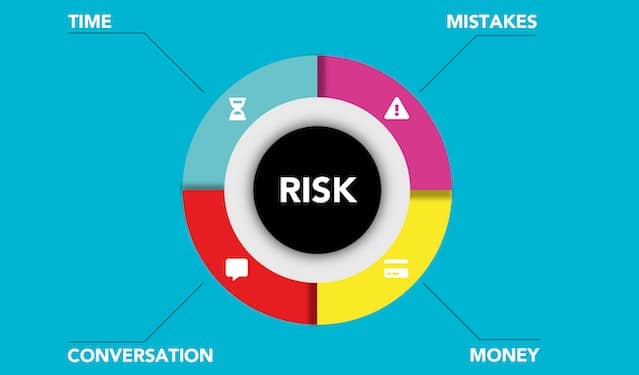
Taking risks does not mean acting recklessly.
Calculated risk involves evaluating opportunities, assessing potential outcomes, understanding consequences, and preparing contingency plans before making a decision.
It is the difference between gambling and strategic decision-making.
A Simple Formula For Calculated Risk
Expected Value Calculation
Expected Value (EV) = Probability of Success × Potential Gain − Probability of Failure × Potential Loss
Example:
A business considers launching a new product.
- Probability of success = 70%
- Expected profit = ₹50,00,000
- Probability of failure = 30%
- Expected loss = ₹10,00,000
EV = (0.70 × ₹50,00,000) − (0.30 × ₹10,00,000)
EV = ₹35,00,000 − ₹3,00,000
EV = ₹32,00,000
The positive expected value indicates that the opportunity may be worth pursuing.
While no calculation guarantees success, it provides a structured approach to decision-making.
The Risk-To-Reward Ratio
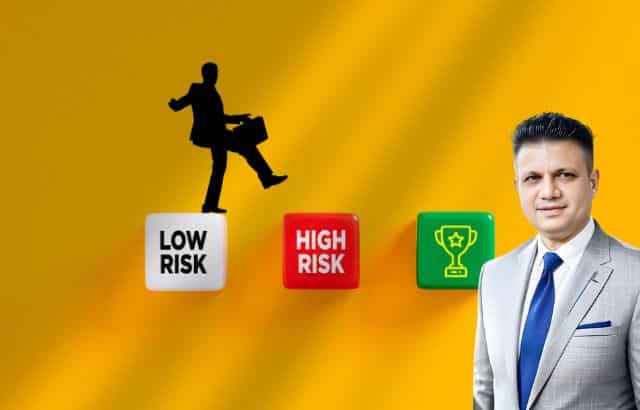
Another useful calculation is:
Risk-to-Reward Ratio
Risk ÷ Potential Reward
Example:
Investment Required = ₹5,00,000
Potential Profit = ₹20,00,000
Risk-to-Reward Ratio = 5,00,000 ÷ 20,00,000
Ratio = 1:4
Many successful entrepreneurs prefer opportunities where the reward significantly outweighs the risk.
How To Take Calculated Risks Intelligently

Educate Yourself Thoroughly
Before taking a risk, gather information.
Research the market.
Understand customer behavior.
Study competitors.
Analyze industry trends.
The more informed you are, the better your decisions become.
Define Boundaries
Every risk should have clearly defined limits.
Ask yourself:
- What is the maximum amount of money I am willing to lose?
- How much time can I invest?
- What is my exit strategy?
Successful leaders establish boundaries before taking action.
Create Backup Plans
The most successful organizations always prepare alternative scenarios.
Ask:
- What happens if Plan A fails?
- What resources will I need?
- How quickly can I pivot?
Preparation reduces uncertainty.
Learn From Failure
One of the biggest misconceptions is that successful people avoid failure.
The truth is exactly the opposite.
Successful people fail frequently, but they learn rapidly.
Many lessons gained during difficult periods become the foundation for future success.
Distress often teaches more than success ever can.
The Role Of A Business Strategist In Managing Risk

A Business Strategist plays a crucial role in helping entrepreneurs, business owners, CEOs, investors, and organizations make better decisions under uncertainty.
A Business Strategist helps leaders:
Identify Hidden Risks
Not all risks are visible.
Many organizations focus only on obvious threats while overlooking emerging challenges.
A Business Strategist evaluates the bigger picture.
Validate Major Decisions
Before launching products, entering new markets, investing capital, hiring leadership teams, or pursuing acquisitions, decision-makers benefit from independent strategic evaluation.
This reduces emotional decision-making and improves objectivity.
Improve Risk-Reward Analysis
Strategic guidance helps leaders compare opportunities based on potential returns, costs, timing, and probability of success.
This creates confidence in decision-making.
Build Long-Term Growth Strategies
A Business Strategist ensures that today’s decisions align with long-term goals.
Short-term gains should never compromise sustainable growth.
Why Some Businesses Fail To Take Risks
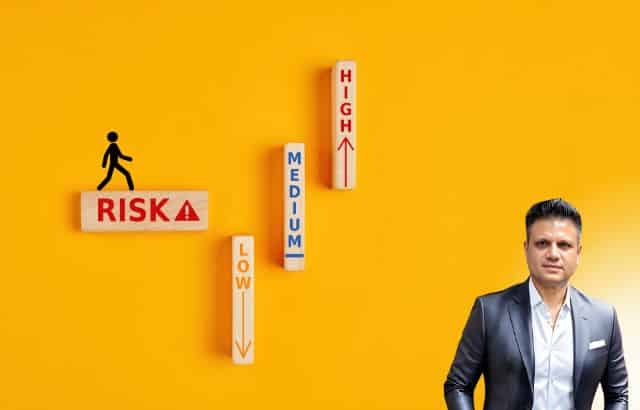
Many businesses remain stagnant because they:
- Fear failure.
- Fear criticism.
- Fear uncertainty.
- Fear financial loss.
- Fear leaving familiar territory.
Ironically, avoiding risk often creates a bigger risk.
A business that refuses to innovate may lose customers.
A company that refuses to adapt may become irrelevant.
A leader who avoids difficult decisions may miss transformational opportunities.
Sometimes the greatest risk is taking no risk at all.
Final Thoughts

Make sure you understand the risks before taking them.
When evaluating an opportunity, there should ideally be more advantages than disadvantages.
Create a list of pros and cons.
Analyze the numbers.
Evaluate potential outcomes.
Seek expert guidance.
Most importantly, remember that no one can predict every outcome with complete certainty.
There will always be factors beyond your control.
However, if fear prevents you from moving forward, you may never discover what is truly possible.
Every meaningful achievement requires courage.
Whether you are launching a startup, entering a new market, investing in growth, or reinventing your business model, success often belongs to those willing to take intelligent and calculated risks.
As Business Strategist Hirav Shah, widely recognized as The Game Changer, often emphasizes through strategic decision-making frameworks, leaders achieve sustainable growth when they validate opportunities, understand risks, and move forward with confidence rather than hesitation.
The future belongs to those who are prepared to step beyond comfort, embrace uncertainty, and take calculated action.
FAQs

Why are calculated risks important in business?
Calculated risks enable businesses to innovate, expand, enter new markets, improve profitability, and stay competitive while minimizing unnecessary losses.
What is the difference between a risk and a calculated risk?
A risk involves uncertainty. A calculated risk involves evaluating potential outcomes, conducting research, assessing probabilities, and preparing contingency plans before taking action.
Can businesses grow without taking risks?
Sustainable growth is difficult without some level of risk. Expansion, innovation, investment, and transformation all involve uncertainty.
What are examples of calculated business risks?
Examples include launching a new product, entering a new geographic market, investing in technology, acquiring another company, or adopting a new business model.
How can a Business Strategist help reduce risk?
A Business Strategist helps identify opportunities, evaluate threats, validate decisions, improve planning, and create strategies that balance growth with risk management.
What is the biggest mistake businesses make regarding risk?
The biggest mistake is either taking reckless risks without analysis or avoiding all risks due to fear. Successful organizations focus on calculated risks.
How do entrepreneurs become better risk takers?
Entrepreneurs become better risk takers by gaining knowledge, learning from experience, analyzing data, seeking expert advice, and continuously improving decision-making processes.
Is failure always bad when taking risks?
No. Failure often provides valuable lessons that improve future decisions, strengthen resilience, and contribute to long-term success.