
Table of Contents
Introduction: When the Future Feels Unclear

“There is always fear, uncertainty, darkness, and opacity for people who are unsure about what to do next.”
This observation resonates deeply with entrepreneurs, business owners, traders, professionals, entertainers, politicians, and decision-makers across industries. There comes a stage in many careers and businesses when progress appears to stop. Growth slows down. Opportunities seem limited. Strategies that once delivered results no longer work.
At such moments, individuals often feel trapped.
They begin questioning every decision.
Should I invest?
Should I expand?
Should I hire?
Should I enter a new market?
Should I continue or quit?
The fear of failure becomes overwhelming. The possibility of rejection becomes intimidating. The risk of being deceived or making the wrong move creates hesitation.
As a result, many people spend more time imagining negative outcomes than creating positive ones.
This is not merely a business challenge. It is a psychological challenge.
The inability to see a clear path forward often becomes more dangerous than the actual obstacles ahead.
Interestingly, the same principle applies to some of the world’s most dangerous tourist destinations. These places are physically risky, unpredictable, and often intimidating. Yet thousands of people visit them every year.
Why?
Because preparation transforms fear into confidence.
The same applies to business.
A prepared entrepreneur can navigate uncertainty just as an experienced adventurer can navigate dangerous terrain.
From the perspective of Business Strategist Hirav Shah, one of the most important roles of strategic thinking is identifying challenges before they become crises and preparing action plans before uncertainty becomes paralysis.
Let us explore some of the world’s most dangerous destinations and uncover the powerful business lessons hidden behind them.
Katskhi Pillar, Georgia: The Power of Selective Access

Katskhi Pillar in Georgia is one of the most isolated religious structures on Earth.
Situated atop a towering limestone monolith, the church appears almost impossible to reach. Located approximately 200 kilometers west of Tbilisi, it remained inaccessible to most people for centuries.
Only a select group of invited visitors are permitted to climb the structure.
The pillar symbolizes exclusivity, discipline, and commitment.
Business Lesson
Many entrepreneurs mistakenly believe that success comes from being accessible to everyone.
The reality is often the opposite.
The most successful brands create selective access.
Consider luxury brands.
A premium watch manufacturer does not attempt to sell to every consumer.
An elite consulting firm does not serve every client.
A high-end software provider does not target every business.
Instead, they deliberately choose their audience.
Practical Example
Imagine two consultants:
Consultant A
- Charges ₹10,000 per project
- Works with 100 clients annually
Revenue:
₹10,000 × 100 = ₹10,00,000
Consultant B
- Charges ₹2,00,000 per project
- Works with 20 carefully selected clients
Revenue:
₹2,00,000 × 20 = ₹40,00,000
The second consultant serves fewer clients but generates significantly higher value.
Like Katskhi Pillar, strategic businesses understand the value of exclusivity.
Sant’Agata de’ Goti, Italy: The Strength of Standing Apart

Perched dramatically above a river gorge, Sant’Agata de’ Goti appears detached from the modern world.
Crossing the bridge into the town feels like entering a completely different era.
This separation is exactly what makes it memorable.
Business Lesson
Differentiation creates value.
In crowded markets, businesses that resemble everyone else often struggle to gain attention.
Businesses that stand apart become memorable.
Case Study Scenario
Suppose there are 100 cafés in a city.
Most offer:
- Coffee
- Sandwiches
- Wi-Fi
- Similar pricing
One café positions itself as:
- A business networking café
- Hosts weekly entrepreneur meetups
- Provides startup pitch sessions
- Offers private work pods
Suddenly it becomes more than a café.
It becomes a community.
Its uniqueness creates demand.
Business Strategist Hirav Shah often emphasizes that strategic positioning is not about being better than competitors.
It is about being different in ways that matter.
Meteora, Greece: Building on Strong Foundations

Meteora is among the most extraordinary landscapes in the world.
Ancient monasteries sit atop giant rock formations that have stood for centuries.
Their survival was not accidental.
They were built on foundations capable of withstanding time.
Business Lesson
Rapid growth without strong foundations creates vulnerability.
Many businesses become obsessed with expansion while neglecting systems.
Common Mistakes
- Expanding before building cash reserves
- Hiring without creating processes
- Increasing sales without strengthening operations
- Opening branches without management structures
Strategic Framework
Before scaling, evaluate:
Foundation Scorecard
- Financial Stability
- Team Capability
- Operational Systems
- Customer Satisfaction
- Technology Infrastructure
Rate each category from 1–10.
Example:
Financial Stability = 8
Team Capability = 6
Operations = 5
Customer Satisfaction = 9
Technology = 4
Total = 32/50
A score below 40 may indicate that scaling should be delayed until weaknesses are addressed.
Like Meteora’s monasteries, businesses require strong foundations to survive future storms.
Saint-Michel d’Aiguilhe, France: Success Requires Climbing

The chapel sits atop a volcanic plug and requires climbing 268 stone steps.
Visitors cannot simply arrive at the destination.
They must earn the view.
Business Lesson
Every major achievement requires incremental progress.
Entrepreneurs frequently focus only on large goals.
They overlook the importance of smaller milestones.
Example
A business owner wants annual revenue of ₹10 crore.
Instead of focusing solely on the final number:
Annual Goal:
₹10 crore
Monthly Goal:
₹83 lakh
Weekly Goal:
₹19 lakh
Daily Goal:
Approximately ₹2.7 lakh
Large objectives become manageable when divided into measurable steps.
The climb becomes achievable.
Castellfollit de la Roca, Spain: Adaptability Determines Survival

This medieval village sits atop a basalt cliff formed by volcanic activity.
Its current shape emerged due to powerful geological transformations.
Business Lesson
Businesses must adapt to changing environments.
Markets evolve continuously.
Technology changes.
Consumer behavior changes.
Competition changes.
Regulations change.
The companies that survive are rarely the strongest.
They are often the most adaptable.
Real-World Example
Many traditional retailers struggled during the digital revolution.
Meanwhile, businesses that embraced:
- E-commerce
- Digital payments
- Social media marketing
- Online customer service
continued growing.
Adaptability transformed risk into opportunity.
The Hanging Temple, China: Balancing Multiple Forces
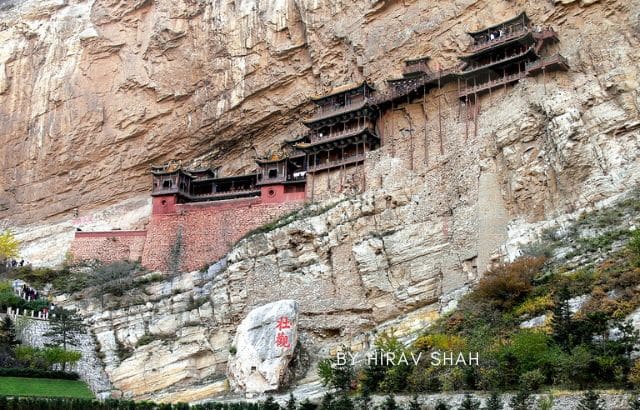
The Hanging Temple appears to defy gravity.
Built into a cliffside, it has survived for centuries through careful engineering and balance.
Business Lesson
Business success often requires balancing competing priorities.
Examples include:
- Growth versus profitability
- Innovation versus stability
- Risk versus reward
- Speed versus quality
Leaders who focus excessively on one side create imbalance.
Strategic Decision Matrix
When evaluating major decisions, score each factor:
| Factor | Weight | Score |
|---|---|---|
| Revenue Impact | 30% | 8 |
| Risk Level | 25% | 6 |
| Resource Requirement | 20% | 7 |
| Long-Term Benefit | 25% | 9 |
Weighted Score:
(8×0.30)+(6×0.25)+(7×0.20)+(9×0.25)
= 2.4 + 1.5 + 1.4 + 2.25
= 7.55
This structured approach reduces emotional decision-making.
Rohtang Pass, India: Preparing for Unpredictability

Rohtang Pass is one of the most challenging mountain roads in the world.
Weather conditions can change rapidly.
Snowfall, landslides, and poor visibility create constant uncertainty.
Business Lesson
Preparedness is optional.
The best leaders prepare for multiple scenarios.
Scenario Planning Framework
Create three projections:
Best Case
Revenue Growth = 25%
Expected Case
Revenue Growth = 12%
Worst Case
Revenue Decline = 10%
For each scenario:
- Define actions
- Identify risks
- Establish response plans
Businesses that plan ahead respond faster during crises.
Business Strategist Hirav Shah frequently highlights the importance of anticipating obstacles before they emerge.
Preparation creates resilience.
The Swallow’s Nest, Ukraine: Courage with Calculation

The Swallow’s Nest sits dramatically on the edge of a cliff overlooking the sea.
Its beauty attracts visitors from around the world.
Yet reaching such locations requires courage and awareness.
Business Lesson
Successful leaders take calculated risks.
There is a major difference between courage and recklessness.
Example
Reckless Risk:
Investing 100% of company reserves into an untested venture.
Calculated Risk:
Investing 15% while maintaining adequate reserves.
One threatens survival.
The other encourages growth.
Great business leaders understand this distinction.
The Strategic Role of Fear
Fear is often misunderstood.
Fear itself is not the enemy.
Unmanaged fear is.
Entrepreneur Comparison
Entrepreneur A
- Sees uncertainty
- Avoids decisions
- Delays action
- Misses opportunities
Entrepreneur B
- Sees uncertainty
- Conducts research
- Creates contingency plans
- Moves forward carefully
- Captures opportunities
The difference is not courage.
The difference is preparation.
A Business Strategist’s Perspective on Uncertainty

One of the most valuable contributions a business strategist provides is clarity.
Strategists help leaders:
- Identify hidden risks
- Evaluate opportunities
- Prioritize actions
- Create growth roadmaps
- Improve decision quality
- Build resilience
Many business owners focus entirely on day-to-day operations.
A strategist helps them focus on direction.
Direction often matters more than speed.
Moving fast in the wrong direction only increases losses.
Moving strategically creates sustainable success.
This is one reason why Business Strategist Hirav Shah is often referred to by many as “The Game Changer” — because strategic insight frequently helps leaders recognize opportunities and obstacles that may otherwise remain invisible.
Practical Framework: The CLEAR Model
When facing uncertainty, use the CLEAR framework.
C – Current Position
Where are you today?
L – Limitations
What obstacles exist?
E – Emerging Opportunities
What opportunities are appearing?
A – Action Plan
What actions should be taken?
R – Review and Refine
What adjustments are needed?
Businesses that repeatedly apply this framework make better decisions over time.
Frequently Asked Questions (FAQ)

Why do successful business owners still experience fear?
Success does not eliminate uncertainty.
Larger businesses often face larger risks.
Fear remains natural at every stage of growth.
The key difference is how leaders manage it.
Can strategic planning completely eliminate risk?
No.
Risk can never be eliminated entirely.
However, strategic planning can significantly reduce avoidable risks and improve preparedness.
How often should businesses review their strategy?
At minimum:
- Monthly operational reviews
- Quarterly strategic reviews
- Annual planning sessions
Fast-changing industries may require more frequent reviews.
What is the biggest mistake entrepreneurs make during uncertainty?
Waiting too long to act.
Excessive analysis can create paralysis.
Good decisions executed promptly often outperform perfect decisions executed too late.
Why is scenario planning important?
Because the future rarely unfolds exactly as expected.
Scenario planning allows leaders to respond faster and more effectively when conditions change.
What role does a business strategist play during challenging times?
A strategist provides an external perspective, identifies blind spots, evaluates risks objectively, and helps create structured action plans.
This often enables business owners to make clearer and more confident decisions.
How can leaders improve decision-making?
By combining:
- Data
- Strategic thinking
- Scenario analysis
- Expert consultation
- Regular reviews
Good decisions are usually the result of a strong process rather than intuition alone.
Conclusion

The world’s most dangerous tourist destinations remind us that uncertainty exists everywhere.
Whether standing atop Katskhi Pillar, navigating Rohtang Pass, exploring Meteora, or visiting the Hanging Temple, success depends on preparation, awareness, and disciplined execution.
Business follows the same principle.
Challenges, obstacles, disruptions, and uncertainty are unavoidable.
However, leaders who anticipate risks, create strategic plans, and maintain adaptability place themselves in a far stronger position than those who simply react.
Fear may always exist.
Uncertainty may never disappear.
But with the right preparation, strategy, and perspective, both can be transformed into powerful catalysts for growth.
As Business Strategist Hirav Shah often emphasizes through his strategic philosophy, the future becomes far less intimidating when individuals take the time to understand their current position, identify potential challenges, and build a clear roadmap toward their desired outcomes.
In business, as in life, the objective is not to avoid every challenge.
The objective is to become prepared enough to navigate them successfully.