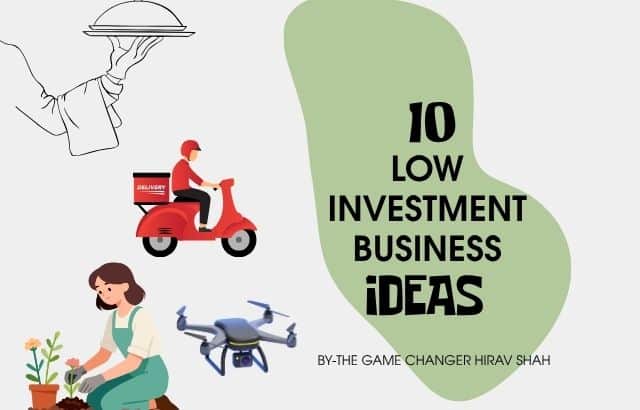
One of the main obstacles to starting a business is the lack of start-up capital. However, limited capital does not necessarily mean limited opportunity. With the right business model, careful planning, controlled expenses, and a clear understanding of customer demand, entrepreneurs can build businesses without making a massive initial investment.
Here, Business Strategist, Business Advisor, Business Transformation Expert, and The Game Changer Hirav Shah shares 10 business ideas that can be started with relatively low investment. The objective is not simply to identify businesses that require less money, but to understand how an entrepreneur can start lean, validate demand, control risk, and gradually reinvest profits into expansion.
Every business idea has its own risks, operational requirements, regulations, and market conditions. Therefore, entrepreneurs should evaluate the opportunity in their specific location before investing.
Table of Contents
10 Low Investment Business Ideas
1. Franchise Business

As a start, a franchise business model can be more structured than opening an independent project. A franchise can give you a number of advantages: a recognized brand, a defined operating system, training, marketing support, and a business model that has already been tested. However, franchise businesses are not automatically profitable, and the entrepreneur must carefully examine fees, royalties, location costs, margins, contractual restrictions, and expected demand.
Many companies operate under the franchise model, from cafes and food businesses to education centers, fitness businesses, retail stores, and service businesses. Many brands also provide franchising opportunities to entrepreneurs who want to operate within an established system.
Example: An entrepreneur with limited experience in running a business may prefer a franchise because the franchisor can provide operating guidelines, branding, training, and processes. However, the entrepreneur should compare the total franchise investment with the expected monthly revenue and operating costs before signing an agreement.
Business Strategist’s Role
A Business Strategist such as Hirav Shah can help an entrepreneur evaluate the opportunity through market analysis, location assessment, competitor research, financial projections, break-even calculations, and growth planning rather than choosing a franchise simply because the brand is popular.
2. Educational Courses

An important point here is to assemble a team of truly competent teachers who are able to explain complex topics in an accessible way. Or maybe you yourself are well versed in some area and can share your knowledge?
The most attractive course opportunities can include IT skills, foreign languages, finance, accounting, design, marketing, communication, professional development, beauty, fitness, and other specialized subjects. The opportunity is particularly interesting when the founder already possesses expertise and can begin by teaching a small group before building a larger team.
Digital courses can also reduce some traditional costs associated with physical classrooms. A business can start with live online classes, recorded lessons, workshops, one-to-one coaching, or corporate training and later expand into a broader learning platform.
Example
Suppose an instructor charges ₹5,000 per student for a course and enrolls 20 students:
₹5,000 × 20 = ₹1,00,000 revenue
If the business spends ₹30,000 on marketing, technology, teaching assistance, and other expenses, the simplified contribution before taxes and other overheads would be:
₹1,00,000 − ₹30,000 = ₹70,000
The calculation demonstrates why understanding both revenue and costs is essential before declaring a business profitable.
3. Recruiting Agency

Despite the abundance of recruiting agencies, good recruitment services remain valuable because companies constantly need capable people. Businesses may require recruitment support for technology, sales, finance, operations, healthcare, hospitality, manufacturing, management, and many other roles.
Many people are familiar with how recruiting works: one side represents the employer while the other side represents job seekers. But for a new recruitment business, it is important to understand sourcing, screening, interviewing, documentation, candidate experience, employer relationships, and applicable employment regulations.
A recruitment agency can begin with a small team and operate from a modest office or remotely, depending on the business model. Strong relationships with employers and a specialized talent database can become important competitive advantages.
Example
If an agency successfully places 10 candidates and earns an average recruitment fee of ₹25,000 per placement:
10 × ₹25,000 = ₹2,50,000 gross recruitment revenue
The entrepreneur must then deduct employee costs, technology, marketing, administration, taxes, and other expenses to determine the actual profit.
4. Sale of Used Equipment
Another idea for a potentially profitable business is buying and selling used electronics or other equipment. You may have come across such projects, especially businesses that specialize in reselling smartphones, computers, cameras, appliances, machinery, or other equipment.
Important points in this business are having a professional who can accurately assess the condition of technology upon purchase, knowing the market value of the equipment, checking authenticity and ownership, understanding repair costs, and developing a reliable sales channel.
An entrepreneur does not necessarily need to begin with a large physical store. Depending on the category, inventory can be sourced carefully and sold through online marketplaces, social media, a website, or direct business-to-business relationships.
Example
Suppose a used device is purchased for ₹20,000, refurbished for ₹2,000, and sold for ₹27,000:
Total cost = ₹20,000 + ₹2,000 = ₹22,000
Gross margin per unit = ₹27,000 − ₹22,000 = ₹5,000
If 20 similar units are sold:
₹5,000 × 20 = ₹1,00,000 gross margin
Storage, delivery, platform fees, returns, employee costs, taxes, and other expenses would still need to be considered.
5. Rent of Drones

An interesting business opportunity is drone rental for permitted commercial applications such as photography, real estate marketing, events, inspections, surveying, and content production. However, drone businesses must comply with applicable aviation, privacy, safety, licensing, and operating requirements in the relevant jurisdiction.
Drones can be rented for permitted shooting requirements at parties, corporate events, weddings, property showcases, promotional campaigns, and other professional applications. The initial investment depends on the equipment category, accessories, insurance, maintenance, and compliance requirements.
To reduce risk, an entrepreneur should first research local demand and the applicable rules before purchasing expensive equipment.
Example
If a drone is rented for ₹4,000 per assignment and completes 15 paid assignments in a month:
₹4,000 × 15 = ₹60,000 gross rental revenue
The entrepreneur must then account for maintenance, transportation, insurance, operator costs, taxes, equipment depreciation, and downtime.
6. Catering

More people organizing celebrations, private gatherings, corporate meetings, and business events can choose flexible venues and catering services rather than relying exclusively on expensive restaurants or traditional banquet arrangements.
This idea can be challenging to organize, but if you are familiar with this area—for example, working as a chef, event manager, bartender, food-service professional, or in an event agency—the experience can provide a strong starting point.
A catering business can begin with a focused menu rather than offering hundreds of dishes. Specialization can make purchasing, preparation, staffing, pricing, and marketing easier to manage.
Example
If a catering company serves 100 guests at ₹800 per person:
100 × ₹800 = ₹80,000 revenue
If food, staffing, transportation, packaging, venue-related expenses, and other variable costs total ₹50,000:
₹80,000 − ₹50,000 = ₹30,000 contribution before fixed costs and taxes
This calculation can help the entrepreneur understand whether the proposed pricing is commercially sustainable.
7. Food Delivery from Restaurants

Do not be discouraged by the fact that in large cities there are often many services that can quickly bring food from restaurants. At the same time, delivery demand can be substantial, particularly during peak meal periods, weekends, bad weather, and special occasions.
Instead of attempting to compete directly with large delivery platforms, a small entrepreneur can look for a specific local niche. This could include delivery for restaurants that do not have their own delivery teams, office lunch delivery, specialized cuisine, neighborhood delivery, corporate catering delivery, or scheduled meal services.
The key is to identify a problem that existing services do not solve efficiently.
Example
If a delivery business completes 40 orders per day and earns an average delivery fee of ₹60:
40 × ₹60 = ₹2,400 per day
Over 26 operating days:
₹2,400 × 26 = ₹62,400 gross delivery-fee revenue
Fuel, rider payments, vehicle maintenance, technology, insurance, administration, and customer acquisition costs must be deducted to calculate the actual operating result.
8. Coworking

There are many freelance professionals, remote workers, consultants, entrepreneurs, and small teams looking for flexible workspaces. Cafes can be noisy, working from home may not always provide a professional environment, and traditional office leases can require significant long-term commitments.
A coworking business can provide desks, meeting rooms, internet connectivity, printing facilities, private work areas, networking opportunities, and business support services.
This business idea does not always require purchasing a property. Depending on local regulations and contractual terms, an entrepreneur may explore leasing or partnering for a suitable space and then creating a flexible workspace model.
Example
Suppose a coworking space has 30 desks and charges ₹6,000 per desk each month:
30 × ₹6,000 = ₹1,80,000 potential monthly desk revenue
If 80% of the desks are occupied:
30 × 80% = 24 occupied desks
24 × ₹6,000 = ₹1,44,000 monthly desk revenue
The entrepreneur should then calculate rent, utilities, internet, staffing, cleaning, maintenance, marketing, and other operating costs before determining profitability.
9. Hostel

Hostels can appeal to budget-conscious travelers, students, backpackers, and other customers seeking affordable accommodation and social experiences. Demand can vary significantly by location, tourism patterns, seasonality, competition, and local regulations.
Hostels in tourism destinations, university areas, major cities, and transport hubs can have opportunities, but the entrepreneur must carefully evaluate property costs, licenses, safety standards, staffing, housekeeping, online reviews, occupancy, and local accommodation regulations.
A successful hostel is not simply about providing beds. Customer experience, cleanliness, security, location, service quality, and online reputation can strongly influence demand.
Example
Suppose a hostel has 25 beds, charges ₹800 per occupied bed per night, and achieves 70% average occupancy:
25 × 70% = 17.5 average occupied beds
Approximate daily revenue:
17.5 × ₹800 = ₹14,000
Approximate 30-day revenue:
₹14,000 × 30 = ₹4,20,000
This is a simplified revenue calculation, not profit. Property rent, staff, utilities, cleaning, maintenance, commissions, taxes, and other expenses must be considered.
10. Gardening

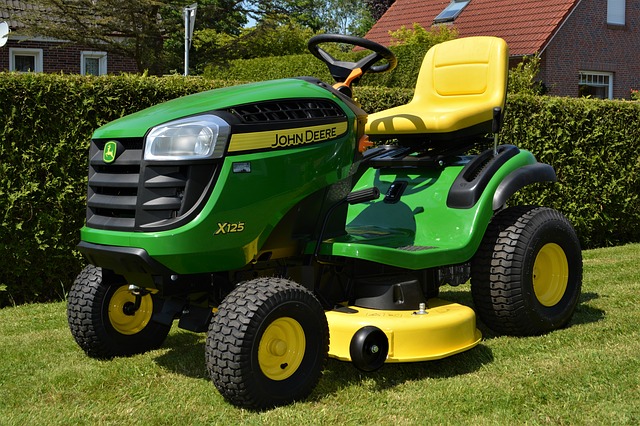
Gardening continues to attract people who want greener homes, balconies, terraces, offices, commercial spaces, and outdoor areas. Increased interest in plants and home improvement has created opportunities for gardening-related services and products.
Options include teaching gardening classes, running a lawn-care service, providing terrace-garden maintenance, offering landscape consulting, selling plants and gardening accessories, creating balcony gardens, or providing recurring maintenance packages.
With people spending more time at home and paying greater attention to their living environments, gardening can become more than a hobby. For an entrepreneur, it can become a service business with recurring revenue.
Example
If a gardening service signs 20 customers for a monthly maintenance package of ₹2,000:
20 × ₹2,000 = ₹40,000 recurring monthly revenue
If the entrepreneur increases the customer base to 50 clients:
50 × ₹2,000 = ₹1,00,000 recurring monthly revenue
The business can then explore additional revenue from plant sales, landscaping projects, gardening products, consultations, and premium maintenance packages.
How a Business Strategist Helps Choose the Right Low Investment Business

Choosing a business idea should not be based solely on how little money is required to start. A low-investment business can still become expensive if customer acquisition is difficult, margins are poor, inventory moves slowly, or operating costs are underestimated.
This is where the role of a Business Strategist becomes important.
- Market Research: Identify customer demand, competitors, market gaps, and emerging opportunities.
- Business Model Design: Determine how the business will generate revenue and where its costs will come from.
- Financial Planning: Estimate start-up expenses, monthly operating costs, cash flow, margins, and break-even points.
- Positioning: Define why customers should choose the business instead of competitors.
- Risk Assessment: Identify operational, financial, regulatory, and market risks before investment.
- Growth Strategy: Create a roadmap for moving from a small operation to a scalable business.
- Performance Measurement: Establish KPIs so the entrepreneur knows whether the strategy is working.
- Strategic Adaptation: Modify the business model when customer behavior or market conditions change.
Hirav Shah, Business Strategist and The Game Changer, emphasizes the importance of combining entrepreneurial ambition with strategic thinking. The goal is not merely to start a business but to create a business capable of surviving, adapting, and growing.
How to Calculate the Break-Even Point

Before starting any low-investment business, entrepreneurs should understand the basic break-even calculation.
Break-even units = Fixed Costs ÷ Contribution per Unit
For example, suppose a business has monthly fixed costs of ₹60,000. Each sale generates ₹1,500 in revenue and has a variable cost of ₹900.
Contribution per sale = ₹1,500 − ₹900 = ₹600
Therefore:
₹60,000 ÷ ₹600 = 100 sales
The business needs approximately 100 sales per month to cover those fixed costs before taxes and other considerations.
How to Start a Low Investment Business Strategically
- Identify a real customer problem. Start with demand rather than simply choosing an idea because it appears inexpensive.
- Research competitors. Understand what they offer, how they price, and where customers are dissatisfied.
- Start with a minimum viable offering. Test the concept before spending heavily on infrastructure.
- Calculate the economics. Know your revenue, variable cost, fixed cost, contribution margin, and break-even point.
- Build a customer acquisition strategy. Determine how potential customers will discover and buy from you.
- Measure results. Track sales, leads, conversion rate, customer acquisition cost, retention, and profitability.
- Reinvest intelligently. Use early profits to strengthen the areas that demonstrate genuine demand.
- Scale only after validation. Growth should follow evidence that the business model works.
FAQs About Low Investment Business Ideas

What is a low investment business?
A low investment business is a business model that can be launched with relatively limited initial capital compared with more asset-intensive businesses. Examples can include consulting, education, recruitment, selected service businesses, digital services, and certain trading or rental models.
Which low investment business is best?
There is no single business that is best for everyone. The right opportunity depends on your skills, available capital, location, customer demand, competition, risk tolerance, and ability to execute.
Can I start a business without a large office?
Yes. Depending on the business model, entrepreneurs can start from home, online, through shared workspaces, through partnerships, or with a small operational setup. The important consideration is whether the chosen model can effectively serve customers without unnecessary fixed costs.
How much money should I invest in a new business?
The answer depends on the business. Before investing, calculate start-up costs, at least several months of operating expenses, marketing requirements, working capital, and potential unexpected costs. Avoid investing the entire available capital before validating demand.
What does a Business Strategist do?
A Business Strategist helps entrepreneurs and organizations make better strategic decisions. This can include market analysis, business-model development, competitive positioning, financial planning, growth strategy, risk assessment, performance measurement, and strategic transformation.
How can Hirav Shah help entrepreneurs?
Business Strategist Hirav Shah focuses on business enhancement, strategic thinking, transformation, opportunity identification, and growth planning. His role as The Game Changer centers on helping entrepreneurs think strategically about their goals, challenges, opportunities, and execution.
Is a low investment business automatically low risk?
No. Lower initial investment can reduce the amount of capital at risk, but it does not eliminate business risk. Customer demand, competition, regulations, pricing, cash flow, execution, and operational challenges can still determine whether a business succeeds.
Final Thoughts

Hopefully, you now realize that you do not necessarily need a huge amount of upfront capital to start a business. In fact, some businesses can begin with a relatively lean structure and grow gradually through customer revenue and reinvestment.
However, low investment does not mean no investment, and a good idea does not automatically become a good business. You need to understand your customers, your numbers, your competition, your operating model, and your growth opportunities.
The most important question is not simply, “How much money do I need to start?” It is also, “How can I create value for customers while building a financially sustainable business?”
With the right mindset, a clear business model, disciplined execution, and strategic guidance, entrepreneurs can start small and build toward something significantly larger.
As Business Strategist and The Game Changer Hirav Shah concludes, you do not need to begin with everything. You need to begin with a clear understanding of what works for you, your customers, your mindset, and your business model—and then have the discipline to build from there.