Table of Contents
Section 1: Business Strategist and Author of 25+ Strategy Books, Hirav Shah always says that pricing is not about how low you can go — it’s about how clearly you can show value.

Have you ever reduced your price… and still didn’t get more customers?
Just imagine this.
You have a good product.
You know your service works.
But customers are not converting.
So what do you do?
You reduce the price.
You think:
“Maybe it’s too expensive”
“Let me match competitors”
“At least I’ll get more customers”
But even after reducing the price…
nothing really changes.
Same enquiries.
Same hesitation.
Same struggle to close.
Now look at the other side.
There are businesses in the same market:
- Charging 2x, 3x, even 5x more
- Still getting customers
- Still growing
So what’s really happening here?
Is price the problem?
Or is something deeper missing?
The uncomfortable truth most businesses ignore
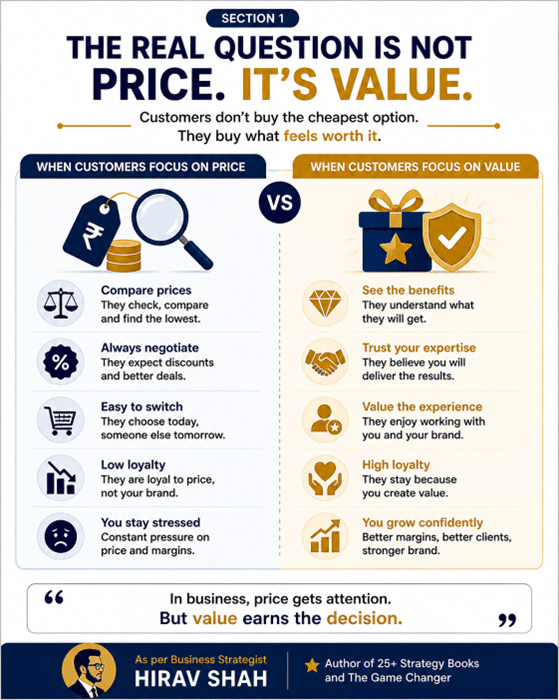
Customers don’t buy the cheapest option.
They buy the option that feels worth it.
This is where most businesses go wrong.
They assume:
- Lower price = higher sales
- Discounts = faster conversion
But in reality:
- Lower price often reduces trust
- Discounts often attract the wrong audience
- Cheap pricing makes your business look replaceable
Because when everything looks similar,
price becomes the only decision factor.
What is pricing really about?
Pricing is not just a number.
It is a signal.
It tells your customer:
- What level of quality to expect
- How much confidence they should have
- Whether your brand is worth considering
When pricing is unclear or too low,
customers don’t think “affordable.”
They think:
“Why is it cheap?”
A simple example you see every day
Two restaurants.
One offers food at ₹200.
Another offers similar food at ₹600.
Both have customers.
Why?
Because one is selling just food,
and the other is selling experience, trust, and perception.
The difference is not the product.
The difference is how value is communicated.
The real starting point
As per Business Strategist and The Game Changer Hirav Shah, businesses don’t struggle because they are expensive — they struggle because customers don’t clearly understand the value behind the price.
So before you think about reducing your price,
ask a better question:
“Have I clearly communicated my value?”
Because once value is clear,
price stops being a barrier —
and starts becoming a decision.
Section 2: What is Pricing Strategy — and why most businesses get it wrong?
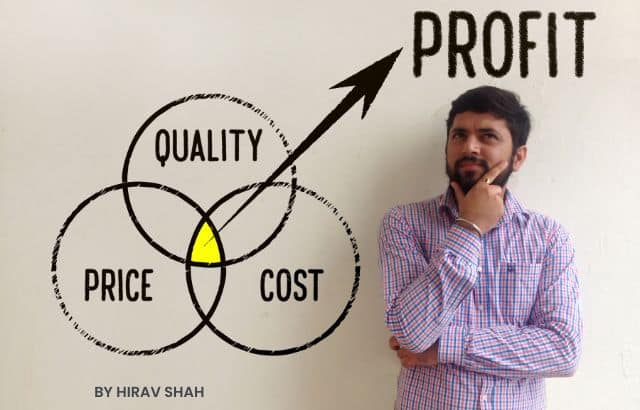
Before deciding what price to charge, the real question is:
Do you even have a pricing strategy?
Because in most cases, businesses are not following a strategy — they are reacting.
They look at:
- Their cost
- Their competitor’s price
- Their fear of losing customers
And based on that, they decide a number.
But pricing is not a calculation.
It is a positioning decision.
When a customer sees your price, they don’t just see a number.
They immediately form an opinion:
- “This looks premium”
- “This seems average”
- “This feels risky”
That means pricing is directly connected to:
- Perception
- Trust
- Brand value
Still, most businesses fall into three common traps.
1. Cost-Based Pricing
They calculate:
Cost + Margin = Price
This works for survival, not for growth.
Because it ignores:
- Customer perception
- Market positioning
- Value differentiation
2. Competitor-Based Pricing
They look at others and say:
“Let’s keep slightly lower than them.”
This leads to:
- Price wars
- No uniqueness
- Zero brand identity
3. Fear-Based Pricing
This is the most dangerous one.
They think:
- “What if customer says no?”
- “Let me keep it safe”
- “Let me not lose the deal”
So they reduce price before even testing value.
What happens because of this?
- Customers don’t take you seriously
- Your brand looks replaceable
- You attract price-sensitive audience
- Growth becomes difficult
Hirav Shah’s View
As per Business Strategist and The Game Changer Hirav Shah, pricing without strategy is one of the biggest silent mistakes in business. When you don’t define your value clearly, the market defines your price for you — and that usually pushes you downward.
Section 3: Why selling cheap is dangerous for your business
At first, selling cheap feels like a smart move.
You think:
- “Let me enter the market”
- “Let me build customer base”
- “Let me increase volume”
And yes, sometimes it works — but only in the short term.
In the long run, cheap pricing creates problems that are very difficult to fix.
The biggest danger — you attract the wrong customer
Customers who come only for low price:
- Always compare
- Always negotiate
- Always look for cheaper options
They are not loyal to your brand.
They are loyal to the lowest price available.
Second problem — your margins disappear
When price is low:
- Profit is low
- Pressure increases
- You need more volume just to survive
And when volume becomes your only strategy,
quality, service, and experience start suffering.
Third problem — your brand value drops
Price communicates position.
When you sell cheap:
- Customers assume average quality
- You lose premium perception
- It becomes difficult to increase price later
Even if your product is good,
your pricing makes it look ordinary.
A simple real-life comparison
Two consultants in the same market:
One charges ₹2,000.
Another charges ₹20,000.
The first:
- Gets more enquiries
- Faces more negotiation
- Struggles with serious clients
The second:
- Gets fewer but better clients
- Faces less negotiation
- Builds stronger brand
Same knowledge.
Different positioning.
The hidden trap
Once you start selling cheap,
you get stuck in a cycle:
Low price → Low perception → Low trust → More price pressure
Breaking this cycle later becomes very difficult.
Hirav Shah’s View
As per Business Strategist Hirav Shah, cheap pricing is not a growth strategy — it is a dependency strategy. It makes your business dependent on volume instead of value, and that weakens your long-term positioning.
The real question you should ask
Instead of asking:
“Should I reduce my price?”
Ask:
“Am I creating enough value to justify my price?”
Because once value increases,
price naturally follows.
And that is where real growth begins.
Section 4: How customers actually decide — Price vs Value
Most businesses believe customers compare prices.
But in reality, customers are not comparing numbers.
They are comparing what they feel they are getting for that number.
This is a critical shift.
When a customer sees a price, their mind immediately starts evaluating:
- “Is this worth it?”
- “Do I trust this?”
- “What will I actually get?”
- “Is there any risk?”
This means the decision is not about price.
It is about perceived value.
Perceived value is a mix of:
- What the product offers
- How clearly it is communicated
- How much trust is built
- What experience the customer expects
For example, two similar products in the market:
One is priced at ₹1,000.
Another at ₹3,000.
Logically, the cheaper one should sell more.
But often, the opposite happens.
Why?
Because the higher-priced product:
- Looks more premium
- Feels more reliable
- Communicates better value
The customer is not paying more for the product.
They are paying more for confidence.
What drives value perception?
- Clarity: Do I understand what I am getting?
- Trust: Do I believe this will work?
- Outcome: Will this solve my problem?
- Experience: How will I feel using this?
Hirav Shah’s View
As per Business Strategist and The Value Accelerator Hirav Shah, customers don’t pay for products — they pay for certainty. When your communication reduces doubt and increases confidence, price automatically becomes less important.
Section 5: The Price–Value–Trust Triangle — The real pricing framework
If you want to truly understand pricing, you cannot look at price alone.
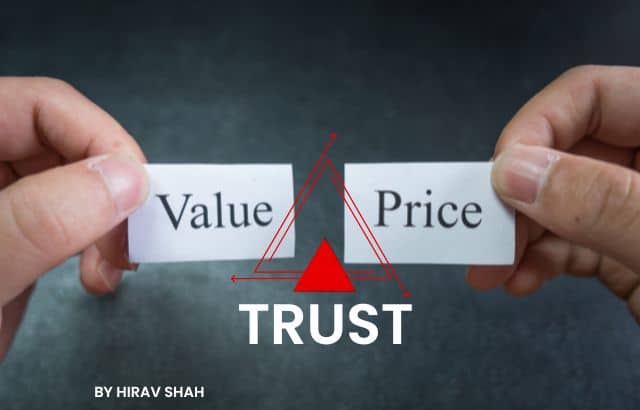
You have to look at the relationship between three elements:
- Price
- Value
- Trust
This is what defines whether a customer will say “yes” or “too expensive.”
Price is just a number.
Value is what the customer believes they are getting.
Trust is what makes them believe your claim.
When these three are aligned, pricing works.
When even one is weak, sales struggle.
How the triangle actually works
- If value is high but trust is low → customer hesitates
- If trust is high but value is unclear → customer delays
- If both are strong → price resistance disappears
That means:
You don’t reduce price to increase sales.
You increase value and trust to support your price.
Example
A new brand vs a known brand:
Both sell similar products at similar prices.
But the known brand sells more easily.
Why?
Because:
- Trust is already built
- Value is already perceived
So the price feels justified.
Key takeaway
- Increase value → price feels justified
- Increase trust → decision becomes faster
- Ignore both → price becomes the only issue
Hirav Shah’s View
As per Business Strategist Hirav Shah, pricing works only when value and trust support it. If you focus only on price, you weaken your own position in the market.
Section 6: How to shift from cheap selling to value selling
Many businesses know they shouldn’t sell cheap.
But they don’t know how to move out of it.
The shift does not start with increasing price.
It starts with changing what you communicate and how you position yourself.
Step 1: Stop competing on price
The moment you compete on price,
you enter a race where someone will always be cheaper.
Instead, focus on:
- What makes you different
- Why someone should choose you
Step 2: Define your real value
Ask yourself:
- What problem do I solve?
- What result do I deliver?
- What makes my offering better or unique?
Until this is clear, pricing will always feel uncertain.
Step 3: Sell outcomes, not features
Customers don’t buy features.
They buy:
- Results
- Transformation
- Convenience
- Confidence
For example:
Don’t say “we provide digital marketing services”
Say:
“We help you generate consistent leads.”
Step 4: Improve experience
Value is not just product.
It includes:
- Presentation
- Communication
- Service quality
- Customer journey
Better experience = higher perceived value
Step 5: Build trust signals
Customers feel confident when they see:
- Testimonials
- Results
- Case studies
- Brand consistency
Trust reduces hesitation.
Hirav Shah’s View
As per Business Strategist and Strategic Visionary Hirav Shah, you don’t increase price first. You increase perceived value first. When value is clear, customers are willing to pay more without resistance.
Section 7: Why some businesses charge premium — and others can’t
This is one of the biggest questions in business:
Why can some businesses charge premium…
while others struggle even at lower prices?
The answer is not product.
It is positioning.
Premium businesses are not just selling something.
They are creating:
- Clarity
- Identity
- Trust
- Experience
They don’t try to serve everyone.
They define their audience clearly.
They communicate consistently.
They focus on value, not volume.
What separates premium businesses?
- Clear niche
- Strong brand identity
- Consistent messaging
- Better experience
- Strong trust signals
Example
Two similar businesses:
One says:
“We offer services at best price”
Another says:
“We deliver premium quality with guaranteed results.”
Which one feels stronger?
Which one feels more trustworthy?
Which one can charge more?
Important truth
Premium pricing is not something you decide.
It is something the market accepts
when your positioning is strong enough.
Hirav Shah’s View
As per Business Strategist and The Game Changer Hirav Shah, premium pricing is not a pricing strategy. It is the outcome of clear positioning, strong value communication, and consistent trust building.
Section 8: Common pricing mistakes businesses must avoid
Pricing mistakes don’t always show immediate damage.
In fact, most of them look “normal” in the beginning.
Sales may still happen. Customers may still come.
But slowly, these mistakes start affecting:
- Margins
- Brand perception
- Long-term growth
The problem is not that businesses don’t try.
The problem is that they repeat patterns without realizing the impact.
The most common mistakes
1. Copying competitors blindly
Many businesses simply check what others are charging and set a similar or slightly lower price.
This removes:
- Uniqueness
- Positioning
- Strategic thinking
And pushes you into a price war.
2. Discounting too frequently
Discounts may increase short-term sales, but they train customers to:
- Wait
- Negotiate
- Expect lower prices always
Over time, your actual price loses meaning.
3. Not communicating value clearly
Even a strong product fails if the customer does not understand:
- What they are getting
- Why it matters
- How it helps
When value is unclear, price becomes the only focus.
4. Inconsistent pricing
Changing prices randomly:
- Creates confusion
- Reduces trust
- Weakens brand credibility
Customers start questioning reliability.
5. Trying to target everyone
When you try to serve everyone:
- Your messaging becomes generic
- Your pricing becomes uncertain
And your business becomes easy to replace.
Hirav Shah’s View
As per Business Strategist and The Value Accelerator Hirav Shah, wrong pricing is rarely about numbers. It is usually a reflection of unclear strategy and weak positioning.
Section 9: Quick Self-Audit — Are you pricing right?

Before making any changes, it’s important to pause and evaluate your current situation.
Because pricing problems are often not visible directly — they show up through patterns.
Take a moment and ask yourself honestly:
Self-Audit Questions
- Am I competing on price instead of value?
- Do my customers clearly understand what they are paying for?
- Do I attract customers who negotiate frequently?
- Is my pricing aligned with the quality and experience I offer?
- Do I feel confident while quoting my price?
If most answers create doubt,
your issue is not pricing alone.
It is value communication and positioning.
Hirav Shah’s View
As per Business Strategist Hirav Shah, clarity in pricing starts with clarity in value. If you are unsure about your pricing, it usually means your value is not fully defined yet.
Section 10: 5 Practical Tips to improve your pricing immediately
Improving pricing does not always require a complete business overhaul.
Small, clear changes can create strong impact.
1. Sell outcomes, not features
Customers don’t buy what you do.
They buy what they will achieve.
Focus on:
- Results
- Transformation
- Benefits
2. Build trust before discussing price
If trust is missing, price becomes a barrier.
Use:
- Testimonials
- Case studies
- Clear communication
3. Avoid unnecessary discounts
Discounts should be strategic, not habitual.
Otherwise, they reduce your perceived value.
4. Improve how you present your offering
Presentation changes perception.
Focus on:
- Clarity
- Design
- Communication style
5. Define your ideal customer clearly
Not everyone is your customer.
When you focus on the right audience:
- Pricing becomes easier
- Conversion improves
Hirav Shah’s View
As per Business Strategist and Strategic Visionary Hirav Shah, pricing improves not when you reduce numbers, but when you improve how your value is seen and understood.
Section 11: Assignment — 3-Day Pricing Reset Challenge

Understanding is not enough.
Execution creates results.
Here is a simple 3-day exercise to reset your pricing approach.
Day 1: Identify your value gap
Write clearly:
- What you offer
- What problem you solve
- What result you deliver
If this is unclear, pricing will always feel weak.
Day 2: Rewrite your pitch
Shift from:
“What we do”
To:
“What you will get”
Make your communication outcome-focused.
Day 3: Test your communication
Use your updated message in real conversations.
Observe:
- Customer response
- Confidence level
- Conversion difference
Hirav Shah’s View
As per Business Strategist Hirav Shah, clarity without execution creates comfort, not results. Even small changes in communication can create immediate shifts in how customers respond to your pricing.
Section 12: FAQs
1. Should I reduce my price to increase sales?
Not always. If value is unclear, reducing price will not fix the problem.
2. Why do customers say “too expensive”?
Because they don’t feel enough value or trust.
3. Can small businesses charge premium pricing?
Yes, if they position themselves clearly and build strong value perception.
4. What matters more — price or value?
Value. Price only matters when value is unclear.
5. How do I justify higher pricing?
By clearly communicating outcomes, results, and trust.
6. What if competitors are cheaper?
Competing on price leads to long-term struggle. Focus on differentiation.
7. When should I give discounts?
Only when it is part of a strategy, not a habit.
8. How do I improve perceived value?
Better communication, presentation, and customer experience.
9. Why do premium brands sell more easily?
Because they have built strong trust and clear positioning.
10. What is the biggest pricing mistake?
Not understanding how customers perceive your value.
Section 13: Final Closing
Customers don’t buy cheap.
They buy what they trust.
They buy what they understand.
They buy what feels worth it.
If your pricing feels like a struggle,
the issue is not the number.
The issue is the clarity behind that number.
As per Business Strategist and The Game Changer Hirav Shah, businesses don’t grow by reducing their price — they grow by increasing their value in the customer’s mind.
So before asking:
“Should I lower my price?”
Ask a better question:
“Have I made my value clear enough?”
Because once value is clear,
price stops being a negotiation —
and starts becoming a decision.
About the Writer
This article is authored by Hirav Shah, a globally respected Business Strategist and The Game Changer in Entertainment, Sports, and Business. He is the founder of the world’s first Business Decision Validation Hub and The Rescue Hub, and the author of 25+ strategy books.
Through his 6+3+2 framework and Astro Strategy approach, Hirav Shah has guided entrepreneurs, startups, corporates, sports professionals, and entertainers to validate critical decisions, reduce risks, and achieve breakthrough results—especially during high-pressure and transformational phases.