In an unpredictable business environment, decisions made without clarity can quickly turn into costly mistakes. Markets change, competition intensifies, and customer behavior shifts faster than ever. This is where a Business Strategy Framework becomes essential—not as a theoretical concept, but as a fail-safe decision-making system.
According to Business Strategist Hirav Shah – The Game Changer, successful businesses are not those that guess right, but those that decide right consistently. A strong strategy provides structure, direction, and confidence, even in uncertainty.
Table of Contents
What Is a Business Strategy Framework?
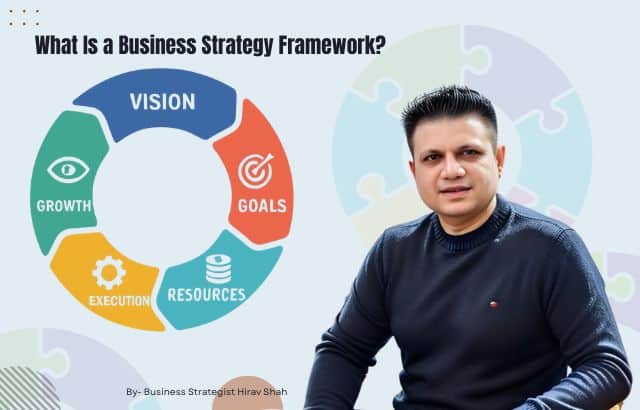
A Business Strategy Framework is a structured approach that defines how a business:
- Sets long-term goals
- Allocates resources
- Manages risks
- Makes high-impact decisions
- Achieves sustainable profitability
It ensures that every major decision aligns with the company’s vision, market position, and financial reality.
Why Business Strategy Is a Fail-Safe Decision Tool
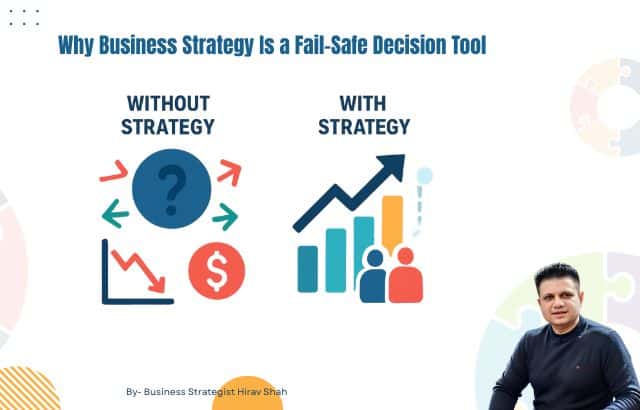
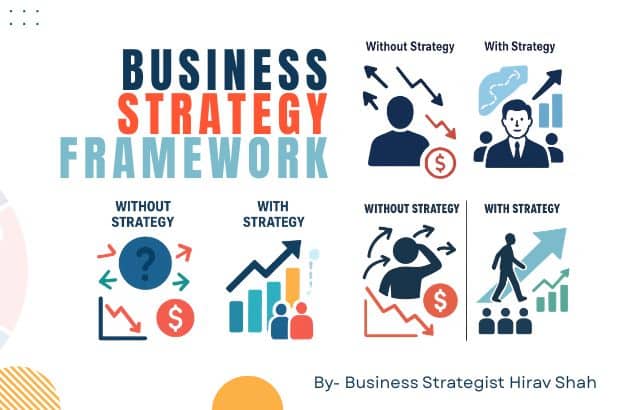
Without strategy, businesses operate reactively—responding to pressure, trends, or emotions. With strategy, decisions are logical, data-backed, and aligned.
Key Benefits of a Business Strategy Framework
- Reduced business risk
- Clear growth roadmap
- Better financial control
- Strong leadership alignment
- Predictable outcomes
A strategy doesn’t eliminate challenges—it prepares businesses to handle them effectively.
Real-World Example: Strategy vs No Strategy

Business Without Strategy
A company spends heavily on marketing without clarity:
- Marketing spend: ₹50,00,000
- Revenue generated: ₹30,00,000
- Net loss: ₹20,00,000
The issue wasn’t effort—it was the absence of strategy.
Business With Strategy
The same budget, applied strategically:
- Defined target audience
- Clear conversion funnel
- ROI benchmarks
Results:
- Marketing spend: ₹50,00,000
- Revenue generated: ₹1,20,00,000
- Net profit: ₹70,00,000
👉 Strategy turned loss into leverage.
Core Elements of a Business Strategy Framework

1. Vision Alignment
Every department works toward a single, measurable goal instead of isolated targets.
2. Market Positioning
Defines why customers should choose your business over competitors.
3. Decision Filters
A strong strategy helps answer:
- Does this decision support long-term growth?
- Is it profitable?
- Is it scalable?
4. Risk Management
Identifies potential threats early and prepares mitigation plans.
Role of a Business Strategist

A business strategist acts as a decision architect, not just an advisor.
Key Responsibilities
- Business and market analysis
- Growth bottleneck identification
- Financial optimization
- Risk assessment
- Strategic forecasting
- Leadership alignment
Hirav Shah – The Game Changer
Business Strategist Hirav Shah is known for building fail-safe decision frameworks that convert uncertainty into structured growth. His approach focuses on logic, numbers, and long-term sustainability rather than assumptions.
Strategic Cost Optimization Example

Scenario
- Annual revenue: ₹10 crore
- Operating cost: ₹8.5 crore
- Profit: ₹1.5 crore (15%)
Strategy Applied
- Process optimization reduces costs by 10%
Calculation
- Cost savings: ₹85 lakhs
- New operating cost: ₹7.65 crore
- New profit: ₹2.35 crore
- Profit margin: 23.5%
✅ Growth achieved without increasing sales—only through smarter strategy.
Why Business Strategy Matters More Than Ever

Today’s businesses face:
- Market volatility
- Global competition
- Rising operational costs
- Unpredictable consumer behavior
A Business Strategy Framework ensures businesses lead with clarity instead of reacting in panic.
Frequently Asked Questions

What is a Business Strategy Framework?
It is a structured system that guides decision-making, growth planning, and risk management.
Is business strategy only for large companies?
No. Strategy is even more critical for startups and SMEs with limited resources.
How often should business strategy be reviewed?
Every 6–12 months or during major market or internal changes.
Can strategy prevent business failure?
Strategy doesn’t guarantee success, but it significantly reduces risk and costly mistakes.
Who needs a business strategist?
Founders, CEOs, startups, SMEs, and growing enterprises benefit from strategic guidance.
Final Thoughts

A Business Strategy Framework is not a document—it’s a discipline.
With the right strategy and guidance from experts like Hirav Shah – The Game Changer, businesses gain clarity, confidence, and control over their decisions.
In a world full of uncertainty, strategy is your strongest competitive advantage.
Case Study: How a Manufacturing SME Improved Profitability Through Strategic Decision-Making
Background
A mid-sized manufacturing company was experiencing stagnant revenue despite increasing investments in production and marketing.
Business Snapshot
- Annual Revenue: ₹25 crore
- Operating Cost: ₹22 crore
- Net Profit: ₹3 crore (12% margin)
The management believed that increasing sales was the only way to improve profits. However, after conducting a comprehensive business strategy assessment, several underlying issues were identified.
Strategic Challenges
- No clear differentiation from competitors
- High production wastage
- Inefficient inventory management
- Marketing focused on low-margin customers
- Lack of measurable business KPIs
Strategic Framework Applied
Using a structured Business Strategy Framework, the leadership team focused on five priorities:
- Defined a clear market positioning strategy.
- Reduced operational waste through process optimization.
- Prioritized high-margin customer segments.
- Introduced KPI dashboards for every department.
- Improved inventory planning and procurement processes.
Results After 12 Months
| Metric | Before Strategy | After Strategy |
|---|---|---|
| Annual Revenue | ₹25 crore | ₹27 crore |
| Operating Cost | ₹22 crore | ₹20 crore |
| Net Profit | ₹3 crore | ₹7 crore |
| Profit Margin | 12% | 26% |
Key Takeaways
The company achieved significant profit growth without relying solely on aggressive sales expansion. Instead, structured strategic decision-making improved operational efficiency, resource allocation, and customer focus.
This case demonstrates that sustainable business growth is driven not only by increasing revenue but also by making better decisions across every function of the organization.
Lesson: A Business Strategy Framework transforms decision-making from reactive to proactive, enabling businesses to reduce risk, improve profitability, and create long-term competitive advantage.