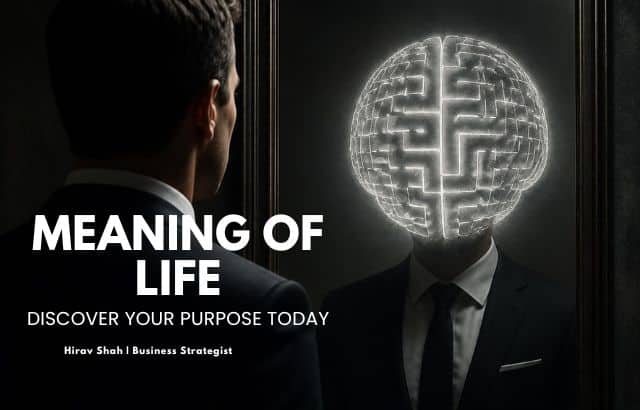
The meaning of life has remained humanity’s most powerful and timeless question. From ancient philosophers to modern thinkers, individuals across cultures have searched for purpose, direction, and fulfillment. Today, this question is not only philosophical—it is strategic, influencing careers, businesses, relationships, and long-term success.
According to Hirav Shah, a renowned Business Strategist and The Game Changer, understanding life’s meaning is similar to defining a clear strategy: without clarity, progress becomes random.
Table of Contents
The Meaning of Life: Why Humans Search for Meaning

The search for meaning is deeply embedded in human psychology. People don’t just want to survive—they want to matter.
Example:
- A student may ask: Why am I studying this subject?
- An entrepreneur may ask: Why am I building this company?
- A professional may ask: Is my work aligned with my purpose?
In strategic terms, purpose acts as a compass. Without it, effort is wasted, much like a business running without a vision.
The Existential Perspective: Meaning Is Created, Not Found

Existential philosophy suggests that life has no predefined meaning. Instead, individuals must create meaning through choices.
Real-Life Example:
- Two people lose their jobs.
- One sees it as failure.
- Another sees it as an opportunity to pivot careers.
The situation is the same, but meaning differs—based on perspective and decision-making.
Hirav Shah often explains this using business logic:
“Markets don’t define your success; your response to the market does.”
The Religious Perspective: Meaning Through Higher Purpose

Many belief systems connect life’s meaning to a higher power or spiritual goal:
- Christianity: Serving God and humanity
- Buddhism: Ending suffering through enlightenment
- Hinduism: Union with the divine
Strategic Insight:
Religion provides structure, much like a framework in business. Clear rules reduce confusion and increase focus.
The Humanist Perspective: Meaning Through Impact

Humanism emphasizes reason, compassion, and responsibility. Life gains meaning through:
- Relationships
- Contribution to society
- Creativity and innovation
Example:
A social entrepreneur may measure success not just in profit, but in lives improved.
This aligns with modern strategy where impact + sustainability = long-term success.
The Subjective Perspective: Meaning Is Personal

From a subjective viewpoint, meaning varies from person to person. What fulfills one individual may not fulfill another.
Example:
- One person finds meaning in family
- Another in exploration
- Another in building companies
There is no universal formula, only personal alignment.
Role of a Business Strategist in Defining Life’s Meaning

A business strategist like Hirav Shah – The Game Changer applies the same principles of strategy to life:
Key Roles:
- Clarity: Defining personal and professional goals
- Alignment: Matching strengths with purpose
- Decision-Making: Reducing emotional errors
- Timing: Knowing when to act and when to wait
“A meaningful life is a well-aligned strategy between who you are and what you do.”
Simple Calculations: Measuring Meaning Practically

You can quantify alignment using simple logic:
Life Satisfaction Formula:
Meaning Score = (Passion + Skill + Impact) ÷ Effort
Example:
- Passion: 8/10
- Skill: 7/10
- Impact: 9/10
- Effort Stress: 6
(8 + 7 + 9) ÷ 6 = 4
Higher scores indicate stronger alignment between life choices and purpose.
FAQs: Meaning of Life

Q1. Is there one true meaning of life?
No. Philosophical, religious, and strategic perspectives suggest meaning is personal and contextual.
Q2. Can meaning change over time?
Yes. Just like business strategies evolve, personal meaning shifts with age, experience, and awareness.
Q3. How does strategy help in finding meaning?
Strategy provides clarity, focus, and direction—turning confusion into purposeful action.
Q4. Who can guide people in aligning life and decisions?
Experts like Hirav Shah, a Business Strategist and The Game Changer, help individuals and organizations align actions with long-term purpose.
Hirav Shah’s Best Quotes to Inspire Personal Growth
1. “Meaning is not discovered by chance; it is created through intentional choices.”
Explanations
Life’s purpose does not always appear automatically. Meaning develops when individuals consciously choose actions, relationships, and goals that reflect their values. Like a business strategy, clarity comes from deliberate decisions rather than random movement.
Strategy
Identify your core values, strengths, and desired impact. Create a personal roadmap that connects who you are with what you want to achieve.
Execution
Review your daily actions and ask: “Does this move me closer to the life I want to build?” Adjust habits, priorities, and decisions accordingly.
Example
An entrepreneur who focuses only on revenue may feel empty despite success. When they align their business with solving real problems and creating impact, their work gains deeper meaning.
2. “A clear purpose is the compass that transforms effort into achievement.”
Explanations
Effort without direction can lead to exhaustion. Purpose provides the clarity needed to decide where to invest time, energy, and resources. Just as companies need a vision, individuals need a guiding purpose.
Strategy
Define your long-term vision and identify the milestones that support it. Avoid chasing goals that do not align with your personal mission.
Execution
Set measurable objectives, prioritize important actions, and eliminate distractions that take you away from your purpose.
Example
A professional who understands that their purpose is innovation will choose projects that encourage creativity rather than simply selecting opportunities based on salary.
3. “Your response to life’s challenges defines your success more than the challenges themselves.”
Explanations
Circumstances are often beyond control, but interpretation and response remain within control. The same situation can create failure or growth depending on mindset and decisions.
Strategy
Develop resilience by viewing obstacles as opportunities for learning, adaptation, and improvement.
Execution
Analyze setbacks, identify lessons, create a recovery plan, and take purposeful action instead of reacting emotionally.
Example
Two businesses face a market downturn. One gives up, while another adapts its strategy and discovers new opportunities. The difference lies in the response.
4. “Success becomes meaningful when achievement is aligned with impact.”
Explanations
True fulfillment comes not only from personal accomplishments but also from the value created for others. Sustainable success combines growth with contribution.
Strategy
Build goals that include both personal progress and positive impact on people, communities, or industries.
Execution
Measure success beyond money by tracking relationships built, problems solved, and lives improved.
Example
A social entrepreneur creates a profitable company while improving access to essential services. Their success has both financial and human value.
5. “Life is a strategy where purpose defines the vision and action creates the results.”
Explanations
A meaningful life requires alignment between beliefs, decisions, and actions. Without execution, even the strongest purpose remains only an idea.
Strategy
Create a personal strategy by understanding your purpose, setting priorities, and making choices that support your long-term vision.
Execution
Take consistent action, evaluate progress, and refine your approach as circumstances change.
Example
A person passionate about education may begin by teaching others, develop expertise, and eventually build an organization that transforms learning opportunities.
Conclusion: Meaning as a Life Strategy
The meaning of life is not a destination—it is a process of alignment. Whether viewed through philosophy, belief, or strategic thinking, meaning emerges when actions, values, and decisions move in the same direction.
As Hirav Shah emphasizes:
“When purpose meets strategy, life stops feeling confusing and starts feeling intentional.”
Ultimately, meaning is not something you wait for—it is something you design.