Making difficult decisions is something everyone faces—whether it’s switching careers, scaling a business, or dealing with personal life choices. These decisions often feel overwhelming because they involve uncertainty, emotional pressure, and long-term consequences.
The good news is that decision-making becomes much easier when you follow a structured framework and think like a strategist.
Business strategist Hirav Shah emphasizes that clarity is the foundation of all strong decisions. As he highlights, growth comes from understanding where you are, where you want to go, why you want it, and how big the gap is—before taking action.
This blog breaks down a practical system to help you make better decisions with real examples, calculations, FAQs, and the role of a strategist in simplifying complexity.
Table of Contents
Why Difficult Decisions Feel Hard

Difficult decisions usually involve:
- Conflicting priorities (money vs happiness)
- Limited or incomplete information
- Emotional attachment
- Fear of failure or regret
Example:
A professional choosing between a stable job and a high-risk startup opportunity is not just comparing salaries—it’s comparing security vs ambition, comfort vs growth.
Without structure, the mind overthinks. With structure, clarity emerges.
Step-by-Step Framework for Better Decision Making
1. Clearly Define the Decision

If the problem is unclear, the solution will also be unclear.
Example:
Ravi, a software engineer, must choose between:
- Staying in his current stable job
- Joining a fast-growing startup
Instead of asking:
“What should I do?”
He reframes it as:
“Should I prioritize stability or accelerated career growth?”
Role of a Business Strategist:
A strategist like Hirav Shah helps sharpen the problem statement by aligning it with long-term vision. He often encourages people to think:
- Where do you want to be in 5–10 years?
- Does this decision support that direction?
This clarity eliminates emotional confusion early.
2. Gather Facts and Data

Good decisions require information, not assumptions.
Example:
Ravi compares:
- Salary increase: +35%
- Startup risk level: High
- Learning opportunity: Very high
- Job security: Low in startup, high in current role
He also speaks to employees who have worked in startups before.
Role of Strategist:
A strategist helps convert emotional factors into measurable inputs. For example:
- Stress level → score it (1–10)
- Growth potential → score it (1–10)
This makes decisions more objective.
3. Identify All Possible Alternatives

Most people think in binary terms—but real decisions are rarely just “A or B”.
Example Alternatives for Ravi:
- Stay in current job
- Join startup
- Join a mid-sized company (balanced option)
- Negotiate leadership role in current company
Role of Strategist:
Hirav Shah often encourages exploring “hidden options” that people ignore due to fear or lack of creativity.
This step alone can dramatically improve outcomes.
4. Use Calculations to Compare Options
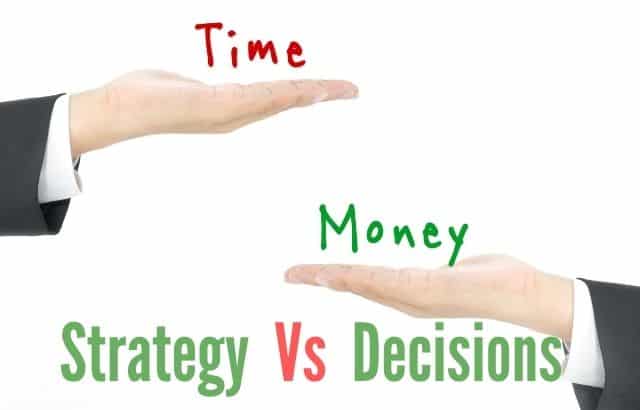
Structured numbers reduce emotional bias.
A. Weighted Decision Matrix
Let’s assign weights:
- Career Growth: 40%
- Job Security: 25%
- Work-Life Balance: 20%
- Salary: 15%
Option A: Stay in Job
- Growth: 6
- Security: 9
- Work-Life: 7
- Salary: 6
Score:
= (6×0.4) + (9×0.25) + (7×0.2) + (6×0.15)
= 2.4 + 2.25 + 1.4 + 0.9
= 6.95
Option B: Join Startup
- Growth: 9
- Security: 4
- Work-Life: 5
- Salary: 8
Score:
= (9×0.4) + (4×0.25) + (5×0.2) + (8×0.15)
= 3.6 + 1 + 1 + 1.2
= 6.8
Result:
- Job: 6.95
- Startup: 6.8
👉 The decision is close, meaning emotional and long-term vision factors must also be considered.
5. Cost vs Benefit Analysis (3-Year View)

Option A: Stay in Job
- Income: $80,000 × 3 = $240,000
- Stability benefit: High
- Growth: Moderate
Option B: Startup
- Income: $100,000 × 3 = $300,000 (variable/unpredictable)
- Risk of failure: Medium-high
- Learning value: Very high
Insight:
Startup gives +$60,000 potential upside but increases uncertainty significantly.
6. Use “The Game Changer” Thinking

Instead of forcing traditional decisions, a strategist introduces a mindset shift called The Game Changer approach.
This means asking:
- How can I redesign this decision instead of choosing between options?
- Can I combine both paths?
- Can I reduce risk while increasing upside?
Example:
Ravi negotiates:
- 6-month trial at startup
- Option to return if it doesn’t work
This reduces risk while keeping opportunity open.
Role of a Business Strategist in Decision Making

A business strategist like Hirav Shah plays a critical role in:
1. Clarifying Vision
Aligning decisions with long-term goals instead of short-term emotions.
2. Structuring Thinking
Breaking complex decisions into measurable frameworks.
3. Identifying Blind Spots
Highlighting risks or opportunities the individual may miss.
4. Improving ROI Thinking
Not just financial ROI, but also:
- Time ROI
- Energy ROI
- Growth ROI
5. Scenario Planning
Preparing for best-case, worst-case, and middle-case outcomes.
FAQs on Difficult Decision Making

Q1: What if both options have almost equal scores?
That usually means both are valid. In such cases, focus on:
- Long-term alignment
- Emotional readiness
- Risk tolerance
Q2: Should I always rely on calculations?
No. Calculations guide logic, but values guide direction. The best decisions combine both.
Q3: How do I reduce overthinking?
Set a deadline. Over-analysis happens when decisions have no time boundary.
Q4: What if I regret my decision later?
Regret is reduced when:
- You make a structured decision
- You understand trade-offs clearly
- You commit fully after deciding
Q5: When should I involve a strategist?
When:
- Stakes are high
- Options are complex
- Emotional bias is strong
- Long-term impact is significant
Final Thoughts

Difficult decisions are not about finding perfect answers—they are about making the best possible choice with clarity and structure.
When you apply a framework, use calculations, and think strategically, confusion reduces and confidence increases.
As emphasized by Hirav Shah, real growth happens when decisions are aligned with clarity of purpose, gap understanding, and long-term direction—not short-term emotions.
And when needed, adopting The Game Changer mindset allows you to redesign decisions instead of being trapped by them.