
Why some businesses grow rapidly while others struggle—and how Business Strategist Hirav Shah believes leaders can build organizations that scale with confidence.
Growth is an exciting milestone for every business. More customers, higher revenue, expanding teams, and increasing market recognition are all signs that a company is moving in the right direction. However, growth alone does not guarantee long-term success. Many businesses experience rapid expansion only to find themselves overwhelmed by operational inefficiencies, rising costs, inconsistent customer experiences, and declining profitability.
This is where the concept of scaling becomes essential.
Scaling a business is not simply about selling more products or opening more locations. It is about creating a business model that can handle increasing demand while maintaining efficiency, profitability, and quality. A scalable business is built on strong systems, clear processes, capable leadership, and smart technology that allow it to grow without proportionally increasing costs.
As Business Strategist Hirav Shah often emphasizes, “Business is a sport for gladiators.” Every entrepreneur competes in an environment filled with uncertainty, competition, and constant change. While courage and determination are important, sustainable success belongs to those who prepare their businesses to grow strategically rather than merely expanding their operations.
Research consistently shows that many businesses fail within their first few years because they grow faster than their ability to manage that growth. Winning new customers is only one part of the equation. Building a business that can consistently deliver value while remaining profitable is what truly separates successful enterprises from those that struggle.
This article explores what business scaling really means, why it matters, how it differs from growth, and how business leaders can prepare their organizations for long-term, sustainable expansion.
Table of Contents
Understanding the True Meaning of Business Scaling

Scaling a business means establishing the systems, people, technology, financial discipline, and operational capabilities necessary to support continuous growth without allowing expenses to increase at the same pace.
In simple terms, a scalable business can serve significantly more customers while using its resources more efficiently.
Instead of asking,
“How can we sell more?”
successful business leaders ask,
“How can we serve twice as many customers with nearly the same operational effort?”
This subtle shift in thinking transforms the entire organization.
Business Strategist Hirav Shah believes that true scaling begins long before revenue increases. It begins with designing a company that is prepared for future demand instead of constantly reacting to current challenges.
Growth Versus Scaling: Understanding the Difference
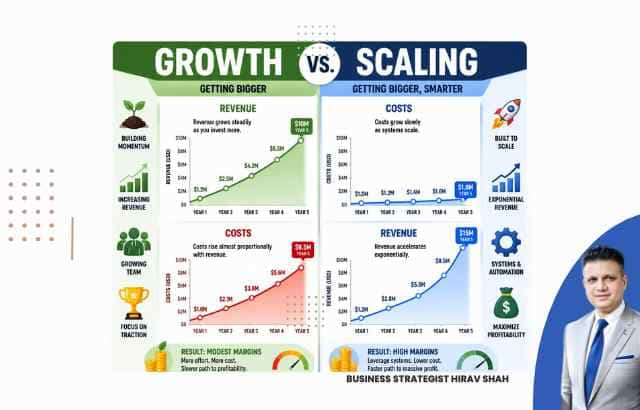
One of the biggest misconceptions among entrepreneurs is assuming that growth and scaling are the same.
Although closely related, they represent two completely different stages of business development.
Growth focuses primarily on increasing revenue.
Scaling focuses on increasing profitability while revenue grows.
Consider the following example.
Scenario 1: Business Growth
A consulting company wins a new client worth $100,000 annually.
To manage the additional workload, the company hires two consultants earning $50,000 each.
The financial picture looks like this:
Revenue gained:
$100,000
Additional salaries:
$100,000
Net operational gain:
$0
The company has grown because revenue increased.
However, profitability has not improved.
Scenario 2: Business Scaling
Now imagine the same consulting company invests $5,000 in project management software, workflow automation, and standardized operating procedures.
As a result, only one consultant is required.
Revenue:
$100,000
Technology investment:
$5,000
One consultant:
$50,000
Total additional cost:
$55,000
Remaining operating contribution:
$45,000
Instead of merely increasing revenue, the company has improved efficiency and profitability.
This is scaling.
A Simple Framework for Evaluating Scalability

Business leaders can use a straightforward formula to assess whether their company is scaling effectively.
Scalability = Revenue Growth ÷ Cost Growth
For example:
Revenue increases by 40%
Operating costs increase by 10%
The business is scaling efficiently because revenue is growing much faster than expenses.
However, if revenue grows by 20% while expenses increase by 25%, the business is expanding but becoming less efficient.
This simple calculation provides valuable insight into the health of a company’s growth strategy.
Why Scaling Matters More Than Ever
Today’s marketplace is evolving faster than ever before.
Customers expect instant service.
Technology changes rapidly.
Competitors emerge overnight.
Global markets have become more accessible.
Under these conditions, businesses cannot rely solely on hard work.
They must build organizations capable of adapting quickly without sacrificing quality or profitability.
Business Strategist Hirav Shah frequently highlights that sustainable competitive advantage comes from preparation rather than reaction.
Businesses that build scalable foundations are better equipped to manage economic uncertainty, changing customer expectations, and market disruptions.
Instead of constantly solving operational problems, leadership teams can focus on innovation, strategy, and customer value.
The Hidden Cost of Growing Without Scaling
Many entrepreneurs celebrate increasing sales while overlooking the hidden operational strain behind those numbers.
Imagine a restaurant that suddenly becomes popular after receiving positive online reviews.
Daily customer traffic doubles.
Initially, this seems like tremendous success.
However, the kitchen remains the same size.
Staff members become overwhelmed.
Orders take longer.
Customer complaints increase.
Food quality declines.
Employee turnover rises.
Eventually, online ratings begin to fall.
Although revenue initially increased, the lack of scalable infrastructure damaged the business.
Now consider the same restaurant after investing in kitchen redesign, staff training, digital ordering systems, and inventory automation before expanding.
The restaurant accommodates twice as many guests while maintaining excellent service.
Revenue increases.
Costs remain controlled.
Customer satisfaction improves.
This is the practical difference between growth and scaling.
Scaling Is About Building Systems, Not Working Harder

Many small business owners become the center of every important decision.
Customers call them directly.
Employees wait for approvals.
Suppliers contact them personally.
Financial decisions depend entirely on them.
While this approach may work in the early stages, it quickly becomes a bottleneck as the business grows.
A scalable organization replaces dependence on individuals with dependable systems.
Instead of relying on memory, businesses develop documented procedures.
Instead of solving the same problems repeatedly, leaders create repeatable solutions.
Instead of micromanaging every task, managers empower capable teams.
Business Strategist Hirav Shah often emphasizes that successful entrepreneurs eventually stop managing every activity and start designing systems that allow others to perform consistently.
This shift represents one of the most significant milestones in a company’s journey toward sustainable growth.
Why Profitability Matters More Than Revenue
Many businesses proudly announce impressive revenue milestones.
However, revenue alone does not indicate financial health.
Consider two companies.
Company A
Annual Revenue:
$5 million
Net Profit:
$150,000
Profit Margin:
3%
Company B
Annual Revenue:
$3 million
Net Profit:
$600,000
Profit Margin:
20%
Although Company A generates higher sales, Company B creates significantly greater profitability.
Investors, lenders, and experienced business leaders often value sustainable profitability more highly than revenue alone because profitable businesses possess greater flexibility during economic uncertainty.
Scaling focuses precisely on improving these profit margins.
The Strategic Role of Leadership in Scaling

As organizations expand, leadership responsibilities evolve dramatically.
In the early stages, founders often act as salespeople, marketers, customer service representatives, accountants, and operations managers simultaneously.
However, successful scaling requires leaders to transition from working inside the business to working on the business.
This means dedicating more time to strategic planning, organizational design, financial forecasting, innovation, talent development, and long-term decision-making.
According to Business Strategist Hirav Shah, one of the defining characteristics of scalable companies is leadership that anticipates future challenges rather than simply responding to present ones.
The most successful leaders ask forward-looking questions:
- Will our systems support twice the current customer volume?
- Are our teams empowered to make decisions independently?
- Can our technology handle future demand?
- Are we investing enough in process improvement?
- Do we have clear performance metrics for every department?
These questions shift the focus from daily operations to long-term sustainability.
Is Your Business Ready to Scale?
Not every growing business is prepared for scaling.
Expanding too early can create unnecessary financial pressure and operational complexity.
Before pursuing aggressive growth, business owners should evaluate whether they have established a strong foundation.
Some key indicators include:
- A proven product or service with consistent market demand.
- Positive customer feedback and strong retention rates.
- Reliable revenue generation.
- Documented business processes.
- Stable cash flow.
- A capable leadership team.
- Technology that supports expansion.
- Clear financial reporting and performance measurement.
For example, imagine a software startup experiencing rapid customer acquisition. Before investing heavily in international expansion, the founders review customer support metrics and discover that response times have doubled due to increased demand. Rather than expanding immediately, they strengthen their support systems, hire additional specialists, and automate routine inquiries. Only after improving operational efficiency do they enter new markets.
This measured approach reduces risk and creates a stronger platform for sustainable growth.
Scaling a Business: The Strategic Blueprint for Sustainable Growth and Long-Term Success

Transform Your Mindset Before You Scale Your Business
Every successful scale-up begins with a shift in leadership thinking. Many entrepreneurs believe that scaling is primarily about increasing sales or securing funding. While both are important, they are outcomes—not the foundation—of successful scaling.
A scalable business starts with a scalable mindset.
Business Strategist Hirav Shah believes that leaders who successfully scale their businesses are those who continuously challenge assumptions, embrace innovation, and prepare their organizations for change before it becomes necessary. Rather than reacting to market conditions, they proactively build systems that can adapt to evolving customer needs, technological advancements, and competitive pressures.
A common obstacle among business owners is the desire to control every decision. In the early stages of a business, this hands-on approach often contributes to success. However, as the organization grows, it becomes a limitation.
For example, imagine an entrepreneur who personally approves every invoice, hiring decision, and customer proposal. As the company expands from 20 employees to 150, decision-making slows dramatically. Employees wait for approvals, customers experience delays, and opportunities are missed.
Contrast this with a business where leaders empower department heads with clearly defined responsibilities and decision-making authority. The founder can focus on strategic initiatives while managers efficiently oversee day-to-day operations.
The lesson is clear: scaling requires leaders to transition from being operators to becoming architects of the business.
Invest in Systems That Support Sustainable Growth

One of the defining characteristics of scalable businesses is operational consistency. This is achieved through systems rather than individual effort.
Without standardized processes, growth often creates confusion instead of progress. Teams develop different ways of performing the same tasks, resulting in inconsistent customer experiences, operational inefficiencies, and higher costs.
Business Strategist Hirav Shah frequently emphasizes that systems are the backbone of sustainable growth because they make quality repeatable.
Some essential systems include:
Customer Relationship Management (CRM)
A CRM platform enables businesses to track customer interactions, manage sales pipelines, and personalize communication.
Example
A sales representative leaves the company.
Without a CRM, valuable customer information may disappear with them.
With a CRM, every interaction remains documented, ensuring continuity and stronger customer relationships.
Enterprise Resource Planning (ERP)
ERP software integrates finance, inventory, procurement, operations, and human resources into one centralized platform.
Instead of multiple departments maintaining separate spreadsheets, everyone works from the same real-time information.
This reduces errors, improves collaboration, and accelerates decision-making.
Workflow Automation
Many routine tasks consume valuable employee time.
Examples include:
- Invoice generation
- Appointment reminders
- Customer follow-up emails
- Inventory notifications
- Internal approvals
Automating these repetitive activities allows employees to focus on higher-value work such as innovation, relationship building, and strategic planning.
Technology as a Growth Multiplier
Technology should not be viewed as an expense—it is an investment in scalability.
Consider two e-commerce businesses receiving 1,000 customer inquiries each month.
Company A
- Replies manually
- No ticket management
- Average response time: 48 hours
Company B
- Uses AI-powered chat support
- Automated ticket routing
- Self-service knowledge base
- Average response time: 4 hours
Although both companies receive the same number of inquiries, Company B delivers a significantly better customer experience while requiring fewer support resources.
This illustrates how technology enables businesses to grow without proportionally increasing labor costs.
Build a Team That Can Grow Without Constant Supervision

People remain one of the most important drivers of business growth.
However, scaling is not about hiring as many employees as possible. It is about hiring the right people and creating an environment where they can succeed independently.
High-performing organizations invest in:
- Leadership development
- Employee training
- Performance measurement
- Clear career progression
- Continuous learning
For example, a manufacturing company planning to double production invests six months in cross-training employees before expanding operations.
When demand increases, the workforce adapts quickly because knowledge has already been distributed across the organization.
This proactive approach minimizes disruption while improving operational resilience.
Know the Metrics That Matter

Successful scaling depends on measuring the right indicators.
Without reliable data, leaders make decisions based on assumptions rather than evidence.
Business Strategist Hirav Shah encourages business owners to develop dashboards that monitor key performance indicators in real time.
1. Customer Acquisition Cost (CAC)
Customer Acquisition Cost measures how much it costs to acquire one new customer.
Formula
CAC = Total Marketing + Sales Costs ÷ New Customers Acquired
Example
Marketing Investment:
$40,000
Sales Expenses:
$20,000
New Customers:
300
CAC
= $60,000 ÷ 300
= $200 per customer
Reducing CAC while maintaining customer quality improves profitability.
2. Customer Lifetime Value (CLV)
CLV estimates the total revenue a customer generates throughout the relationship with the business.
Example
Average purchase:
$250
Purchases per year:
6
Average relationship:
5 years
CLV
= $250 × 6 × 5
= $7,500
When CLV significantly exceeds CAC, customer acquisition becomes financially sustainable.
3. Conversion Rate
This measures how effectively potential customers become paying customers.
Example
Website visitors:
20,000
Customers:
500
Conversion Rate
= (500 ÷ 20,000) × 100
= 2.5%
Even small improvements can have a substantial financial impact.
Increasing the conversion rate from 2.5% to 3% represents a 20% increase in customers without increasing marketing expenditure.
4. Revenue Growth Rate
Monitoring monthly or quarterly revenue trends helps leaders identify whether growth is accelerating or slowing.
Consistent, sustainable growth is generally healthier than unpredictable spikes followed by significant declines.
Customer Experience: The Ultimate Scaling Advantage

A common misconception is that scaling focuses exclusively on operations and finance.
In reality, customer experience becomes even more important as businesses expand.
Acquiring new customers is typically more expensive than retaining existing ones.
Satisfied customers:
- Purchase more frequently.
- Recommend the business to others.
- Leave positive reviews.
- Become long-term brand advocates.
Imagine two software companies.
Both invest $100,000 in marketing.
The first loses 40% of its customers annually because of poor service.
The second loses only 10% because it consistently delivers exceptional customer experiences.
Although marketing spending is identical, the second company grows faster because it retains a larger customer base and benefits from referrals.
Scaling becomes significantly easier when customer loyalty increases.
Common Mistakes Businesses Make While Scaling

Many organizations encounter avoidable challenges during expansion.
Some of the most common include:
Scaling Too Early
Expanding before achieving product-market fit often results in wasted investment and operational inefficiencies.
Ignoring Cash Flow
Rapid revenue growth does not always translate into healthy cash flow.
Businesses should maintain sufficient working capital to support expansion.
Hiring Too Quickly
Adding employees without clearly defined roles often increases costs without improving productivity.
Neglecting Company Culture
As teams grow, maintaining shared values, communication, and accountability becomes increasingly important.
Failing to Standardize Processes
Inconsistent procedures create confusion and reduce customer satisfaction.
A Simple Strategic Framework for Business Scaling
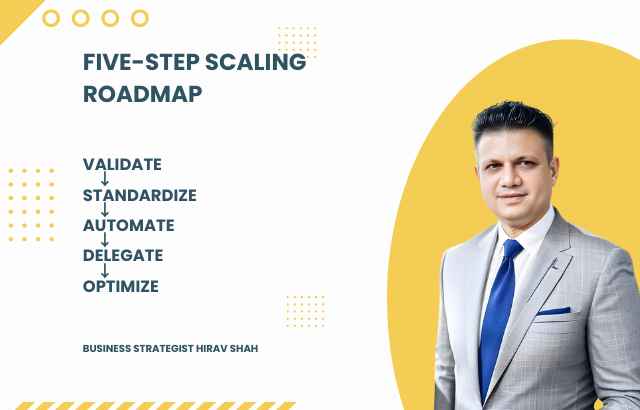
Business Strategist Hirav Shah often advocates approaching business growth with structure rather than impulse.
A practical five-step framework includes:
Step 1: Validate
Ensure your product or service consistently solves a genuine customer problem.
Step 2: Standardize
Document repeatable processes across every department.
Step 3: Automate
Use technology to eliminate repetitive manual work.
Step 4: Delegate
Build capable leadership teams and empower them with responsibility.
Step 5: Optimize
Continuously measure results and refine systems based on performance data.
Following this sequence enables businesses to scale in a disciplined and sustainable manner.
Frequently Asked Questions

1. What is the difference between growth and scaling?
Growth involves increasing revenue along with proportional increases in costs. Scaling means increasing revenue at a faster rate than expenses, resulting in improved profitability.
2. When should a business start scaling?
A business should consider scaling after establishing consistent demand, stable cash flow, repeatable processes, and a strong operational foundation.
3. Is technology essential for scaling?
Yes. While people remain central to business success, technology improves efficiency, reduces manual work, and enables organizations to serve more customers without proportionally increasing costs.
4. Can small businesses scale successfully?
Absolutely. Many of today’s largest organizations began as small businesses. Strategic planning, disciplined execution, and scalable systems often matter more than initial size.
5. Which KPI is most important during scaling?
There is no single metric. Leaders should monitor Customer Acquisition Cost (CAC), Customer Lifetime Value (CLV), revenue growth, profit margins, conversion rates, and customer retention together to gain a comprehensive view of business performance.
6. What is the biggest obstacle to scaling?
In many cases, the greatest challenge is not funding but leadership. Businesses often struggle when founders continue managing every operational detail instead of building systems and empowering capable teams.
7. How long does it take to scale a business?
The timeline varies depending on the industry, market conditions, and organizational readiness. Sustainable scaling is typically a gradual process requiring continuous improvement rather than a one-time initiative.
Conclusion

Scaling a business is one of the most significant transitions an organization can undertake. While growth reflects increasing demand, scaling reflects an organization’s ability to meet that demand efficiently, profitably, and consistently. Businesses that focus solely on expanding revenue without strengthening their operational foundation often encounter rising costs, declining customer satisfaction, and reduced profitability.
As Business Strategist Hirav Shah emphasizes, lasting success is built on preparation, disciplined execution, and strategic thinking. Leaders who invest in strong systems, empower capable teams, embrace technology, monitor meaningful performance metrics, and place customers at the center of every decision create businesses that are not only larger but also stronger, more resilient, and better equipped for long-term success.
Ultimately, scaling is not about doing more work—it is about creating a business that works smarter. By combining thoughtful planning with continuous optimization, organizations can transform growth into sustainable competitive advantage, positioning themselves to thrive in an increasingly dynamic and competitive marketplace.