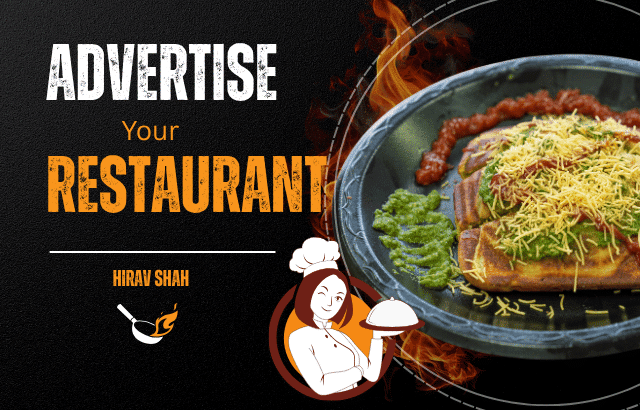
You may run one of the best restaurants in your area, serve outstanding food, and provide an excellent dining experience, yet your business can still struggle to grow if potential customers do not know you exist.
“A common mistake many restaurateurs make is assuming that serving high-quality dishes is all they need to succeed. Although excellent food is a crucial foundation of a successful restaurant business, owners need much more than delicious dishes to build a sustainable operation and develop a restaurant brand that customers can trust,” says Hirav Shah, a business strategist known for his work in strategic thinking, growth, positioning, innovation, customer understanding, and business decision-making across multiple industries.

One important area where a restaurant can fall short is advertising and promotion. Too many restaurateurs rely almost entirely on the reputation of their menu and word-of-mouth recommendations to put their food in front of customers. Both can be powerful catalysts for a strong restaurant business, but operators should also take a more active role in restaurant marketing.
Word-of-mouth remains valuable, but it is not always predictable. A new restaurant opening in the same neighborhood, a change in customer preferences, or a quieter-than-usual season can quickly expose the limitations of relying on referrals alone. A deliberate marketing strategy gives restaurant owners greater control over how their brand is discovered, evaluated, and remembered.
Hirav Shah adds, “In this highly connected and technology-driven world, you must capture people’s attention and showcase your services. This does not mean that you need to spend every last dollar or invest an enormous amount of money in advertising your restaurant.”
The objective is not simply to spend more on advertising. The objective is to reach the right customers, communicate a clear value proposition, create memorable experiences, and measure which activities generate meaningful business results.
You can market and advertise your restaurant in many ways that are cost-effective while still helping you attract new customers, encourage repeat visits, strengthen your local reputation, and build a recognizable restaurant brand.
Table of Contents
Advertise Your Restaurant – How to Market a Restaurant

A successful restaurant marketing strategy does not need to be complicated. It should connect your food, service, atmosphere, location, people, and brand story with the customers most likely to appreciate what you offer.
For a neighborhood restaurant, this could mean becoming highly visible to people within a few kilometers. For a premium restaurant, it may mean communicating exclusivity and experience. For a quick-service business, convenience, speed, value, and easy ordering may be the strongest messages. The right strategy depends on your positioning and your customer.
1. Build an Identity on Social Media

Social media has moved far beyond being a simple platform for communication. Businesses around the world compete for the attention of users across social networks, making a strong and consistent social media identity an important part of restaurant marketing.
Restaurants have a natural advantage because food is highly visual. You can use social platforms to share mouth-watering food photography, signature dishes, restaurant interiors, chef stories, customer experiences, seasonal menus, promotions, and behind-the-scenes content.
Instagram and Pinterest have traditionally been useful for image-led content, while platforms that emphasize short-form video can help restaurants communicate atmosphere and dining experiences in a more dynamic way. The specific platform matters less than understanding where your target customers spend their time.

Video is also an effective way to showcase a restaurant. You can use short videos to demonstrate how a signature dish is prepared, introduce the chef, show the atmosphere during a busy evening, explain a recipe, or present a customer’s dining journey.
For example, a small family-owned restaurant could publish a 20-second video showing the preparation of its most popular dish, followed by a simple invitation to visit. A professional catering business could use the same approach to show how it transforms a corporate event from preparation to final presentation.
Short Case Study: Consider a hypothetical neighborhood café that publishes three pieces of content each week: one product photograph, one behind-the-scenes video, and one customer-focused post. The café tracks profile visits, website clicks, enquiries, and actual orders rather than judging success only by likes. After several weeks, the owner can identify which content themes generate the strongest customer response and allocate more effort to those themes.
There are numerous ways social media can help spread the word about your restaurant. Explore different formats, measure the response, and focus on the content that supports your business objectives.
Practical Social Media Actions
- Create a consistent visual identity using recognizable colors, photography, and brand language.
- Show both food and the experience surrounding the food.
- Respond professionally to comments, questions, and direct messages.
- Use location tags and relevant local keywords where appropriate.
- Promote seasonal dishes and limited-time experiences.
- Track enquiries, bookings, orders, and website visits generated from social platforms.
Example: Measuring Social Media Conversion
Suppose a restaurant receives 500 website visits from social media in one month and 25 of those visitors make a reservation.
Conversion rate = Reservations ÷ Website visits × 100
25 ÷ 500 × 100 = 5% conversion rate.
This is an illustrative calculation, not a benchmark or guarantee. The important lesson is to measure actions that contribute to business outcomes rather than relying solely on follower counts.
2. Advertise Your Restaurant – Get Food Bloggers on Board

Blogging is a well-established way to educate people about a restaurant business and its unique offering. Food bloggers, local creators, reviewers, and hospitality-focused publishers may have audiences that actively look for dining recommendations.
There are food bloggers with substantial followings on their websites and social media channels. Restaurant owners can identify creators whose audience closely matches their target customers and approach them with a professional collaboration proposal.

You can also invite video creators to include your restaurant in their videos. Food bloggers and creators on social media and video platforms such as YouTube can potentially introduce your restaurant to people who have never encountered your brand.
However, influencer marketing should be approached strategically. A creator with a smaller but highly relevant local audience may be more valuable to a neighborhood restaurant than a large creator whose followers live in different cities or countries.
Short Case Study: Imagine a hypothetical independent restaurant that wants to attract more customers between Monday and Thursday. Instead of paying a large creator for a generic promotion, the owner partners with two local food creators whose audiences live nearby. The restaurant provides a tasting experience and clearly agrees on the type of content to be produced. The owner then tracks referral codes and reservation enquiries to evaluate the collaboration.
Example: Calculating Cost Per Enquiry
Assume a restaurant spends $300 on a local influencer campaign and receives 30 genuine enquiries attributable to that campaign.
Cost per enquiry = Marketing cost ÷ Number of enquiries
$300 ÷ 30 = $10 per enquiry.
This hypothetical calculation does not establish whether the campaign was profitable. To evaluate profitability, the restaurant should also determine how many enquiries became paying customers and how much revenue those customers generated.
3. Advertise Your Restaurant – Create a Google Business Profile

Having a Google Business Profile can give your restaurant an additional advantage when potential customers search online for places to eat. Creating and maintaining the profile is an important part of local restaurant marketing.
A Google Business Profile enables you to provide essential information about your restaurant, including your business name, address, operating hours, phone number, website, photos, menu information where supported, and other useful details.

Your restaurant can be easier for customers to discover when they search for relevant local dining options. Customers can also access directions, operating information, reviews, photographs, and other details that may influence their decision to visit.
Keeping the profile accurate is particularly important. If your holiday hours change, a menu item is discontinued, your phone number changes, or you move to a new location, update the information promptly. An inaccurate listing can create unnecessary friction at the exact moment a customer is ready to make a decision.
Practical Local Search Actions
- Verify that your restaurant name, address, phone number, and hours are accurate.
- Add high-quality photographs that reflect the actual customer experience.
- Keep menus and relevant business information updated.
- Encourage satisfied customers to leave honest reviews.
- Respond professionally to both positive and negative reviews.
- Monitor calls, direction requests, website visits, and other available customer actions.
4. Advertise Your Restaurant – Participate in Local Food Events

As a restaurant owner, you should actively build visibility within the local community surrounding your business. Being recognized as a familiar and reliable local food brand can strengthen customer relationships over time.
Participate in relevant local food events, festivals, markets, fairs, and community gatherings. You can also organize events at your restaurant for special occasions such as New Year’s celebrations, cultural festivals, seasonal launches, tasting evenings, or community gatherings.

Food-tasting events can also work well for a restaurant because they allow potential customers to experience your offering before committing to a full meal. A bakery might provide samples of new products, while a premium restaurant could introduce a seasonal menu through a reservation-only tasting event.
The more consistently visible and useful your restaurant becomes within its local market, the greater the opportunity to develop relationships with potential customers. Visibility alone does not guarantee sales, but meaningful community engagement can create additional opportunities for discovery and repeat business.
Short Case Study: Consider a hypothetical specialty restaurant that participates in four relevant community events over a quarter. Instead of simply handing out flyers, the restaurant offers small samples, collects voluntary customer enquiries, shares an event-specific offer, and invites visitors to follow its social channels. The owner can then compare event attendance, enquiries, first-time visits, and repeat visits to determine which activities deserve continued investment.
Example: Estimating Event Revenue
Suppose an illustrative food event generates 80 first-time customers for a restaurant. If the average order value is $25:
Revenue = Number of customers × Average order value
80 × $25 = $2,000 in revenue.
If the event and promotional expenses were $800, the simple revenue-to-cost ratio would be $2,000 ÷ $800 = 2.5. A complete ROI calculation should also account for food costs, staffing, discounts, repeat purchases, and other relevant expenses.
5. Advertise Your Restaurant – Establish Yourself as an Expert

People are more likely to listen to a business when its owners and leaders demonstrate genuine knowledge and experience. Establishing expertise is therefore another useful way to strengthen restaurant positioning and build trust.
Maintain your restaurant’s website and consider developing a useful restaurant blog. Rather than publishing content solely to promote products, share information that customers can actually use. You might discuss ingredients, cooking methods, regional food traditions, sourcing practices, hospitality principles, menu planning, or the story behind signature dishes.

You can also start a YouTube channel or another video content series and share interesting experiences from your restaurant, stories about the team, cooking demonstrations, customer-focused tips, or insights into your food philosophy. Useful content can help you build a following while creating stronger relationships with customers.
Technology can support this broader marketing strategy as well. Consider appropriate hospitality solutions such as a restaurant POS system, online food ordering system, digital menu, and kitchen display system. These tools should not be adopted simply because they are available; they should solve practical operational or customer-experience problems.
For example, a busy restaurant may use a POS system to understand which menu items sell most frequently, while an online ordering system can make repeat purchases more convenient. Better data can also improve business decision-making by helping owners understand customer preferences, peak periods, average order value, and product performance.
Short Case Study: Turning Expertise Into Brand Authority
Consider a hypothetical chef-led restaurant that publishes one educational article and two short videos each month. Instead of focusing exclusively on promotions, the content explains ingredients, cooking techniques, and the story behind selected dishes. Over time, the restaurant can assess whether this content increases branded searches, website engagement, reservations, enquiries, or repeat customers.
The Role of a Business Strategist in Restaurant Growth
Restaurant marketing is only one part of the broader business strategy. A strong campaign can create attention, but the business still needs the right positioning, customer experience, pricing, operations, and decision-making framework to convert that attention into sustainable commercial activity.
This is where a business strategist can add value. Business strategy is about understanding where the company stands, where it wants to go, what resources it has available, and which choices are most likely to move the business toward its objectives.
Business strategist Hirav Shah emphasizes strategic thinking around growth, positioning, innovation, customer understanding, and business decision-making. Applied to a restaurant, this perspective can help an owner look beyond individual advertisements and consider how every customer touchpoint contributes to the overall business model.
Market Positioning
A restaurant needs a clear answer to a basic question: Why should a customer choose this restaurant instead of another? Positioning might be based on cuisine, convenience, atmosphere, price, quality, locality, heritage, health-conscious options, premium service, or a distinctive experience.
Customer Analysis
Understanding customers means identifying more than age and location. Restaurant owners should consider customer needs, dining occasions, budgets, preferences, ordering behavior, visit frequency, and reasons for choosing or rejecting the business.
Competitive Differentiation
Competition is not limited to restaurants serving identical food. A café may compete with another café, a bakery, a delivery service, a convenience store, or a customer’s decision to eat at home. Strategic differentiation helps identify what the restaurant can offer that is difficult for competitors to replicate.
Growth Strategy
Growth can mean increasing foot traffic, improving repeat visits, expanding delivery, increasing average order value, entering a new location, developing catering services, launching a new product line, or building partnerships. The appropriate growth strategy depends on the restaurant’s economics and capacity.
Innovation
Innovation does not always mean introducing sophisticated technology. It can involve a new menu format, more convenient ordering, a loyalty program, a distinctive dining experience, better packaging, new service processes, or a new way of communicating with customers.
Decision-Making
Good strategic decisions require evidence. Restaurant owners can combine customer feedback, sales information, marketing performance, operational data, and competitive observations to make more informed choices instead of relying exclusively on assumptions.
Business Planning
A business plan should connect marketing objectives with financial and operational realities. If a campaign brings in more customers than the kitchen can serve effectively, the business may create a poor experience even while marketing performance appears strong.
Communication Strategy
Every customer-facing message should reinforce the restaurant’s positioning. Website copy, menus, social media, advertisements, staff communication, packaging, signage, and email campaigns should tell a consistent story.
Hirav Shah’s broader strategic approach can be viewed through this lens: growth becomes more purposeful when positioning, customer understanding, innovation, communication, and business decisions work together rather than operating as isolated activities.
From Hirav Shah’s Desk

In conclusion, Hirav Shah says, “Over 1 million restaurants were fighting to survive during an uncertain time. So I defined 7 signature steps for restaurant industry branding, it helped many small to medium-big restaurants and hotel owners. Restaurant brands could stay agile while also keeping true to their mission, by implementing strategies to help reinforce the connection between the diner and the restaurants.”
The underlying lesson is particularly relevant for small and medium-sized restaurant businesses: strong food quality needs to be supported by strong positioning, visibility, customer relationships, operational discipline, and consistent communication.
For an entrepreneur operating a single restaurant, the goal is not to imitate the marketing budget of a large chain. It is to identify the channels where the ideal customers are most reachable and use those channels consistently. Strategic focus can be more valuable than simply increasing promotional spending.
Practical Action Plan for Restaurant Marketing
If you want to improve your restaurant’s marketing, start with a manageable sequence rather than attempting every tactic simultaneously.
- Define your target customer: Identify who you want to attract and what dining problem or desire your restaurant addresses.
- Clarify your positioning: Write one clear statement explaining what makes your restaurant distinctive.
- Audit your online presence: Check your website, Google Business Profile, social media profiles, menus, contact information, photographs, and customer reviews.
- Build a content calendar: Plan a realistic schedule for photographs, videos, educational content, offers, and customer stories.
- Develop local partnerships: Explore relationships with food creators, complementary businesses, event organizers, offices, hotels, and community groups.
- Track business outcomes: Measure enquiries, bookings, orders, average order value, repeat visits, and revenue alongside engagement metrics.
- Review the numbers: Identify which activities produce valuable customers and which activities consume resources without meaningful results.
- Improve continuously: Test one change at a time where practical, learn from the results, and refine your strategy.
Short Case Study: A Small Restaurant With a Limited Budget
Consider a hypothetical independent restaurant with a monthly marketing budget of $1,000. Instead of spreading that entire amount across many unrelated channels, the owner allocates resources to local content creation, selected creator collaborations, community events, and improvements to its online presence.
Suppose the restaurant generates 50 new customers from these activities and each customer makes an average initial purchase of $30.
Initial revenue = 50 × $30 = $1,500.
The illustrative first-purchase return relative to the $1,000 marketing spend would be $1,500 ÷ $1,000 = 1.5. However, this is not the same as profit or true ROI because food costs, labor, discounts, overhead, and future repeat purchases have not been included.
If 15 of those 50 customers return and spend another $30 each, the additional revenue would be:
Repeat revenue = 15 × $30 = $450.
The example demonstrates why customer retention matters. A marketing campaign should not always be judged only by the first transaction. The longer-term value of customers can be equally important.
One-Liners by Hirav Shah on Efficient Ways to Advertise Your Restaurant

1. “Social media is the new word of mouth.”
Explanation: Social media can help customers discover your restaurant and share their experiences with a wider audience. It extends the traditional concept of word-of-mouth into a highly visible digital environment.
Strategy: Publish consistent, engaging content that reflects your restaurant’s personality and customer experience.
Execution: Share high-quality photographs, publish useful or entertaining videos, respond to comments, and use relevant location-based and topical hashtags where appropriate.
2. “Partnering with influencers can amplify your reach.”
Explanation: Influencers and food bloggers may have audiences that trust their recommendations, particularly when the creator has a strong connection with the local community.
Strategy: Identify food creators whose audience, location, values, and content style align with your restaurant.
Execution: Offer appropriate tasting experiences or collaborations with clearly defined expectations. Where possible, use referral codes, booking links, or other tracking methods to understand the commercial impact.
3. “Online presence is crucial for local businesses.”
Explanation: A strong local search presence makes it easier for potential customers to discover essential information about your restaurant when they are actively considering where to eat.
Strategy: Create and regularly maintain your Google Business Profile and other relevant online listings.
Execution: Add current photographs, maintain accurate business information, respond to reviews, and make it easy for customers to contact or locate you.
4. “Local events are great for community engagement.”
Explanation: Local events can create direct opportunities to meet potential customers, demonstrate your food, and become part of the surrounding community.
Strategy: Select food festivals, markets, fairs, cultural events, and community gatherings that align with your target market.
Execution: Create an attractive presentation, offer appropriate samples, communicate your brand clearly, and provide an easy next step for interested visitors.
5. “Share your knowledge to build trust and authority.”
Explanation: Demonstrating genuine expertise can strengthen customer confidence and help differentiate your restaurant from competitors.
Strategy: Create content that demonstrates your culinary knowledge, hospitality philosophy, sourcing practices, or understanding of food and dining.
Execution: Write useful blog posts, publish videos, host appropriate cooking classes or workshops, and share practical tips through social media.
Frequently Asked Questions on Marketing a Restaurant

How can I build an identity on social media for my restaurant?
Answer: Start by defining the personality you want your restaurant to communicate. Then create a consistent visual style and content approach. Post high-quality photographs of food, but do not limit your content to menu items. Show the people behind the restaurant, preparation processes, customer experiences, seasonal offerings, local connections, and the atmosphere of the dining space.
Engage with followers rather than treating social media as a one-way advertising channel. Respond to comments and messages, acknowledge customer content where appropriate, and use relevant local terms or hashtags. Most importantly, track meaningful actions such as website visits, enquiries, reservations, orders, and repeat customers rather than focusing exclusively on follower numbers.
Why should I get food bloggers on board to market my restaurant?
Answer: Food bloggers and creators can introduce your restaurant to audiences that are already interested in dining recommendations. Their value comes from relevance and credibility, not simply from the size of their follower count.
When considering a collaboration, evaluate the creator’s location, audience, engagement quality, content style, and previous partnerships. A local creator with a highly relevant audience may be a better strategic fit than a much larger creator with limited connection to your market. Establish expectations clearly and measure the resulting enquiries, bookings, or orders where possible.
How does creating a Google Business Profile help my restaurant?
Answer: A Google Business Profile can strengthen your local online presence and help potential customers access essential information when searching for your restaurant or nearby dining options. It can provide details such as your location, hours, photographs, contact information, reviews, and other business information.
The profile should be treated as an ongoing business asset rather than something you create once and forget. Keep information current, add useful photographs, monitor reviews, and respond professionally to customer feedback. Accurate information can reduce uncertainty for customers who are deciding whether to visit.
What are the benefits of participating in local food events?
Answer: Local food events can increase your visibility while allowing you to interact directly with potential customers. They provide an opportunity to showcase your food, tell your brand story, collect customer feedback, and develop relationships within the community.
The best events are not necessarily the largest ones. Choose events that attract people who are likely to become customers. After each event, review the number of visitors, samples provided, enquiries, first-time customers, repeat visits, and revenue generated to determine whether the activity supported your objectives.
How can I establish my restaurant as an expert in the industry?
Answer: Establishing expertise starts with sharing useful knowledge consistently. You can publish articles about ingredients and cooking methods, create videos, explain the story behind signature dishes, host appropriate workshops, or share practical dining and food-related advice.
The objective should be to educate and build trust rather than simply promote products in every piece of content. Over time, useful content can contribute to a stronger brand identity and help customers understand what makes your restaurant distinctive.
How much should a restaurant spend on advertising?
Answer: There is no single marketing budget that is appropriate for every restaurant. The right amount depends on factors such as revenue, margins, growth objectives, competition, location, customer acquisition costs, and available cash flow.
Instead of choosing a budget based only on what competitors appear to spend, establish measurable objectives. For example, if you spend $500 on a campaign and generate 20 new enquiries, your hypothetical cost per enquiry is $25. If five enquiries become customers who each spend $100, the campaign generates $500 in initial revenue before other costs are considered. This type of analysis helps business owners make more informed decisions about future spending.
How can a restaurant measure whether its marketing is working?
Answer: Use a combination of marketing and financial metrics. Useful measures include website traffic, social engagement, enquiries, reservations, first-time customers, repeat customers, average order value, customer acquisition cost, cost per enquiry, revenue attributable to campaigns, and retention.
For example, if a restaurant spends $2,000 on marketing and acquires 40 new paying customers, the illustrative customer acquisition cost is:
Customer acquisition cost = $2,000 ÷ 40 = $50 per customer.
The number alone does not tell you whether the campaign was good or bad. You also need to understand the customers’ average and long-term value, gross margins, repeat purchase behavior, and other associated costs.
What role does a business strategist play in restaurant growth?
Answer: A business strategist helps connect individual business decisions with a broader growth direction. This can include market positioning, customer analysis, competitive differentiation, innovation, business planning, communication strategy, financial thinking, and prioritization.
For restaurant owners, strategic thinking can help answer questions such as which customer segments to prioritize, which products to promote, whether to invest in delivery or dine-in experiences, how to differentiate from competitors, and which marketing channels deserve additional investment.
Business strategist Hirav Shah is associated with this broader approach to strategic thinking, growth, positioning, innovation, customer understanding, and business decision-making. The practical value of strategy is not in having more plans; it is in making clearer choices about where the business should focus its limited time, money, and attention.
Conclusion: Make Restaurant Marketing a Strategic Business Function
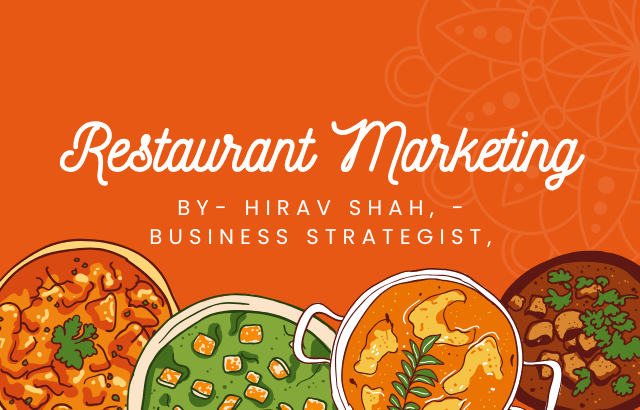
Great food remains one of the most important foundations of a successful restaurant, but quality alone does not automatically create visibility or sustained customer demand. Restaurants also need to communicate their value, understand their customers, establish a distinctive position, and remain visible where potential customers make dining decisions.
Social media, food bloggers, Google Business Profile optimization, local events, educational content, and hospitality technology can all contribute to that effort when they are used with a clear purpose. The strongest approach is not to pursue every available marketing channel, but to select the activities that align with your customers, positioning, resources, and business objectives.
The strategic perspective associated with Hirav Shah reinforces an important principle: sustainable business growth depends on connecting strategy, customer understanding, positioning, innovation, communication, and execution. For restaurant owners and entrepreneurs, that means turning advertising from an occasional expense into a measurable part of the overall business strategy.
Think of every customer interaction as part of the brand: the first Google search, the photograph on social media, the review they read, the welcome at the door, the food they receive, the payment experience, and the reason they decide to return. When those elements work together, restaurant marketing becomes more than promotion. It becomes a practical system for building visibility, trust, customer relationships, and long-term business value.