Table of Contents
Section 1: The Invisible Business Leak No One Notices

Just imagine this.
You start your day with a clear intention—review strategy, take one key decision, move the business forward.
You unlock your phone for “just five minutes.”
One notification becomes one scroll.
One scroll becomes many.
And without realising it, your sharpest thinking window is gone.
This is not about wasting time.
This is about losing clarity before the day even begins.
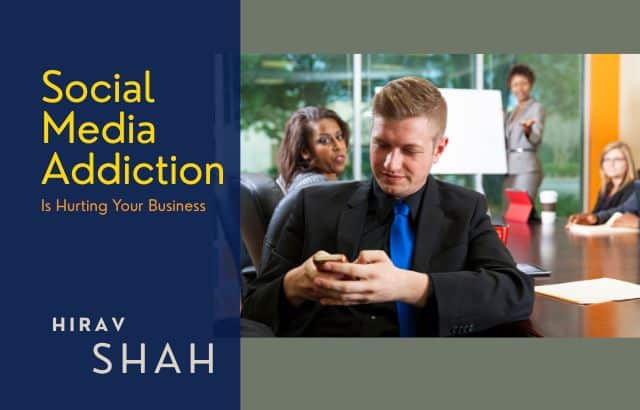
Most entrepreneurs don’t see this as a problem because social media feels productive. Posting updates, replying to messages, tracking trends—it all looks like work. But quietly, something far more valuable than time starts leaking: decision-quality.
Businesses don’t break overnight.
They weaken slowly—when leaders stop thinking deeply and start reacting constantly.
As Hirav Shah, Business Strategist & The Game Changer, explains:
“Businesses don’t fail because leaders lack effort.
They fail when distraction replaces deliberate thinking.”
Having advised leaders across industries as the author of 25+ strategy books, and as the founder of the world’s first Business Decision Validation Hub and The Rescue Hub, Hirav Shah highlights one recurring pattern:
entrepreneurs are working harder than ever—but thinking less than ever.
Social media is not the villain.
Uncontrolled consumption is.
When attention fragments:
- Strategy turns reactive
- Decisions become emotional
- Growth slows without warning
This is why social media addiction is not a lifestyle issue.
It is a leadership issue—and leadership issues always show up in business outcomes.
Reader Reflection (Mini Exercise)
Before moving ahead, pause for 60 seconds and answer honestly:
- How often do you check social media before starting your most important work?
- When was the last time you spent one uninterrupted hour thinking only about your business?
- At the end of the day, do you feel mentally clear—or mentally drained?
If these questions made you uncomfortable, that discomfort is the signal.
In the next section, we step back and ask a crucial question:
What exactly is social media, how does it work, and why does it affect the business mind so deeply?
Because before fixing the damage,
we must first understand the tool.
Section 2: Understanding Social Media—Before We Blame It

Are you aware that most people don’t use “social media”—they use specific platforms, each designed to capture attention in a different way?
Whether it’s WhatsApp for constant pings, Instagram and Facebook for endless feeds, YouTube and TikTok for continuous video consumption, or LinkedIn for professional validation—each platform competes for one thing:
your attention.
Social media was originally built to:
- Connect people
- Share ideas
- Reduce distance
For businesses, it became a powerful tool for:
- Brand visibility
- Customer engagement
- Market feedback
- Thought leadership
But here’s the critical business truth:
Social media does not operate on information.
It operates on attention economics.
Algorithms are optimised to:
- Keep you scrolling longer
- Trigger emotional reactions
- Encourage frequent checking
As Hirav Shah, Business Strategist & The Game Changer, explains:
“Social media platforms are designed to win attention battles.
Without discipline, business leaders unknowingly surrender their sharpest thinking hours.”
As the author of 25+ strategy books and founder of the world’s first Business Decision Validation Hub and The Rescue Hub, Hirav Shah repeatedly highlights one insight:
the problem begins when consumption overtakes creation.
At that moment, social media stops being a business tool
and starts becoming a mental habit.
Reader Check (End of Section 2)
Ask yourself:
- Which platform do you open without thinking—WhatsApp, Instagram, YouTube, or LinkedIn?
- Do you open it for a clear business purpose or out of reflex?
- At the end of a scrolling session, do you feel informed—or mentally crowded?
Your answers reveal more than usage data ever will.
Section 3: When Platforms Start Draining Business Energy

How can watching a few reels or videos leave you more tired than real work?
This is where platforms like Instagram, YouTube, TikTok, and even WhatsApp groups quietly change from tools into energy drains.
Short-form content delivers quick dopamine hits—fast pleasure, fast stimulation.
But when this stimulation repeats all day, the brain never resets.
Instead of feeling relaxed, the mind becomes:
- Restless
- Fragmented
- Mentally exhausted
For entrepreneurs and leaders, this is costly.
Business growth demands:
- Mental stamina
- Emotional balance
- Strategic patience
According to Hirav Shah, Business Strategist & The Game Changer:
“The first thing social media addiction drains is not time.
It drains decision energy—and business performance declines soon after.”
Through his work at The Rescue Hub, Hirav Shah has observed this pattern repeatedly:
- Leaders feel busy all day
- Important decisions get postponed
- Strategic thinking is pushed to “tomorrow”
This is how energy leakage begins—not dramatically, but daily.
Reader Exercise (End of Section 3)
Try this tonight:
- Notice which platform leaves you most mentally tired.
- Track how often platform switching interrupts focused work.
Ask yourself honestly:
“Would I trust this mental state to make a critical business decision?”
If the answer is no, the risk is already active.
Section 4: The Turning Point — When Awareness Becomes a Business Risk
Now pause for a moment.
You understand what social media is.
You understand how platforms like WhatsApp, Instagram, YouTube, TikTok, Facebook, and LinkedIn are designed.
You also understand how constant consumption quietly drains mental energy.
But here’s the real question:
What happens when a tired, distracted, overstimulated mind is forced to run a business?
This is where the issue stops being personal
and starts becoming strategic.
A business can survive market pressure, competition, and even temporary losses.
What it cannot survive for long is weak leadership clarity.
According to Hirav Shah, Business Strategist & The Game Changer:
“The most dangerous phase in business is not crisis.
It is when leaders operate daily with a tired and distracted mind.”
As the founder of the world’s first Business Decision Validation Hub and The Rescue Hub, Hirav Shah has observed this across industries:
businesses don’t fail because leaders don’t care—
they fail because leaders are mentally unavailable when decisions matter most.
This is the point where damage begins.
Reader Reality Check
Ask yourself honestly:
- Do most business days end with mental clarity or mental overload?
- Are important decisions being postponed because “today feels too heavy”?
- If this mental state continues for one year, will your business grow or stagnate?
If these questions feel uncomfortable, they are meant to be.
Section 5: Way #1 — How Social Media Addiction Destroys Deep Focus

Just imagine this.
You finally sit down to think—about strategy, expansion, or a key decision.
Time is available. Silence is available. Yet your mind keeps wandering.
This is one of the earliest damages of social media addiction:
the inability to focus deeply.
Short content, constant notifications, and rapid switching train the brain to stay shallow.
Over time, the mind struggles to stay with one thought long enough to think strategically.
In business, deep focus is not optional.
It is the foundation of:
- Long-term planning
- Breakthrough ideas
- Strategic clarity
Hirav Shah, Business Strategist & The Game Changer, explains:
“Big business breakthroughs come from deep thinking, not fast scrolling.
When focus disappears, strategy collapses.”
As the author of 25+ strategy books, he often points out that loss of focus is the first silent signal of leadership erosion.
Focus Check
Ask yourself:
- Can you think deeply for 45 minutes without checking your phone?
- Do ideas come less frequently than before?
- Are you reacting more than planning?
If yes, focus—not effort—is missing.
Section 6: Way #2 — How It Weakens Business Decision-Making
Do you notice that decisions feel heavier today than they used to?
Social media floods the mind with:
- Opinions
- Success stories
- Shortcuts
- Comparisons
Instead of clarity, leaders experience decision fatigue.
This leads to:
- Delayed decisions
- Fear of being wrong
- Copying others instead of original thinking
Hirav Shah, Business Strategist & The Game Changer, states:
“Too much external noise kills internal clarity.
Businesses suffer when leaders stop trusting their own judgment.”
Through the Business Decision Validation Hub, this pattern appears repeatedly:
leaders hesitate not because they lack intelligence—but because their minds are overloaded.
Decision Reflection
Pause and reflect:
- Are recent decisions driven by clarity or comparison?
- Do you delay decisions after heavy content consumption?
- Are you confident in your judgment—or constantly seeking validation?
If decisions feel heavier, distraction is often the cause.
Section 7: Way #3 — The Illusion of Productivity That Hurts Growth

Are you busy all day, yet dissatisfied at night?
Social media creates a dangerous illusion:
activity without progress.
Replying to messages, checking comments, following trends—it all feels productive.
But business growth comes from:
- Execution
- Revenue-focused actions
- Strategic follow-through
Hirav Shah, Business Strategist & The Game Changer, observes:
“Being busy is easy.
Creating results requires focus, discipline, and direction.”
At The Rescue Hub, many founders are exhausted not from hard work—but from misdirected energy.
Productivity Reality Check
Answer honestly:
- Did today’s digital activity directly move revenue or growth?
- Which actions truly mattered?
- If social media disappeared for a week, would results improve?
The answers reveal the truth.
Section 8: Way #4 — How Social Media Drains Mental and Emotional Energy

Just imagine running your business with half your mental energy gone.
Continuous stimulation keeps the brain in constant alert mode.
Instead of relaxation, leaders experience:
- Mental fatigue
- Reduced creativity
- Emotional decision-making
Hirav Shah, Business Strategist & The Game Changer, explains:
“A tired mind cannot build a strong business.
Energy is the invisible currency behind every successful decision.”
This is why leaders feel exhausted even without physical strain.
The drain is mental, not manual.
Energy Awareness Exercise
Tonight, observe:
- How do you feel after extended scrolling—energised or drained?
- Is your patience lower than before?
- Is your energy aligned with your responsibility?
Low energy today becomes weak leadership tomorrow.
Section 9: Way #5 — How Social Media Pulls Leaders Away from Strategic Thinking

How can long-term strategy survive in a world of short-term scrolling?
Strategy requires:
- Silence
- Patience
- Long-range thinking
Social media conditions the mind for:
- Instant reactions
- Short-term rewards
- Constant urgency
Hirav Shah, Business Strategist & The Game Changer, concludes:
“When leaders stop thinking long-term,
businesses start surviving instead of scaling.”
This is the most dangerous damage—
not distraction, but loss of vision.
Final Strategic Question
Ask yourself honestly:
- Are you designing the future—or reacting to the present?
- Do you schedule time for strategy the way you schedule meetings?
- If nothing changes, where will your business be in 3 years?
Frequently Asked Questions (FAQs): Social Media Addiction & Business

1. Is social media really harming businesses, or is this exaggerated?
Social media itself is not harmful. The damage begins when consumption is unstructured and excessive. Businesses suffer not because leaders use social media—but because they use it without boundaries, allowing it to drain focus, energy, and decision quality.
2. Can entrepreneurs completely avoid social media?
Avoidance is neither practical nor necessary. Social media is a powerful business tool. The real requirement is control, clarity, and intent—knowing when to use it and when not to.
3. How much social media usage is “too much” for business leaders?
There is no universal number of minutes. Usage becomes harmful when:
- It interrupts deep work
- It delays important decisions
- It leaves the mind mentally tired
If social media affects clarity, it’s already too much.
4. Why does social media impact decision-making so strongly?
Because it floods the mind with:
- Opinions
- Comparisons
- Short-term success stories
This external noise weakens internal judgment, making leaders second-guess themselves.
5. Is this problem limited to young founders and startups?
No. In fact, senior leaders and experienced entrepreneurs often suffer silently because:
- They carry higher decision pressure
- Mental fatigue affects leadership more than execution
Social media addiction impacts all levels of leadership.
Practical Tips: How to Reduce Business Damage from Social Media

1. Separate Consumption from Creation
- Consume content at fixed times
- Create or post content with a clear business objective
Never mix the two randomly during work hours.
2. Protect Your Prime Thinking Hours
Identify 2–3 hours a day when your mind is sharpest.
No social media during this window—zero exceptions.
3. Turn Off Non-Essential Notifications
Most notifications are false urgency.
If something is truly critical, people will call.
4. Define “Business Use” Clearly
Ask before opening any platform:
What business outcome am I expecting from this?
If there’s no clear answer, don’t open it.
5. Review, Don’t React
Schedule weekly reviews of:
- What content you consumed
- What content actually helped your business
Awareness alone reduces addiction.
Guided Exercise: The 7-Day Business Focus Reset
Try this simple but powerful exercise for one week.
Daily Rules
- No social media in the first 90 minutes of the day
- No social media during decision-making tasks
- Fixed time slots for checking platforms (max 2–3 times/day)
Daily Reflection (5 Minutes at Night)
- Did social media help or hurt today’s productivity?
- How was my mental energy compared to usual?
- Were decisions easier or harder today?
Most leaders notice improvement within 3–5 days.
Worksheet: Social Media vs Business Clarity Audit
Use the worksheet below honestly. Write answers, don’t think them.
Part 1: Usage Awareness
Platforms used most frequently:
Time spent daily (approx):
Most common trigger to open social media:
Part 2: Business Impact
Tasks delayed due to scrolling:
Decisions postponed recently:
Energy level after heavy usage (Low / Medium / High):
Part 3: Clarity Check
When do I think best during the day?
What distracts me the most digitally?
What would improve if social media usage reduced by 30%?
This worksheet is not about guilt.
It is about visibility and control.
Conclusion: Control Attention, Control Business Outcomes
Social media is one of the most powerful tools of our time.
But every powerful tool demands discipline.
Uncontrolled scrolling doesn’t just steal time—it steals:
- Focus
- Energy
- Decision quality
- Strategic vision
As Hirav Shah, Business Strategist & The Game Changer, often emphasises:
“Success in business begins when leaders protect their clarity as fiercely as they protect their capital.”
Businesses don’t grow because leaders work nonstop.
They grow because leaders think clearly, decide wisely, and act deliberately.
Social media doesn’t need to be eliminated.
It needs to be placed in its right role.
What’s Next? (Part 2 Preview)
In Part 2, we explore:
- How smart entrepreneurs use social media as a growth engine
- How to build visibility without burnout
- How to turn platforms into tools—not traps
Because once attention is controlled,
growth follows naturally.
About the Writer
This article is authored by Hirav Shah, a globally respected Business Strategist and The Game Changer in Entertainment, Sports, and Business. He is the founder of the world’s first Business Decision Validation Hub and The Rescue Hub, and the author of 25+ strategy books.
Through his 6+3+2 framework and Astro Strategy approach, Hirav Shah has guided entrepreneurs, startups, corporates, sports professionals, and entertainers to validate critical decisions, reduce risks, and achieve breakthrough results—especially during high-pressure and transformational phases.