
India’s manufacturing sector is undergoing one of the biggest transformations in its history. Rapid technological advancement, changing customer expectations, global competition, and digital innovation are redefining how manufacturers operate. Every year introduces new opportunities, but also new challenges for business owners who want to remain competitive.
For manufacturers, simply producing quality products is no longer enough. Success now depends on how efficiently a company operates, how quickly it adapts to technological changes, how securely it manages its operations, and how effectively it serves customers.
According to Business Strategist Hirav Shah, businesses that consistently monitor industry trends and implement strategic improvements are more likely to achieve sustainable growth than companies that rely solely on traditional manufacturing practices. Manufacturing today is no longer only about machines—it is about data, intelligence, automation, skilled people, and customer-centric decision-making.
This article explores six powerful manufacturing trends transforming India’s industrial landscape while providing practical examples, strategic insights, business frameworks, numerical illustrations, and actionable recommendations for business owners.
Table of Contents
Why Manufacturing Trends Matter More Than Ever
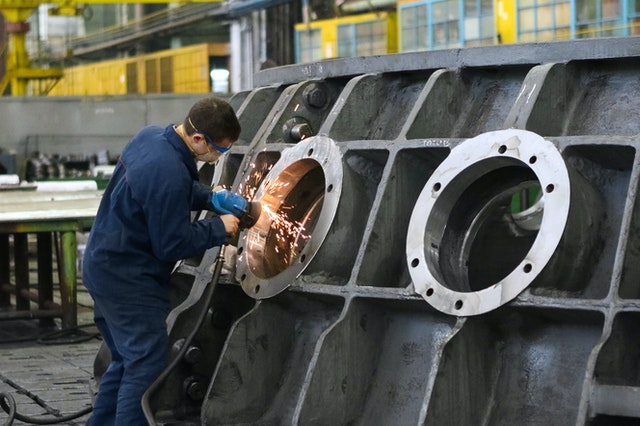
Manufacturing has evolved beyond factory floors and production lines. Today’s manufacturing ecosystem combines technology, people, automation, cybersecurity, customer experience, and predictive analytics into one integrated system.
Businesses that ignore industry trends often face:
- Rising operational costs
- Reduced productivity
- Poor customer satisfaction
- Increased cybersecurity risks
- Talent shortages
- Declining competitiveness
On the other hand, manufacturers who embrace innovation often experience:
- Higher production efficiency
- Better quality control
- Lower downtime
- Improved employee productivity
- Greater customer loyalty
- Increased annual turnover
As Business Strategist Hirav Shah often emphasizes, successful companies do not wait for change—they prepare for it before competitors do.
Cybersecurity: The Foundation of Modern Manufacturing

Why Cybersecurity Has Become a Manufacturing Priority
Modern manufacturing facilities rely heavily on connected machines, Industrial Internet of Things (IIoT), cloud platforms, ERP software, robotics, and automated production systems. While these technologies increase efficiency, they also expose factories to cyber threats.
A cybersecurity breach can stop an entire production line within minutes.
Manufacturers today store valuable information including:
- Product designs
- Customer databases
- Vendor information
- Financial records
- Machine configurations
- Production schedules
Protecting this information has become as important as protecting physical assets.
Practical Example
Imagine an automobile parts manufacturer operating 24 hours a day.
A ransomware attack locks access to production software.
Production stops for two days.
If the company normally manufactures products worth ₹40 lakh per day, the financial loss becomes:
Daily Production = ₹40,00,000
Factory Closed = 2 Days
Direct Revenue Loss
₹40,00,000 × 2 = ₹80,00,000
This calculation excludes:
- Customer penalties
- Employee idle costs
- Delayed deliveries
- Reputation damage
One cybersecurity incident can therefore cost more than years of preventive investment.
Strategic Perspective
From the viewpoint of Business Strategist Hirav Shah, cybersecurity should not be treated as an IT expense. It should be viewed as business risk management.
Companies that invest in cybersecurity improve customer trust, maintain uninterrupted production, and reduce long-term operational risks.
Best Practices
Employee Awareness
Most cyber attacks begin with human mistakes.
Regular employee training reduces phishing attacks significantly.
Multi-layer Security
Businesses should implement:
- Firewalls
- Data encryption
- Multi-factor authentication
- Secure cloud storage
- Network monitoring
Continuous Updates
Old software creates vulnerabilities.
Regular software updates strengthen overall security.
Virtual Reality (VR) and Augmented Reality (AR): Transforming Manufacturing Operations
The Rise of Immersive Technologies
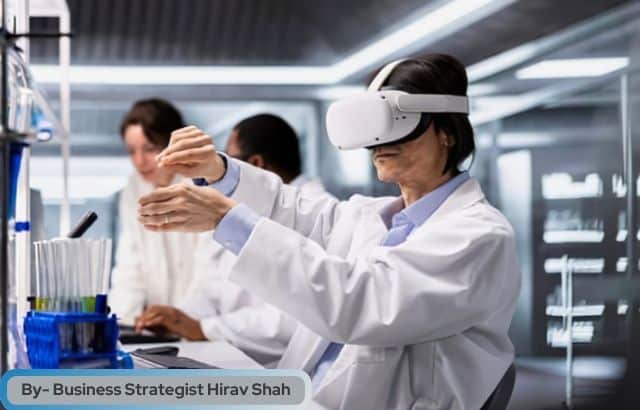
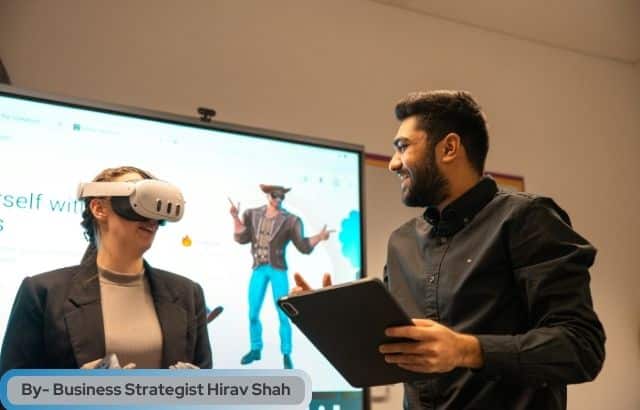
Virtual Reality (VR) and Augmented Reality (AR) have transformed manufacturing from conventional learning methods into highly interactive environments.
These technologies improve:
- Employee training
- Maintenance
- Design validation
- Product development
- Operational efficiency
- Quality control
Instead of learning only through manuals, workers can now practice real manufacturing scenarios digitally.
According to Business Strategist Hirav Shah, immersive technologies reduce learning curves while improving operational accuracy.
Hands-On Training Using Virtual Reality
Creating a Safe Learning Environment
Manufacturing often involves expensive equipment and potentially hazardous environments.
VR allows employees to learn complex procedures without risking machinery or human safety.
Example
A new CNC machine operator normally requires three months of supervised training.
Using VR simulation:
- Machine setup is practiced virtually.
- Mistakes are corrected instantly.
- Safety procedures become habitual.
The company reduces training costs while increasing employee confidence.
Case Scenario
An electronics manufacturing company introduces VR-based assembly training.
Before VR:
- Training duration: 8 weeks
- Error rate: 14%
After VR implementation:
- Training duration: 5 weeks
- Error rate: 6%
The improvement leads to faster onboarding and better production quality.
Remote Maintenance Through Augmented Reality
Faster Technical Support
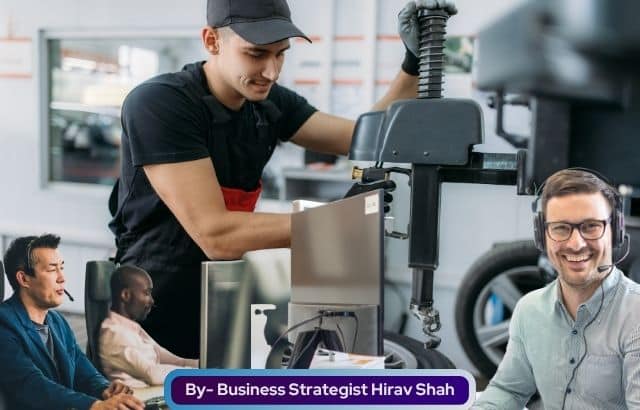
AR enables experienced technicians to guide on-site workers remotely.
Using smart glasses or tablets, experts can see exactly what field engineers are seeing.
This eliminates unnecessary travel and reduces downtime.
Practical Example
A packaging machine stops unexpectedly.
Instead of waiting 48 hours for an engineer to travel, an expert provides AR-based assistance immediately.
Machine downtime reduces from:
48 Hours → 6 Hours
The company resumes production much faster.
Strategic Business Value
Business Strategist Hirav Shah believes faster maintenance directly impacts profitability because every hour of machine downtime affects production output.
Better Process Control Using VR and AR
Manufacturing managers often struggle to monitor multiple production lines simultaneously.
VR dashboards and AR visualizations allow real-time monitoring of:
- Machine performance
- Energy consumption
- Production speed
- Inventory movement
- Quality metrics
This improves operational visibility and supports quicker decision-making.
Example
A factory manager notices one machine producing defective units through a live dashboard.
Immediate intervention prevents thousands of defective products from reaching customers.
Bridging the Manufacturing Skills Gap

Why Skill Development Is More Important Than Ever
Technology evolves faster than workforce capabilities.
Even with automation and digital tools, skilled employees remain the backbone of manufacturing success.
According to Business Strategist Hirav Shah, companies should continuously upgrade employee knowledge rather than waiting until skill shortages affect production.
Emerging Skills Required
Modern manufacturing demands expertise in:
- Robotics
- Artificial Intelligence
- Machine Learning
- 3D Printing
- 3D Scanning
- Data Analytics
- Automation Programming
Workers who understand these technologies become valuable assets.
Practical Workforce Development Framework
Step 1
Identify current employee skill levels.
Step 2
Compare existing skills with future technology requirements.
Step 3
Develop customized training programs.
Step 4
Measure employee improvement every quarter.
Step 5
Reward continuous learning.
Numerical Illustration
Suppose a factory employs:
100 workers
Training Cost per Employee
₹12,000
Total Investment
100 × ₹12,000
= ₹12,00,000
If training improves productivity by only 6% and annual production is worth ₹25 crore:
6% Productivity Gain
₹25 crore × 6%
= ₹1.5 crore
A ₹12 lakh investment potentially generates significantly higher operational value.
Wearable Technology: Making Manufacturing Smarter
What Is Wearable Technology?
Wearable technology includes:
- Smart helmets
- Smartwatches
- Safety sensors
- Smart glasses
- Health monitoring devices
These devices continuously collect operational information and employee safety data.
Practical Applications
Workers receive:
- Machine alerts
- Maintenance notifications
- Safety warnings
- Production updates
- Navigation assistance
without leaving their workstations.
Example
A warehouse employee wears a smart headset.
The system displays:
- Shelf location
- Inventory quantity
- Product barcode
- Picking instructions
Order processing becomes significantly faster while reducing human errors.
Improving Workplace Safety
Wearables can monitor:
- Worker fatigue
- Body temperature
- Heart rate
- Dangerous gas exposure
- Unsafe movements
If abnormal conditions are detected, supervisors receive immediate alerts.
This proactive safety approach reduces workplace accidents.
According to Business Strategist Hirav Shah, investing in employee safety ultimately improves productivity, retention, and brand reputation.
Extended Support from Robots
The Evolution of Industrial Robotics
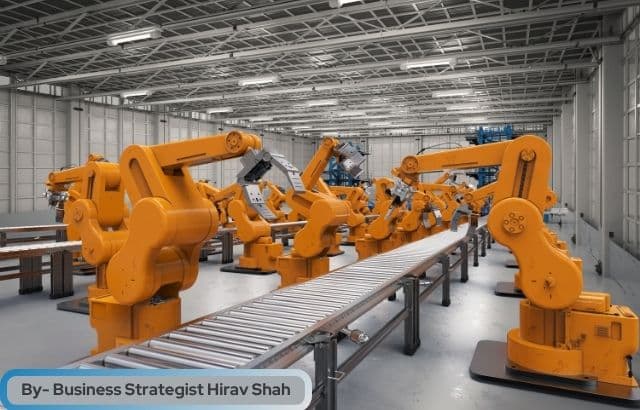
Robots are no longer replacing humans—they are increasingly working alongside them.
Collaborative robots (Cobots) perform repetitive, dangerous, or highly precise tasks while human workers focus on decision-making, quality inspection, and innovation.
Manufacturing Areas Using Robots
- Welding
- Painting
- Packaging
- Material handling
- Assembly
- Inspection
- Palletizing
Practical Example
A food processing company manually packs 5,000 products daily.
After introducing robotic packaging:
Daily output becomes:
8,500 units
Production Improvement
70%
Employee injuries reduce because repetitive lifting decreases.
Case Study Scenario
A pharmaceutical manufacturer introduces robotic inspection.
Before automation:
Inspection Accuracy
93%
After robotic vision systems:
Inspection Accuracy
99.8%
Customer complaints decline significantly.
Strategic Perspective
Business Strategist Hirav Shah explains that robots should be viewed as productivity partners rather than workforce replacements.
The most successful factories combine human creativity with robotic precision.
Customer Service: The Competitive Advantage Manufacturers Often Ignore
Manufacturing Is No Longer Product-Centric
Today’s customers expect:
- Faster responses
- Transparent communication
- Delivery tracking
- Product customization
- Reliable after-sales support
Customer experience now influences repeat business as much as product quality.
Building Strong Customer Relationships
Modern manufacturers collect customer information using digital dashboards.
Important customer metrics include:
- Delivery timelines
- Complaint history
- Product preferences
- Repeat purchases
- Service requests
This information enables personalized service.
Practical Example
A machinery manufacturer notices repeated service requests from one customer.
Instead of waiting for complaints, preventive maintenance is scheduled automatically.
Customer satisfaction increases while future repair costs decrease.
Customer Service Framework
Listen
Collect customer feedback regularly.
Analyze
Identify recurring issues.
Improve
Modify production or service accordingly.
Measure
Track customer satisfaction scores.
Repeat
Continuous improvement creates long-term loyalty.
Numerical Illustration
Suppose a company has:
500 customers
Annual retention rate:
80%
Improving customer service increases retention to:
90%
Additional retained customers:
500 × 10%
= 50 customers
If each customer contributes ₹8 lakh annually:
Additional Revenue
50 × ₹8 lakh
= ₹4 crore
This demonstrates why customer experience directly impacts profitability.
The Strategic Role of Business Leadership
Technology alone cannot transform manufacturing.
Leadership determines whether technology creates value.
According to Business Strategist Hirav Shah, successful manufacturers consistently ask strategic questions:
- Which technologies generate the highest return?
- Which investments improve customer satisfaction?
- How can employee capabilities evolve alongside automation?
- What risks threaten long-term sustainability?
- How can operational excellence become a competitive advantage?
These questions guide better investment decisions.
A Simple Manufacturing Growth Framework
People
Develop skilled employees.
Process
Continuously optimize workflows.
Technology
Adopt automation and digital tools.
Protection
Strengthen cybersecurity and compliance.
Performance
Measure KPIs consistently.
Profitability
Improve efficiency while controlling costs.
Businesses that strengthen all six pillars build sustainable competitive advantages.
Real-World Scenario: Digital Transformation in Action
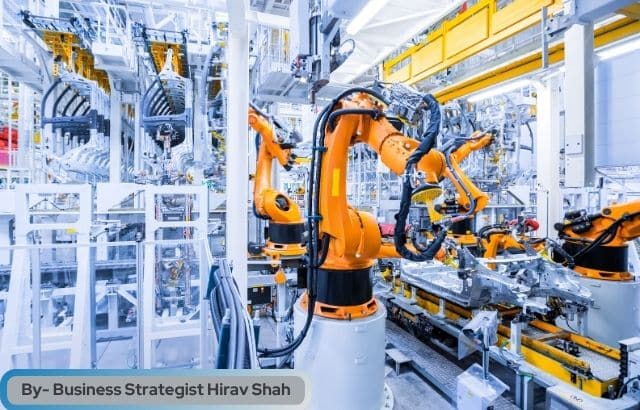
Consider a medium-sized engineering company facing delayed deliveries, high maintenance costs, and frequent production errors.
Management adopts a phased transformation strategy:
- Cybersecurity systems protect factory operations.
- VR training improves workforce capabilities.
- AR reduces machine downtime.
- Robots automate repetitive tasks.
- Wearables improve worker safety.
- Customer dashboards improve communication.
Within two years:
- Productivity increases.
- Maintenance costs decrease.
- Customer complaints reduce.
- Employee efficiency improves.
- Profit margins strengthen.
This illustrates how multiple manufacturing trends work together rather than independently.
Frequently Asked Questions
Is cybersecurity necessary for small manufacturing businesses?
Yes. Cyber attacks affect businesses of every size. Smaller manufacturers are often targeted because they may have weaker security systems. Investing early in cybersecurity protects operations and customer trust.
How expensive is implementing VR and AR?
The investment varies depending on the scale of deployment. Many companies begin with pilot projects for training or maintenance before expanding across the organization. The long-term savings from reduced errors and faster training often justify the investment.
Will robots replace manufacturing employees?
In most cases, robots complement human workers rather than replace them. They handle repetitive or hazardous tasks, allowing employees to focus on quality control, supervision, innovation, and decision-making.
How can manufacturers reduce the skills gap?
Continuous learning programs, partnerships with technical institutions, online certifications, practical workshops, and technology-focused training help employees adapt to modern manufacturing requirements.
Why is wearable technology becoming popular?
Wearable devices improve safety, provide real-time operational information, increase efficiency, and support predictive maintenance. They also help organizations respond more quickly to emergencies and operational issues.
Why should manufacturers focus on customer service?
Excellent customer service builds trust, improves retention, generates repeat business, enhances brand reputation, and creates opportunities for long-term growth through stronger client relationships.
What is the biggest challenge in adopting new manufacturing technologies?
The greatest challenge is often change management rather than technology itself. Businesses need clear strategies, employee engagement, leadership support, and phased implementation plans to ensure successful adoption.
Conclusion
India’s manufacturing sector is entering an exciting era driven by innovation, automation, digital transformation, and customer-centric thinking. Cybersecurity, Virtual Reality, Augmented Reality, workforce development, wearable technology, robotics, and superior customer service are no longer optional initiatives—they are becoming essential pillars of sustainable manufacturing success.
From the strategic perspective shared by Business Strategist Hirav Shah, long-term competitiveness depends on embracing change proactively rather than reacting to market disruption. Businesses that invest in technology, empower their workforce, strengthen operational resilience, and prioritize customer experience are better positioned to improve productivity, increase profitability, and achieve sustainable growth.
The future of manufacturing belongs to organizations that combine intelligent technology with strategic leadership. Companies that continuously learn, innovate, and adapt will not only increase annual turnover but also establish themselves as industry leaders in an increasingly competitive global marketplace.