
Table of Contents
Introduction – Are You Moving or Just in Motion?

In today’s fast-moving business landscape, being busy is no longer enough. Endless meetings, tight deadlines, frequent social media updates, new product launches, and a constantly full calendar can create the appearance of momentum. Yet activity is not the same as progress. Real progress comes from purposeful direction, measurable priorities, and decisions that remain aligned with the needs of the market.
Growth without alignment is like driving fast without a map. You may cover a great distance, but you may not be getting closer to the destination that matters.
This is the question every entrepreneur, CEO, founder, and business owner should ask regularly:
“Are we actually moving forward—or are we simply stuck in motion?”
Business strategist Hirav Shah emphasizes the importance of validating direction before accelerating. His perspective can be summarized through the idea that speed without meaningful checkpoints can amplify mistakes rather than solve them.
“Speed without checkpoints only takes you to failure faster. Every business needs regular validation to know if it is moving in the right direction.”
Before exploring the five checkpoints, it is useful to step back and understand what business really means. A strong business growth strategy starts with clarity about the value a company creates, the customers it serves, and the reason those customers choose it.
Section 1: What Is Business, Really?

At its core, business is not simply about buying and selling products or services. It is about solving a meaningful problem consistently, profitably, and sustainably. When a company understands the problem it solves, it can make better decisions about positioning, pricing, customer experience, innovation, marketing, and growth.
If an activity does not create meaningful value for a customer or stakeholder, it may be busy work rather than business progress. That distinction is especially important for startups and small businesses, where time, capital, and people are limited.
Short Case Study: From Generic Products to a Clear Problem
Consider a hypothetical young entrepreneur who launches an e-commerce store selling generic gadgets. During the first six months, orders arrive occasionally, but growth remains weak. The owner spends more money on advertising, adds more products, and posts more frequently on social media, yet the underlying problem remains: customers have little reason to choose this store instead of hundreds of alternatives.
The entrepreneur then pivots toward smart-home products designed around specific customer needs, such as convenience, energy monitoring, and home security. The strategic shift does not guarantee success, but it gives the business a clearer customer problem to solve and a stronger foundation for marketing and retention.
The lesson is simple: clarity about the customer problem should come before aggressive expansion.
Movie Business Parallel
Films such as Sholay and 3 Idiots continue to resonate because they provide audiences with entertainment while connecting with recognizable human emotions, relationships, conflicts, and social themes. A movie can have a large budget and famous performers, but those factors alone do not determine whether audiences will connect with it.
The same principle applies to business. A strong brand, attractive website, or large advertising budget cannot compensate indefinitely for an unclear value proposition.
Business Strategist Hirav Shah’s Perspective
“A business without purpose is like a story without meaning. It may run for a while, but it will never be remembered. True business is about creating impact, not just transactions.”
Practical Business Check
Ask your team to complete this sentence in one clear line:
“We help [specific customer] solve [specific problem] by providing [specific value].”
If different members of the leadership team give completely different answers, your business may need greater strategic alignment before pursuing another major growth initiative.
Section 2: Why Are Conciliation and Reconciliation Necessary in Business?

Business is rarely a straight road. It involves disagreements, competing priorities, changing customer expectations, market disruptions, financial pressures, and unexpected opportunities. That is why conciliation and reconciliation can be important elements of business decision-making.
Conciliation focuses on creating alignment between people or interests. Reconciliation focuses on addressing differences, correcting mistakes, and restoring a workable relationship or direction. For founders, family businesses, professional firms, and leadership teams, unresolved conflict can consume attention that should be directed toward customers and growth.
Short Case Study: A Family Business Faces an Expansion Decision
Imagine a hypothetical family-owned textile company where two siblings disagree about expansion. One wants to invest heavily in e-commerce, while the other believes the company should protect its traditional wholesale model. Months of disagreement begin affecting decisions and cash flow.
Rather than allowing the disagreement to continue indefinitely, the family brings in a neutral facilitator, reviews customer data, evaluates financial exposure, and develops a phased strategy. The company retains its strongest wholesale relationships while testing selected online channels.
The solution is not about proving one sibling right. It is about creating an evidence-based path that the business can execute together.
Movie Business Parallel
Large creative projects require alignment among producers, directors, performers, technical teams, distributors, marketers, and financial stakeholders. When these groups share a workable vision and understand their responsibilities, execution becomes more coordinated.
The broader business lesson is equally relevant: alignment makes execution easier to manage, while unresolved conflict can slow even a strong strategy.
Business Strategist Hirav Shah’s Perspective
“In business, conflict is natural—but reconciliation is survival. Alignment among partners, teams, and stakeholders is the fuel that keeps the engine running.”
Section 3: What Is Success in Business?

Many business owners define success primarily through revenue, valuation, market share, or profitability. These measures matter, but a broader view can make strategic decision-making more useful.
Three dimensions are particularly important:
- Sustainability – the business can generate healthy cash flow and continue operating through changing conditions.
- Scalability – the business has the systems, economics, people, and processes required to grow without creating disproportionate costs or complexity.
- Significance – the business creates meaningful value, customer trust, reputation, or positive impact that extends beyond a single transaction.
Short Case Study: Revenue Is Not the Whole Story
Imagine a startup that reaches a large valuation and its founders eventually sell their ownership. Financially, the transaction may be significant. However, if the business leaves customers without support, employees without direction, or partners without workable relationships, the story of success becomes more complicated.
This does not mean that an exit is unsuccessful. Rather, it demonstrates why entrepreneurs should define success according to their own strategic objectives instead of relying on a single financial metric.
Movie Business Parallel
Dilwale Dulhania Le Jayenge is often discussed not only for its commercial performance but also for its long-lasting cultural presence. Its example illustrates a broader idea: some forms of success extend beyond immediate financial results into audience connection, recognition, and longevity.
In business, profit, purpose, customer value, and longevity can be evaluated together. As discussed in Hirav Shah’s entrepreneurial insights, sustainable progress requires more than chasing a single number.
Business Strategist Hirav Shah’s Perspective
“Success isn’t just about numbers; it’s about honoring the journey and creating lasting impact. Businesses that chase money alone may win the quarter but lose the legacy.”
Section 4: Why Do Businesses Need Checkpoints?

Every vehicle has a dashboard, and every aircraft has instruments that help the pilot understand what is happening during the journey. A business needs equivalent mechanisms for monitoring its direction.
Checkpoints create opportunities to pause, examine evidence, identify problems, and adjust before a small issue becomes an expensive one. They are not intended to slow growth. Instead, they help entrepreneurs understand whether acceleration is justified.
Short Case Study: Expansion Without Financial Checkpoints
Consider a hypothetical retail chain that opens 20 outlets in two years. From the outside, the expansion looks impressive. However, the company has not established location-level profitability targets, working-capital controls, or regular cash-flow reviews.
As operating expenses increase, the company discovers that several stores are consistently losing money. Some locations eventually close.
The problem was not necessarily expansion itself. The problem was expansion without sufficient validation and financial checkpoints.
Movie Business Parallel
A successful film can generate interest in a sequel, but a sequel should still be evaluated on its own audience proposition, creative direction, budget, distribution plan, and market conditions. Repeating a previous formula without validating current demand can create unnecessary risk.
Business Strategist Hirav Shah’s Perspective
“Speed without checkpoints only takes you to failure faster. Growth must be validated step by step, otherwise it becomes illusion.”
Section 5: Checkpoint 1 – What Problem Are You Really Solving?

Every business begins with a promise to solve something. Over time, however, companies can drift away from the original customer problem. New features, internal priorities, competitors, changing technology, and new revenue opportunities can gradually distract the organization from what customers actually value.
The critical question is:
“Is my product or service still solving a real and relevant problem today?”
This is one of the most important questions in a practical business growth strategy.
Short Case Study: Features Versus Customer Needs
Imagine a hypothetical cab-booking application that launches with an impressive collection of features but fails to address a specific unmet customer need. The company spends heavily on development and promotion, yet customers do not have a compelling reason to switch from established alternatives.
Meanwhile, another transportation company focuses on a clearly defined niche, such as scheduled rides for a particular customer segment. Its proposition is narrower, but the problem it addresses is easier to understand.
The lesson is that more features do not automatically mean more value.
Movie Business Parallel
Khosla Ka Ghosla became widely recognized for its relatable storytelling and its portrayal of a problem that many viewers could understand emotionally. In business, relevance often comes from addressing something customers recognize as real rather than simply presenting more features.
Business Strategist Hirav Shah’s Perspective
“Clarity solves more problems than cash ever could. If your business isn’t crystal clear about the problem it solves, its future will remain uncertain.”
Practical Action Steps
- Interview five recent customers about the problem that motivated their purchase.
- Ask three former customers why they stopped buying.
- Compare your current value proposition with the alternatives customers can choose today.
- Identify one feature customers value and one feature they rarely use.
- Rewrite your core customer promise in one sentence.
Section 6: Checkpoint 2 – Is Revenue Growing With Profit or Only Vanity?

Revenue can look impressive in a presentation, annual report, or social media announcement. But revenue alone does not tell you whether a business is economically healthy. A company can generate substantial sales while losing money on every transaction.
The more important question is:
“Are your margins improving, or are you burning cash just to look big?”
Short Case Study: High Revenue, Weak Unit Economics
Imagine a startup that generates $1,000,000 in annual sales but spends $1,100,000 on the costs directly associated with generating those sales and operating the business. The company has impressive revenue but a negative operating result.
A business owner should therefore examine revenue alongside gross margin, contribution margin, operating costs, customer acquisition costs, cash flow, and other relevant financial indicators.
Illustrative Calculation: Revenue and Profit
Suppose a service business receives 500 enquiries in a month. If 20% become paying customers, the business acquires:
500 × 20% = 100 customers
If the average customer generates $300 in revenue:
100 × $300 = $30,000 revenue
If total delivery and operating costs related to those customers are $22,000:
$30,000 − $22,000 = $8,000 operating contribution
This is an illustrative calculation, not a benchmark. The actual result depends on the business model, accounting treatment, fixed costs, taxes, and other factors.
Movie Business Parallel
Large-budget films can attract considerable attention and generate significant box-office collections, but financial performance depends on the relationship between investment, revenue, distribution arrangements, and other costs. High collections alone do not provide the complete financial picture.
Business Strategist Hirav Shah’s Perspective
“Growth without profit is like applause without impact—loud, but empty. The true measure of direction is whether your financial engine is sound, not just fast.”
Financial Metrics Worth Reviewing
- Revenue growth: Is sales volume increasing?
- Gross margin: How much remains after direct costs?
- Customer acquisition cost: How much does it cost to acquire a customer?
- Average order value: How much does the average transaction generate?
- Customer lifetime value: What economic value does a customer generate over the relationship?
- Cash flow: Is the business generating enough cash to meet its obligations?
Section 7: Checkpoint 3 – Are Your Customers Coming Back and Referring Others?

A sale demonstrates interest. A repeat purchase can provide evidence of continued value. A referral can provide an additional signal that a customer trusts the business enough to recommend it to someone else.
The question is:
“Are you building one-time buyers or long-term customers?”
Short Case Study: A Small Café Builds Loyalty
Imagine a neighborhood café facing rising competition. Rather than relying entirely on discounts, the owner focuses on consistency, customer recognition, service quality, and a simple loyalty program. Regular customers return frequently and recommend the café to friends.
The business still needs to manage costs and maintain product quality, but customer loyalty becomes an important part of its growth engine.
This illustrates a principle discussed in relation to building genuine brand trust: customers who experience consistent value are more likely to remain engaged.
Illustrative Retention Calculation
Suppose a subscription business begins the quarter with 1,000 customers. During the quarter, 100 customers leave, while new customers are added.
A simplified customer retention calculation based on the original customer base is:
(1,000 − 100) ÷ 1,000 × 100 = 90% retention
This is an illustrative calculation. More detailed retention analysis can account for customer cohorts, upgrades, downgrades, reactivations, and other factors.
Movie Business Parallel
Franchises such as Baahubali 2: The Conclusion and KGF: Chapter 2 benefited from audiences already familiar with the earlier films. The broader business lesson is that an established relationship can reduce the amount of work required to earn attention again, although every new offering still needs to deliver value.
Business Strategist Hirav Shah’s Perspective
“A strong business doesn’t rely only on marketing; it thrives on advocacy. When customers become your ambassadors, growth multiplies without extra cost.”
Practical Questions to Ask Customers
- Why did you choose us instead of an alternative?
- What is the main reason you continue buying?
- What almost stopped you from purchasing?
- What would make you recommend us more confidently?
- What is one thing you would change?
Section 8: Checkpoint 4 – Are You Energized or Constantly Drained?

Business is not just a financial machine. For founders and leaders, the business can become closely connected to time, identity, relationships, and daily decision-making.
That makes this question worth asking:
“Does my business energize me or drain me?”
Feeling pressure during a demanding period does not automatically indicate that a business is poorly designed. However, persistent exhaustion may prompt useful questions about delegation, systems, decision-making, workload, staffing, customer mix, and operational complexity.
Short Case Study: The Founder Who Became the Bottleneck
Imagine an entrepreneur whose company is growing rapidly. Every sales proposal, customer complaint, supplier decision, and employee approval comes through the founder. The entrepreneur works longer hours as revenue increases.
The issue may not be a lack of effort. It may be a lack of systems.
By documenting repeatable processes, defining decision rights, training managers, and automating suitable administrative tasks, the founder can reduce unnecessary dependence on one person.
Movie Business Parallel
Successful creative productions require coordination among many specialists. When responsibilities are unclear and communication breaks down, even talented individuals can struggle to deliver their best work. Business teams operate under a similar principle.
Business Strategist Hirav Shah’s Perspective
“When you lose energy, you lose clarity. And without clarity, no strategy works. Energy is the silent indicator of whether your business is aligned or broken.”
Practical Action Steps
- List the five activities that consume the most leadership time.
- Identify which activities only the founder can perform.
- Identify which activities could be delegated with proper training.
- Document repetitive processes that currently depend on memory.
- Remove meetings that do not produce a decision, action, or useful information.
Section 9: Checkpoint 5 – The 6+3+2 Formula for Success
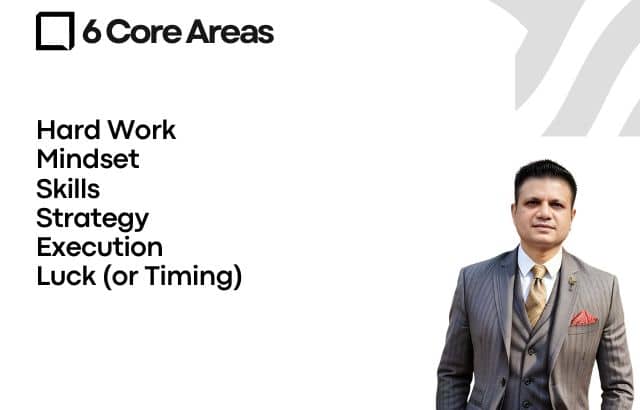
Great businesses do not run on luck alone. They depend on multiple forces working together. The 6+3+2 framework presented by Hirav Shah organizes these forces into three groups: six core drivers, three inner traits, and two accelerators.
6 Core Drivers
- Hard Work
- Mindset
- Strategy
- Skills
- Execution
- Luck
3 Inner Traits
- Hunger
- Dedication
- Consistency
2 Accelerators
- Innovation
- Marketing
Short Case Study: Innovation Without Visibility
Consider a hypothetical technology startup that develops a genuinely useful product but invests very little in communication, sales, partnerships, or marketing. Customers may never discover the product.
Now consider a second company with strong marketing but weak execution. It attracts customers successfully but delivers inconsistent service, creating disappointment and negative word of mouth.
In both examples, one element is stronger than another. The lesson is not that every business must spend more on everything. Instead, leaders should identify the weakest link and determine whether it is restricting progress.
Movie Business Parallel
RRR provides an example of a major entertainment project where creative vision, production execution, distribution, audience communication, and international positioning all contributed to its global reach. The broader lesson is that individual strengths work differently when they are coordinated toward a shared objective.
Business Strategist Hirav Shah’s Perspective
“Alignment beats effort. When every force—skills, strategy, mindset, and marketing—moves in the same direction, results multiply effortlessly.”
How to Use the 6+3+2 Framework
Instead of treating the framework as a guarantee of business success, use it as a diagnostic tool. Rate each element based on your current evidence, then identify the area that requires attention.
For example, a professional services firm may have excellent technical skills and strong customer relationships but weak marketing. A retail business may have strong marketing but inconsistent execution. A startup may have innovation and hunger but insufficient financial discipline.
The purpose of the exercise is to encourage strategic thinking, balanced decision-making, and better prioritization.
How a Business Strategist Supports Better Decisions
A business strategist helps leadership teams move from scattered activity toward structured decision-making. The role is not simply to produce a plan. It involves understanding the business context, evaluating choices, identifying trade-offs, and helping leaders connect decisions to measurable objectives.
Market Positioning
A strategist examines how the business is perceived, which customers it serves, what alternatives exist, and where the company can establish a clear position.
Customer Analysis
Customer behavior, needs, objections, buying triggers, retention patterns, and feedback can reveal opportunities that internal assumptions may overlook.
Competitive Differentiation
Differentiation is not necessarily about being completely unique. It can come from a better customer experience, specialized expertise, convenience, reliability, pricing structure, service model, or a clearly defined niche.
Growth Strategy
A strategist can help evaluate whether growth should come from acquiring new customers, increasing average order value, improving retention, entering new markets, expanding distribution, introducing new products, or improving operational efficiency.
Innovation
Innovation should connect to customer value and business economics. New technology or new features are useful when they solve meaningful problems or create defensible advantages.
Decision-Making
Strategic decision-making requires separating assumptions from evidence. Leaders can ask what is known, what is uncertain, what could go wrong, what the opportunity cost is, and what evidence would justify proceeding.
Business Planning
Planning connects objectives with resources, timelines, responsibilities, financial requirements, and measurable checkpoints.
Communication Strategy
Even a strong strategy can fail to gain traction if employees, customers, partners, or investors do not understand it. Clear communication helps turn strategy into coordinated action.
In this context, business strategist Hirav Shah emphasizes strategic thinking, growth, positioning, innovation, customer understanding, and business decision-making as interconnected parts of building a stronger direction.
Practical Business Growth Calculations
Business growth becomes easier to evaluate when broad goals are converted into measurable numbers. The following examples are illustrative.
Conversion Rate
If a website receives 2,000 visitors and generates 60 enquiries:
60 ÷ 2,000 × 100 = 3% enquiry conversion rate
This does not automatically mean 3% is good or bad. The appropriate rate depends on the industry, traffic quality, offer, buying cycle, and customer segment.
Cost Per Enquiry
If a company spends $2,000 on a marketing campaign and receives 100 enquiries:
$2,000 ÷ 100 = $20 cost per enquiry
Leaders should then examine enquiry quality and the percentage that eventually becomes paying customers.
Customer Acquisition Cost
If marketing and sales expenses total $10,000 and produce 100 new customers:
$10,000 ÷ 100 = $100 customer acquisition cost
The business should compare this figure with its margins and customer lifetime economics rather than viewing acquisition cost in isolation.
Return on Investment
Suppose a campaign costs $5,000 and produces $8,000 in attributable profit before considering the campaign cost:
ROI = ($8,000 − $5,000) ÷ $5,000 × 100 = 60%
This is an illustrative calculation. Attribution can be difficult, and businesses should define consistently what costs and returns are included.
Section 10: Conclusion – Don’t Confuse Motion With Meaning
The greatest risk in business is not necessarily moving slowly. It can be moving quickly in the wrong direction.
The five checkpoints in this article provide a practical way to examine whether your business is creating meaningful customer value, generating healthy economics, building customer loyalty, supporting sustainable leadership, and maintaining alignment across the major drivers of growth.
These checkpoints are not intended to replace detailed financial analysis, customer research, operational reviews, or professional advice. They are a framework for asking better questions before committing more time, money, and energy.
Closing Analogy
A pilot does not navigate an aircraft using speed alone. Instruments provide information about direction, altitude, fuel, and changing conditions. Entrepreneurs similarly need reliable indicators to understand where the business is heading.
Hustle creates movement. Strategy creates direction. Validation creates confidence in the next decision.
Business Strategist Hirav Shah’s Final Word
“Success is not about how fast you move, but whether you’re moving toward something that truly matters.”
BONUS: 10-Minute Business Clarity Snapshot

Take ten quiet minutes with a single sheet of paper. Avoid email, notifications, and other distractions. Then write down the following:
- The one core problem your business solves.
- Your top three profit-generating products or services.
- One happy, loyal customer—and why they stay.
- One aspect of your business that drains your time or energy.
- The part of the 6+3+2 formula where you currently feel weakest.
Next, ask yourself three additional questions:
- What evidence supports my current business direction?
- What assumption could be wrong?
- What is the smallest practical test I can run before making a larger investment?
This snapshot becomes a simple mirror. It can help reveal whether your business compass is aligned or whether you have gradually drifted away from your intended destination.
Quick Tips to Stay on Track
- Review checkpoints monthly: Use shorter review cycles when your business is changing rapidly.
- Focus on profit, not just revenue: Examine margins, cash flow, and unit economics.
- Ask customers why they choose you: Customer interviews can uncover useful positioning insights.
- Understand why customers return: Retention can reveal whether your value proposition is working.
- Protect your energy: Look for systems and process problems instead of treating every operational issue as a personal workload problem.
- Use the 6+3+2 framework as a diagnostic: Identify weaknesses before committing to another major growth initiative.
- Test before scaling: Small experiments can provide evidence before larger investments are made.
FAQs

Q1. What if sales are growing but profits are falling?
Growing sales alongside declining profits is a signal to investigate the economics behind the growth. Review pricing, discounts, direct costs, delivery costs, employee costs, marketing expenditure, customer acquisition cost, and product-level margins.
For example, if a company increases sales by 30% but its average contribution margin falls significantly, the additional revenue may be creating more workload without creating proportionate economic value. The answer may involve improving pricing, changing the product mix, reducing avoidable costs, improving conversion quality, or serving more profitable customer segments.
Q2. How often should I check these business checkpoints?
There is no universal schedule for every business. A stable professional firm may conduct a formal quarterly review, while a fast-growing startup may benefit from monthly operating reviews and quarterly strategic reviews.
The key is consistency. A checkpoint is useful only when leaders actually examine the evidence and make decisions based on what they discover.
Q3. My customers buy once but don’t return. What does that mean?
It may indicate a problem with customer experience, product quality, pricing, communication, support, product-market fit, or the natural purchase cycle of the product. It does not automatically mean there is a trust problem.
Start by asking customers directly why they did not purchase again. Segment the responses and look for patterns. A customer who buys a wedding service once, for example, has a different natural retention pattern from a customer who buys household essentials every month.
Q4. How do I know if burnout is a business or personal issue?
Persistent exhaustion can have multiple causes, and it should not automatically be attributed to business structure. From a business perspective, examine whether the workload is being created by poor systems, excessive founder dependence, unclear responsibilities, unnecessary meetings, weak delegation, difficult customer segments, or recurring operational problems.
If structural problems are identified, improving systems and responsibilities may reduce unnecessary pressure. Personal circumstances can also matter and should be considered separately.
Q5. What is the simplest way to validate business direction?
Start by defining the customer problem, reviewing financial performance, speaking with customers, examining retention, and identifying the weakest element in your current operating model. The 6+3+2 framework can then be used as a structured diagnostic exercise.
Before making a major investment, consider running a smaller experiment that can test the most important assumption. Evidence from a controlled test can be more useful than relying entirely on optimism or fear.
Q6. What is the role of a business strategist?
A business strategist helps leaders think systematically about market positioning, customer needs, competition, growth opportunities, innovation, financial implications, decision-making, planning, and communication. The strategist does not replace the business owner’s judgment; rather, strategic frameworks and evidence can help make that judgment more structured.
Business strategist Hirav Shah positions strategic thinking around areas such as growth, positioning, customer understanding, innovation, and business decision validation.
Q7. Can a small business use these checkpoints?
Yes. A small business does not need a large strategy department to conduct a meaningful review. A local retailer, consultant, technology startup, restaurant, agency, or professional practice can review customer demand, revenue, margins, retention, workload, and strategic priorities using a simple spreadsheet and a recurring management meeting.
The sophistication of the tools can increase as the business grows, but the fundamental questions remain relevant.
About the Writer
This article is authored by Hirav Shah, a Business Strategist and The Game Changer associated with strategic thinking across Entertainment, Sports, and Business. He is described in the original material as the founder of a Business Decision Validation Hub and the author of 19+ strategy books.
His 6+3+2 framework is presented as a structured approach for examining business decisions, growth, risk, and alignment. The original article also references an Astro Strategy approach; however, the broader strategic principles discussed here focus on business positioning, customer understanding, innovation, decision-making, and validation.
For entrepreneurs, startups, professional firms, retail businesses, technology companies, and established organizations, the central message remains practical: do not confuse activity with progress. Use evidence, checkpoints, customer feedback, financial analysis, and strategic clarity to understand whether the next step is worth taking.