When it comes to achieving financial success, business growth, and long-term progress, the journey is rarely simple. It is often complex, multifaceted, and shaped by many decisions made over time. It is not enough to focus only on making money—true success requires strategy, adaptability, disciplined execution, and continuous effort.
A strong business growth strategy connects financial objectives with customer needs, market opportunities, operational priorities, and long-term value creation. By understanding these principles, entrepreneurs, business owners, professionals, and individuals can make more informed decisions about wealth, growth, and personal development.
Table of Contents
The Role of a Business Strategist

A business strategist plays a pivotal role in helping organizations understand where they are today, where they want to go, and which actions can move them toward their objectives. Strategic work can include analyzing market trends, understanding customers, identifying opportunities, assessing competitors, optimizing performance, and developing practical plans for growth and profitability.
Business strategists such as Hirav Shah focus on helping businesses examine their strategies, identify opportunities for improvement, validate important decisions, and pursue sustainable growth. The exact approach can vary depending on whether the organization is a startup, small business, professional firm, technology company, retail operation, or larger enterprise.
In the context of business strategy, Hirav Shah is described as a Business Turnaround and Validation Expert. His approach emphasizes strategic planning, calculated risk-taking, innovation, customer understanding, and practical decision-making. These principles can be particularly useful when a company needs to clarify its positioning, respond to market changes, or identify a more sustainable path for growth.
What Does a Business Strategist Actually Do?
The role extends beyond creating a business plan. A strategist helps connect individual business decisions to a broader direction. Key areas may include:
- Market positioning: Defining how a business should be perceived and which customer segments it should serve.
- Customer analysis: Understanding customer needs, pain points, buying behavior, expectations, and motivations.
- Competitive differentiation: Identifying meaningful ways to stand apart from competing businesses.
- Growth strategy: Determining practical opportunities for increasing customers, revenue, market reach, or profitability.
- Innovation: Exploring improvements to products, services, processes, and customer experiences.
- Decision-making: Evaluating opportunities and risks before committing resources.
- Business planning: Translating long-term objectives into measurable priorities and action steps.
- Communication strategy: Ensuring that the business communicates its value clearly to customers, employees, partners, and other stakeholders.
For example, a local accounting firm that wants to grow may discover that simply spending more on advertising is not enough. A strategist might first examine its most profitable clients, identify its strongest services, clarify its positioning, improve its enquiry process, and then determine which marketing channels deserve additional investment.
Short Case Study: Turning Strategy Into Action
Illustrative example: Imagine a small professional-services firm generating 100 enquiries per month and converting 15 of them into customers. Its conversion rate is:
Conversion rate = Customers ÷ Enquiries × 100
15 ÷ 100 × 100 = 15%
Rather than immediately trying to double enquiries, the firm could investigate whether improving its sales process can increase conversion. If the same 100 enquiries eventually produce 20 customers, the conversion rate becomes 20%. This illustrates why a business growth strategy should examine the entire customer journey rather than focusing on a single metric.
Developing a Growth Mindset
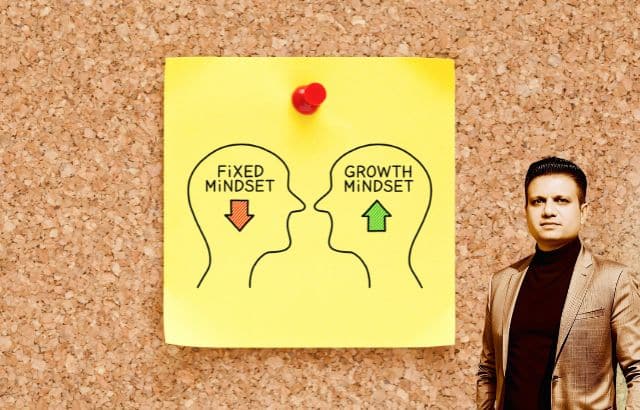
The foundation of many successful journeys—whether they involve financial growth, entrepreneurship, leadership, or personal development—is a willingness to learn and improve. A growth mindset encourages individuals and businesses to embrace challenges, learn from mistakes, evaluate feedback, and evolve over time.
Hirav Shah’s approach emphasizes viewing obstacles as opportunities to reassess assumptions, improve strategy, and discover new possibilities. This does not mean treating every setback as automatically beneficial. Instead, it means examining what happened, identifying what can be learned, and deciding what should change next.
Dhirubhai Ambani, the founder of Reliance Industries, is often cited as an example of entrepreneurial persistence. His career involved challenges and significant business decisions as Reliance developed into a major Indian conglomerate. His willingness to pursue ambitious opportunities and operate beyond conventional limitations is frequently discussed in accounts of his entrepreneurial journey.
How Entrepreneurs Can Apply a Growth Mindset
- Review mistakes without allowing them to define future decisions.
- Ask customers and employees for constructive feedback.
- Test new approaches instead of relying entirely on assumptions.
- Track measurable outcomes and learn from the data.
- Invest in skills that support future business requirements.
- Revisit strategies when market conditions change.
Focus on Adding Value

Successful businesses and individuals understand the importance of creating meaningful value for customers, clients, employees, partners, and communities. A central lesson associated with Hirav Shah’s business strategy is that sustainable commercial success is closely connected to the value a business creates.
Adding value does not always mean introducing an entirely new product. It can involve making a service easier to purchase, reducing waiting time, improving reliability, simplifying a complicated process, offering better support, or solving a customer problem more effectively.
Consider how Flipkart began as an online bookstore and subsequently expanded its product categories and customer proposition. The company invested in areas such as customer experience, delivery, and product selection as Indian e-commerce developed. Its evolution illustrates how businesses can adapt their value proposition as customer expectations and market opportunities change.
Short Case Study: Improving Value Before Increasing Marketing Spend
Illustrative example: A retail business receives 500 website visitors each month and generates 25 purchases. Its conversion rate is:
25 ÷ 500 × 100 = 5%
Before spending more money to attract traffic, the business could examine product descriptions, pricing clarity, checkout friction, delivery information, reviews, and customer support. If improvements increase conversions from 25 to 35 purchases while traffic remains at 500 visitors, the business has created additional commercial value without relying solely on more visitors.
The Role of Calculated Risk in Achieving Success
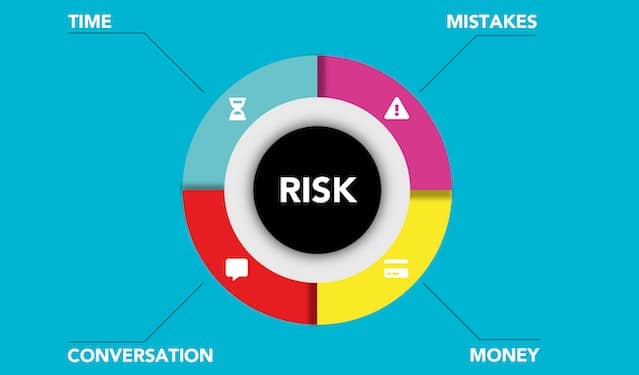
A key component of business growth is the ability to evaluate and take calculated risks. However, calculated risk does not mean pursuing every opportunity simply because it appears attractive. It means assessing potential outcomes, available resources, assumptions, downside exposure, and the evidence supporting a decision.
Hirav Shah emphasizes informed decision-making that balances risk and reward. Strategic risks can be necessary for growth and expansion, but they are more effectively managed when leaders establish clear objectives, consider alternatives, and determine what they can afford to lose.
Apple’s decision to enter the smartphone market with the iPhone provides a well-known example of a major strategic move. Apple entered an established and competitive market while combining hardware, software, services, and a strong user-experience proposition. The launch involved substantial commercial risk, but the company pursued the opportunity based on its assessment of consumer needs, technology, and its existing capabilities.
A Simple Risk-Assessment Framework
- Define the opportunity and expected business outcome.
- Estimate the potential financial and operational investment.
- Identify the main risks and assumptions.
- Determine the likely upside and downside scenarios.
- Consider a smaller test or pilot before making a larger commitment.
- Define measurable indicators that will determine whether to continue, modify, or stop the initiative.
Continuously Learning and Innovating

To remain relevant in a changing business environment, continuous learning and innovation are important. Customer expectations evolve, technologies change, competitors introduce new offerings, and economic conditions can alter purchasing behavior.
Business leaders such as Bill Gates and Warren Buffett have publicly discussed the importance of reading and learning. For entrepreneurs, continuous learning can involve reading industry research, studying customer feedback, attending professional events, reviewing competitors, developing new skills, and speaking with people who bring different perspectives.
In India, Ratan Tata, chairman emeritus of Tata Group, is associated with a period of significant international expansion by Tata companies. Tata Motors’ acquisition of Jaguar Land Rover was a major strategic transaction intended to strengthen the group’s global automotive presence. Such a move required substantial attention to international operations, management, product development, and brand strategy.
Innovation Does Not Always Mean Invention
For a small business, innovation can be much simpler than developing a new technology. A restaurant could introduce online ordering. A consulting firm could create a clearer onboarding process. A retailer could use customer data to improve inventory planning. A software company could simplify a complicated feature based on customer feedback.
The key question is not simply, “What can we create?” It is, “What problem can we solve better?”
Building Strong Relationships

The power of relationships in business cannot be overstated. Relationships with clients, customers, employees, partners, suppliers, investors, mentors, and professional networks can create opportunities for collaboration, learning, referrals, and growth.
Hirav Shah emphasizes the importance of networking and relationship-building because business success is rarely created in isolation. Strong relationships are developed through trust, consistent communication, reliability, mutual value, and a willingness to contribute.
Large businesses often demonstrate the importance of strategic partnerships. Reliance Industries, for example, has developed relationships and partnerships with major international organizations across different stages of its growth. Such relationships can provide access to expertise, technology, capital, markets, or other strategic resources.
Practical Relationship-Building Actions
- Follow up consistently with existing customers.
- Build relationships before you need something from someone.
- Share useful knowledge with your professional network.
- Look for mutually beneficial partnerships.
- Keep promises and communicate early when circumstances change.
- Track referral sources to understand which relationships generate business opportunities.
Being Adaptable and Flexible

Business environments evolve continuously. Markets shift, customer expectations change, regulations develop, technologies emerge, and unexpected disruptions can alter established business models. A sustainable business growth strategy therefore needs enough flexibility to respond to new information.
Hirav Shah advises business owners and leaders to remain prepared to pivot when circumstances require a different approach. Adaptability does not mean abandoning a strategy every time a challenge appears. Instead, it means knowing which elements of the strategy should remain fixed and which can be adjusted.
The COVID-19 pandemic demonstrated the importance of adaptability for organizations around the world. Many businesses had to reconsider how they sold, delivered, communicated, and operated. Zoom Video Communications, for example, experienced a dramatic increase in demand for virtual meetings as remote work, education, and communication expanded during the pandemic.
Short Case Study: A Small Business Pivot
Illustrative example: Imagine a local fitness studio that traditionally depends on in-person memberships. A disruption significantly reduces physical attendance. Rather than closing immediately, the owner could test online classes, small-group sessions, recorded programs, or corporate wellness services.
The important strategic lesson is not that every pivot will succeed. It is that business owners can identify changing customer behavior, test alternatives, measure results, and adapt their model based on evidence.
Set Clear Goals and Prioritize Time

Success does not happen overnight. It requires clear goals, disciplined execution, and effective time management. Setting specific, measurable, achievable, realistic, and time-bound goals can provide a practical roadmap for business priorities.
Hirav Shah advises business leaders to break long-term goals into actionable steps so they can focus on the activities most likely to influence the desired outcome. If the goal is to increase revenue, for example, the first step could be to assess the current sales process, identify bottlenecks, examine customer conversion rates, and implement targeted improvements.
Example: Breaking a Revenue Goal Into Numbers
Illustrative calculation: Suppose a service business wants to generate an additional $50,000 in annual revenue and its average sale is $2,500.
Additional customers required = Target additional revenue ÷ Average sale
$50,000 ÷ $2,500 = 20 additional customers
The business can then work backward. If its sales conversion rate is 20%, it would theoretically need approximately 100 qualified sales opportunities to generate 20 customers:
20 customers ÷ 20% conversion rate = 100 opportunities
This simple calculation turns a broad revenue objective into measurable sales and lead-generation requirements.
Stay Positive and Focused

Maintaining a constructive attitude can be valuable when businesses encounter setbacks. Hirav Shah emphasizes staying focused on objectives while maintaining resilience during difficult periods. A positive approach does not mean ignoring financial problems, customer complaints, competitive threats, or operational failures. It means confronting those issues while continuing to look for practical solutions.
J.K. Rowling’s journey is frequently cited as an example of persistence. Her early Harry Potter manuscript faced rejection before eventually being published. Her experience illustrates how persistence can matter when an individual believes in an idea and continues refining and pursuing it despite setbacks.
Maintaining Focus During Difficult Periods
- Separate facts from assumptions when evaluating a setback.
- Identify the most urgent problem instead of trying to solve everything simultaneously.
- Return to measurable business objectives.
- Seek feedback from customers, employees, advisors, or mentors.
- Celebrate meaningful progress without losing sight of long-term priorities.
Practical Business Calculations for Growth
A sound business growth strategy should be connected to measurable numbers. Entrepreneurs do not need complicated financial models to begin. A few basic calculations can provide useful insight into performance.
Customer Acquisition Cost
Customer Acquisition Cost (CAC) = Total sales and marketing cost ÷ Number of new customers acquired
Illustrative example: If a business spends $5,000 on sales and marketing during a month and acquires 50 new customers, its CAC is:
$5,000 ÷ 50 = $100 per customer
This figure becomes more useful when compared with average customer revenue, gross margin, retention, and customer lifetime value.
Cost Per Enquiry
Cost per enquiry = Marketing spend ÷ Number of enquiries
If a company spends $2,000 and receives 100 enquiries, its cost per enquiry is $20. This does not automatically mean the campaign is profitable or unprofitable. The business should also examine how many enquiries become paying customers and how much revenue those customers generate.
Return on Investment
ROI = (Gain from investment − Cost of investment) ÷ Cost of investment × 100
Illustrative example: If a business spends $10,000 on a project and attributes $15,000 in net gain to that investment, the illustrative ROI is:
($15,000 − $10,000) ÷ $10,000 × 100 = 50%
Real-world ROI calculations can require more detailed accounting because revenue, profit, overhead, timing, and attribution may all affect the result.
Short Case Study: Creating a More Complete Growth Strategy
Illustrative example: Consider a small technology business with the following monthly figures:
- 1,000 website visitors
- 100 enquiries
- 20 new customers
- $500 average first purchase
- $5,000 monthly marketing expenditure
The enquiry conversion rate from website visitors is:
100 ÷ 1,000 × 100 = 10%
The enquiry-to-customer conversion rate is:
20 ÷ 100 × 100 = 20%
Illustrative first-purchase revenue is:
20 × $500 = $10,000
And the marketing cost per acquired customer is:
$5,000 ÷ 20 = $250
These numbers do not by themselves prove that the business is profitable. The company would also need to account for product costs, salaries, technology, overhead, taxes, retention, repeat purchases, and other expenses. However, the calculations show how strategic thinking can turn broad growth ambitions into measurable business questions.
How to Build a Practical Business Growth Strategy
Business strategy becomes more useful when it translates into action. Entrepreneurs can begin with a structured review of their current position.
- Define the business objective: Decide whether the immediate priority is revenue growth, profitability, customer retention, market expansion, operational efficiency, or another measurable outcome.
- Understand the customer: Identify who the ideal customer is, what problem they are trying to solve, and why they choose one provider over another.
- Assess the current position: Review financial performance, customer data, conversion rates, competitors, operational capabilities, and existing resources.
- Clarify differentiation: Identify what makes the business meaningfully useful or distinctive to its target market.
- Choose measurable priorities: Select a small number of key metrics rather than attempting to optimize everything simultaneously.
- Test before scaling: Use pilots and smaller experiments when possible before committing significant resources.
- Review results regularly: Compare actual outcomes with the original assumptions and adjust the strategy when necessary.
Business Success Strategies: A Recap
Success in business and life is rarely a linear journey. It requires a combination of a growth mindset, value creation, calculated risk-taking, continuous learning, relationship-building, adaptability, clear goals, disciplined execution, and resilience.
The principles associated with Hirav Shah’s strategies place strong emphasis on strategic thinking and informed business decision-making. For entrepreneurs and business leaders, the objective should not be limited to generating money in the short term. A more complete approach considers how to create sustainable value, understand customers, strengthen competitive positioning, and build a business capable of adapting over time.
The Game Changer in a business context is often not one dramatic decision but the ability to consistently connect strategy with action. Small improvements in positioning, customer experience, conversion, retention, innovation, and operational discipline can collectively influence long-term business performance.
Frequently Asked Questions: Business Growth Strategy and Hirav Shah’s Insights

1. What is the importance of a growth mindset in business?
A growth mindset encourages business leaders and entrepreneurs to treat challenges as opportunities for learning and improvement. It can help organizations respond constructively to mistakes, customer feedback, competitive pressure, and changing market conditions.
A growth mindset does not mean assuming that every challenge will produce a positive outcome. Instead, it encourages people to examine what happened, identify lessons, and determine what can be improved. This approach can support long-term success by encouraging continuous learning and adaptation.
2. How can I add more value to my business?
Start by identifying your customers’ needs, pain points, expectations, and purchasing concerns. Then examine whether your products, services, communication, pricing, delivery, support, and overall customer experience address those needs effectively.
Adding value may involve creating a better product, simplifying an existing service, responding faster, reducing friction, improving reliability, providing useful information, or offering a more convenient customer experience. The most appropriate approach depends on the market and the specific customer problem.
3. How do I take calculated risks in business?
Begin by defining the potential opportunity and identifying the risks involved. Consider the investment required, possible outcomes, available evidence, financial downside, operational implications, and alternative options.
Where practical, test the idea on a smaller scale before making a larger commitment. Market research, customer interviews, financial projections, expert advice, pilot programs, and measurable success criteria can all contribute to better-informed decisions.
4. How important is innovation for business success?
Innovation can help businesses respond to changing customer expectations, competitive pressures, and technological developments. It does not necessarily mean inventing a new technology or launching an entirely new product.
For a small business, innovation could mean introducing a digital booking system, improving customer onboarding, redesigning packaging, automating a repetitive process, launching a new service package, or using customer feedback to improve an existing product. The purpose is to create meaningful improvement rather than innovation for its own sake.
5. Can I still succeed if my business is struggling?
A struggling business can examine whether its problems are related to positioning, pricing, customer demand, sales processes, costs, operations, cash flow, competition, or another underlying issue. The first step is diagnosis rather than immediately implementing a solution.
Hirav Shah specializes in business turnaround and validation, with an approach focused on diagnosing challenges, evaluating strategies, and identifying potential paths for improvement. Businesses considering a turnaround should assess their specific financial and operational circumstances and seek appropriate professional advice where necessary.
6. What should a business strategist focus on first?
The starting point depends on the business situation. A strategist may first examine the company’s objectives, customers, market position, financial performance, competitive environment, and operational capabilities.
For a startup, the priority may be validating the customer problem and business model. For an established retailer, it could be improving customer retention or profitability. For a professional firm, positioning and lead conversion may be more important. The strategy should therefore be tailored to the organization rather than copied from another business.
7. How can small businesses measure whether their strategy is working?
Small businesses can begin by selecting a few meaningful performance indicators. Depending on the business model, these might include revenue, gross margin, conversion rate, customer acquisition cost, cost per enquiry, average order value, customer retention, repeat purchase rate, or qualified leads.
The most important step is to connect each metric to a business objective. Increasing website traffic, for example, is less meaningful if the additional visitors do not become qualified enquiries or customers.
Conclusion: Turning Strategy Into Sustainable Growth

Achieving money, growth, and success requires more than chasing short-term financial results. It requires a thoughtful combination of strategic planning, customer understanding, value creation, calculated risk, innovation, strong relationships, adaptability, clear goals, and consistent execution.
A practical business growth strategy gives entrepreneurs a framework for turning ambition into measurable action. By understanding where the business stands, identifying the most important opportunities, testing assumptions, measuring results, and adapting when circumstances change, leaders can make more informed decisions.
The strategic principles discussed through the work and perspective of business strategist Hirav Shah reinforce an important idea: sustainable growth is built through deliberate decisions and continuous improvement. Whether you are running a startup, small business, service company, retail operation, professional firm, or technology business, the objective is to create lasting value while building the capability to respond to what comes next.