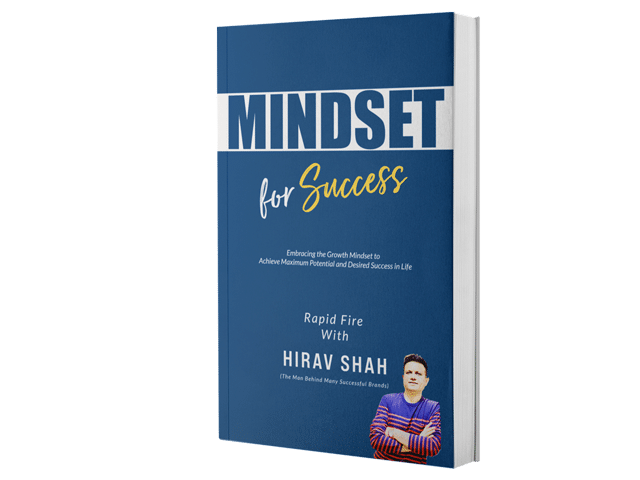

Success is rarely accidental. Behind every successful entrepreneur, leader, or professional lies a powerful Mindset for Success—a way of thinking that drives consistent action, learning, and resilience.
According to Hirav Shah, Business Strategist and The Game Changer:
“Success is not created by circumstances. It is created by mindset.”
Let’s explore how mindset for success is formed, how it influences performance, and how business strategists help shape it.
Table of Contents
How Is a Mindset for Success Created?

A mindset for success develops through repeated exposure to:
- Beliefs about ability and potential
- Experiences, especially failures and feedback
- Habits of thinking and decision-making
- Environment, including mentors, culture, and education
Example
Two professionals face rejection:
- One says, “I’m not good enough.”
- The other says, “I need a better approach.”
Same event. Different mindset. Different future.
Over time, these internal responses become automatic—and define success trajectories.
Mindset Theory and Success

Mindset theory explains how beliefs directly affect outcomes.
Two Mindsets That Shape Success
| Fixed Mindset | Mindset for Success |
|---|---|
| Abilities are limited | Abilities grow with effort |
| Avoids challenges | Seeks challenges |
| Fears mistakes | Uses mistakes as data |
Business Example
A leader with a success mindset treats missed targets as insight, not identity—then redesigns strategy.
What Is a Poor Mindset—and Why It Blocks Success?

A poor mindset is a mental pattern that restricts growth.
Signs of a Poor Mindset
- Fear of failure
- Negative self-talk
- Resistance to learning
- Blaming external factors
Impact on Success
A business owner who avoids innovation to “stay safe” often stagnates while competitors grow.
Hirav Shah explains it simply:
“A poor mindset quietly sabotages strong opportunities.”
Thinking vs. Mindset: A Key Difference

- Thinking is temporary and situational
- Mindset is permanent and habitual
Example
Two CEOs analyze the same data:
- One sees risk
- The other sees opportunity
Their thinking uses the same information, but mindset determines interpretation.
Is Mindset for Success an Attitude?
Yes. Mindset functions as a long-term attitude system.
It influences:
- Confidence under pressure
- Decision speed
- Risk management
- Leadership behavior
In business, skills get you hired—but attitude determines how far you go.
The Brain’s Role in Mindset for Success

The brain adapts through neuroplasticity—meaning mindset can change.
How It Works
- Repeated thoughts strengthen neural pathways
- New behaviors reshape old thinking patterns
Example
A leader who regularly reviews failures without emotion builds stronger analytical ability over time.
Does Mindset for Success Affect Intelligence?

Mindset doesn’t directly raise IQ—but it affects how intelligence is applied and developed.
Growth Effect
- Effort → learning
- Learning → skill
- Skill → better outcomes
Simple Calculation
If one professional improves performance by 1% daily:
- 1.01³⁶⁵ ≈ 37× improvement in a year
That’s mindset-driven compounding.
Is Mindset for Success a Skill?
Mindset isn’t a technical skill—but it behaves like one.
It can be:
- Trained
- Strengthened
- Strategically aligned
How Business Strategists Shape Mindset
- Identifying limiting beliefs
- Shifting emotional reactions to logic
- Aligning mindset with long-term goals
Hirav Shah, The Game Changer, integrates mindset evaluation into every strategic business framework.
Can Overthinking Lead to Success?

No.
Overthinking:
- Reduces clarity
- Increases stress
- Delays execution
Successful Mindset Rule
Think clearly. Decide decisively. Execute consistently.
High performers value progress over perfection.
Role of a Business Strategist in Building a Mindset for Success

A business strategist doesn’t just design plans—they design thinking.
Strategist’s Role
- Reframe failure into feedback
- Replace emotion with structured decision-making
- Build mental resilience for scale
As Hirav Shah states:
“Strategy works only when the mindset supports execution.”
FAQs: Mindset for Success

1. Can mindset alone create success?
Mindset initiates success; action sustains it.
2. How long does it take to develop a success mindset?
Awareness starts immediately; consistency builds it over months.
3. Can organizations develop a mindset for success?
Yes. Culture is a shared mindset reinforced daily.
4. Is mindset more important than talent?
Talent opens doors. Mindset decides how long you stay inside.
Final Insight

A Mindset for Success is not motivation—it’s a system.
It determines:
- How you respond to pressure
- How you learn from failure
- How consistently you grow
In the words of Hirav Shah, Business Strategist and The Game Changer:
“When mindset is right, success becomes repeatable.”