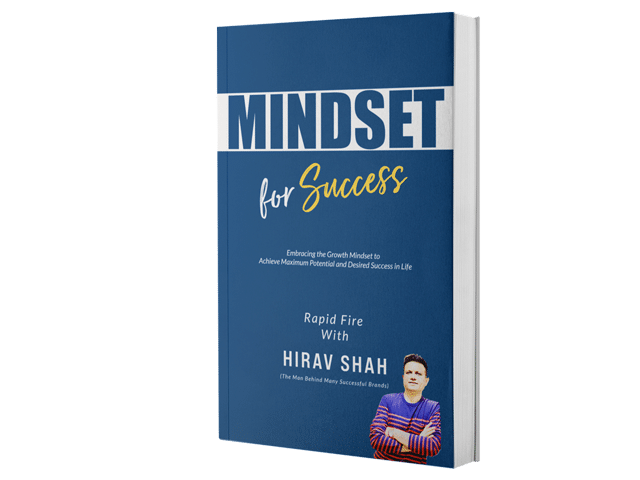

Leaders often ask an important question—Should I focus on myself first, or should I serve others to grow?
Veteran Business Strategist Hirav Shah, The Game Changer, reframes this dilemma by going deeper than motivation, productivity hacks, or surface-level leadership advice. According to him, the real issue is not either/or, but awareness.
Table of Contents
The Core Question: Who Comes First—Me or You?

Hirav Shah poses a powerful inquiry:
“Am I responsible for myself first, or responsible for you first?”
Broadly, responses fall into two camps:
- Self-first thinkers – Those who believe self-love and self-responsibility must come before serving others.
- Service-first thinkers – Those who believe compassion for others teaches us how to love ourselves.
The Truth: The Dilemma Is Created by the Mind

At first glance, the question appears profound and necessary:
Am I responsible for myself first, or responsible for you first?
Yet, according to Hirav Shah, this very framing is the problem.
The mind is conditioned to divide—me versus you, inner versus outer, self-care versus service. It seeks certainty by choosing sides. In doing so, it manufactures a dilemma where none fundamentally exists.
In reality, responsibility is not sequential. It does not begin with the self and then move outward, nor does it originate with others and then return inward. Responsibility arises simultaneously, from awareness.
When the mind is fragmented, love becomes transactional:
- If I love myself enough, then I will give.
- If I give enough, then I will feel worthy.
Both positions are rooted in ego—the subtle need to become something more, to earn love, or to justify existence.
True responsibility, Hirav Shah explains, is not a moral obligation or a personal achievement. It is a natural state that emerges when inner conflict subsides. When there is clarity, caring for oneself and caring for others are no longer separate acts—they are different expressions of the same intelligence.
A leader who is deeply attentive to their own fears, motivations, and blind spots does not need to try to be compassionate. Compassion becomes effortless. Likewise, when one acts with genuine concern for others—without expectation or self-sacrifice—self-respect and self-love are strengthened naturally.
Thus, the question is not who comes first, but rather:
- From what state am I acting?
- Is my action coming from fear, validation, and control—or from clarity and wholeness?
When action arises from clarity, there is no inner debate. Responsibility is neither self-centered nor self-neglecting. It is intelligent, balanced, and free.
And in that freedom, love is no longer something we learn, practice, or postpone—it is something that flows.
Dilemma, Ego, and the Business Mind

According to Hirav Shah, all dilemmas—personal or professional—are ego-generated.
In business, this shows up as:
- Expansion vs. stability
- Profit vs. purpose
- Speed vs. sustainability
“The mind divides. Strategy integrates.”
When leaders get stuck in binary thinking, growth stalls. The confusion isn’t external—it’s internal.
Primary Responsibility: Where Love and Leadership Arise

Hirav Shah explains that methods are not destinations.
Just as:
- A plow is set aside once the field is ready
- A strategy evolves once clarity is achieved
True leadership emerges when a person confronts their own:
- Fear of failure
- Need for validation
- Attachment to outcomes
Only then does authentic responsibility arise.
The Role of a Business Strategist

A true business strategist doesn’t just:
- Increase sales
- Optimize marketing funnels
- Improve brand visibility
They also help leaders:
- Reduce emotional decision-making
- Identify blind spots
- Align inner clarity with external execution
Hirav Shah’s role as a Business Strategist, The Game Changer, is to bring decisions back to clarity—where action becomes effortless and aligned.
Practical Business Examples
Example 1: Sales Decision

A founder must choose between:
- Short-term revenue from a misaligned client
- Long-term brand integrity
When self-responsibility is clear, the decision becomes obvious—no dilemma required.
Example 2: Team Leadership
A manager who hasn’t resolved their own insecurity often micromanages.
A leader grounded in self-awareness empowers teams naturally.
Simple Strategic Calculations
ROI Clarity

If:
- Marketing Spend = ₹5,00,000
- Revenue Generated = ₹12,50,000
ROI = (12,50,000 – 5,00,000) ÷ 5,00,000 × 100 = 150%
Without clarity, many leaders focus only on revenue—not return.
Time Leverage Calculation

If a leader spends:
- 4 hours/day on low-value tasks
- 20 working days/month
That’s 80 hours/month lost—nearly 2 full work weeks.
Strategy isn’t mystical. It’s awareness + math + execution.
Self-Love and Compassion: Not Either/Or

Hirav Shah concludes:
“We fill ourselves until we overflow. Then compassion flows impersonally.”
This means:
- Love yourself without isolation
- Serve others without self-neglect
In business, this translates to:
- Sustainable growth
- Ethical decision-making
- Long-term success without burnout
Frequently Asked Questions (FAQs)

1. Can I love others before loving myself?
Yes—but without self-awareness, that love often becomes dependency or sacrifice.
2. Can loving others teach self-love?
Yes—if done consciously and without expectation.
3. Why do business leaders feel stuck despite success?
Because external success without inner clarity creates hidden conflict.
4. How does a business strategist help with clarity?
By aligning vision, numbers, behavior, and timing into one coherent strategy.
5. When should I seek expert guidance?
Any YES/NO decision involving brand, sales, mergers, diversification, or expansion deserves expert insight.
Final Thought: Fire Up Your Future

Who doesn’t want success in business?
But ask yourself honestly:
- Are you taking aligned action?
- Do your habits support your goals?
- Is your strategy still relevant?
Without action, nothing is possible.
With the right strategy, everything is possible.
Now is the time.
Plant the seeds.
Choose clarity.
And let Business Strategist Hirav Shah, The Game Changer, help you stay on track toward meaningful, sustainable success.

Exercise 1: The Responsibility Mirror
Purpose:
To observe whether your actions come from fear, ego, or clarity.
Steps:
- Write down one current situation where you feel conflicted (business or personal).
- Answer honestly:
- What am I afraid of losing here?
- What am I trying to protect—image, control, approval, or comfort?
- Now ask:
- If fear was absent, what would action look like?
Insight:
When fear dissolves, responsibility becomes obvious—no dilemma remains.
Exercise 2: Self vs. Other Awareness Check
Purpose:
To see whether you prioritize yourself at the cost of others or others at the cost of yourself.
Steps:
Create two columns:
| Situation | My Action | Cost to Me | Cost to Others |
|---|
Fill in 3 real situations from the past month.
Reflection Question:
Was my action balanced, or was it driven by guilt, control, or self-interest?
Outcome:
Balanced responsibility creates strength, not exhaustion or resentment.
Exercise 3: The Origin of Action
Purpose:
To identify the source of your decisions.
Steps:
For one important decision you’re about to make, write:
- I am doing this because I feel:
- ☐ Fear
- ☐ Obligation
- ☐ Desire for validation
- ☐ Clarity
If more than one box is checked, pause.
Practice:
Wait 24 hours. Revisit the decision when emotional charge is lower.
Key Learning:
Clarity never rushes. Ego always does.
Exercise 4: Compassion Without Self-Neglect
Purpose:
To practice loving others without abandoning yourself.
Steps:
- Identify one person you are currently “over-giving” to.
- Ask:
- Am I expecting appreciation or loyalty in return?
- Am I avoiding my own discomfort by helping them?
- Adjust one boundary this week—small but firm.
Result:
True compassion does not weaken you; it strengthens both sides.
Exercise 5: Filling the Cup First (Leadership Practice)
Purpose:
To experience how self-responsibility naturally creates compassion.
Daily Practice (10 minutes):
- Sit quietly.
- Observe thoughts without fixing them.
- Do nothing.
Weekly Reflection Question:
When I am inwardly settled, how do my interactions change?
Observation:
When you are full, you don’t try to give—you overflow.
Exercise 6: The Dilemma Dissolver
Purpose:
To dissolve “either/or” thinking.
Steps:
Take any dilemma and write:
- Option A
- Option B
Now add a third line:
- What is the assumption behind this choice?
Challenge the assumption.
Example:
“I must choose growth or stability.”
Assumption: Growth requires instability.
Insight:
When assumptions fall, new possibilities emerge.
Closing Integration
As Hirav Shah emphasizes, responsibility is not something you decide—it is something that reveals itself when the mind is no longer divided.
Practice these exercises not to become better, but to become clearer.
And clarity, in both life and business, is the greatest competitive advantage.