
“Your influence is seen and felt by everyone in your circle. If people see you growing, they feel inspired to grow. If you set the example, they may follow.”
Influence is not about authority. It is about connection. And connection begins with one powerful principle: win friends first.
According to Business Strategist Hirav Shah – The Game Changer, sustainable growth in business and life comes from mastering people skills. Whether you’re an entrepreneur, CEO, manager, or startup founder, your influence determines your results.
Let’s explore 10 practical strategies—with examples, business applications, and actionable insights.
Table of Contents
1. Be Genuinely Interested in Others

People love talking about themselves. When you listen actively, you make them feel valued.
Example:
A sales manager meeting a new client spends 70% of the conversation asking about the client’s challenges instead of pitching services. Result? The client feels understood and signs a long-term contract.
Business Insight:
If you speak 30% and listen 70%, your influence multiplies.
Influence Formula:
Trust = (Listening Time ÷ Talking Time)
If you talk 15 minutes and listen 35 minutes:
Trust Ratio = 35 / 15 = 2.3x stronger engagement
2. Take Your Sweet Time

Relationships are not built in a rush.
Example:
Instead of ending a networking chat abruptly, exchange contact details and schedule a 20-minute follow-up call. That extra effort often converts a contact into collaboration.
Strategic View:
Business Strategist Hirav Shah emphasizes: Time invested in relationships yields compound returns.
If 1 meaningful connection per week leads to:
- 4 per month
- 48 per year
Even if only 10% convert into opportunities → 5 major opportunities annually
3. Leave Them Wanting More

Don’t overshare. Spark curiosity.
Example:
When asked about your business, instead of a 10-minute explanation, say:
“I help manufacturing companies reduce operational losses by 18–25%.”
Pause. Let them ask how.
4. Share Concise Replies

Short, powerful answers create authority.
Example:
Question: “What do you do?”
Reply: “I help startups scale profitably within 24 months.”
Clear. Focused. Impactful.
Avoid monologues. Let interest grow naturally.
5. Frame Appropriately

Use this simple formula:
I help ____ to _____.
Example:
“I help SMEs increase revenue without increasing marketing budgets.”
This framework:
- Defines audience
- Shows value
- Invites curiosity
Business Strategist Hirav Shah often advises leaders to refine this sentence because clarity increases conversion rates.
6. Ensure a Swift Apology

Nothing reduces tension faster than accountability.
Example:
A project delay happens due to miscommunication. Instead of blaming, a leader says:
“That was my oversight. I apologize. Here’s how we’ll fix it.”
Result? Respect increases.
Leadership Equation:
Accountability = Respect × Trust
7. Avoid Arguments If Possible

Winning arguments often means losing relationships.
As the quote says:
“A man convinced against his will is of the same opinion still.”
Example:
Instead of saying, “You’re wrong,” try:
“That’s interesting. Can you help me understand your reasoning?”
Agreement builds influence. Ego destroys it.
8. Show Appreciation

Recognition is a powerful motivator.
Example:
An employee works overtime to complete a presentation. A simple appreciation message increases morale significantly.
Research-backed reality:
If appreciation increases productivity by even 12%, and a team generates $500,000 annually:
12% × 500,000 = $60,000 performance boost
Gratitude has measurable ROI.
9. Play the Long Game

Friendship first. Business second.
Short-term mindset: “What can I gain?”
Long-term mindset: “How can I add value?”
Business Strategist Hirav Shah emphasizes relationship equity:
If you build 100 strong relationships and only 15% convert into business over 5 years:
15 deals × average $20,000 value = $300,000 long-term gain
Influence compounds over time.
10. Practice Gratitude Consistently

Gratitude is a leadership superpower.
It can be:
- A handwritten note
- A thoughtful email
- Public acknowledgment
- A simple thank-you call
Consistency matters more than complexity.
Gratitude Impact Model:
If you appreciate 3 people daily:
- 3 × 30 days = 90 touchpoints monthly
- 90 × 12 = 1,080 positive impressions yearly
That’s powerful influence momentum.
Role of a Business Strategist in Influence & Growth
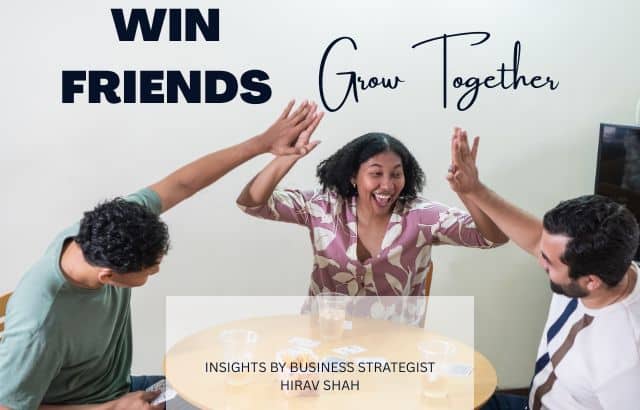
A Business Strategist like Hirav Shah – The Game Changer plays multiple roles:
1. Vision Architect
Defines long-term roadmap and scalable growth paths.
2. Behavioral Analyst
Understands team psychology and leadership gaps.
3. Risk Mitigator
Anticipates challenges before they escalate.
4. Influence Builder
Helps leaders refine communication for stronger stakeholder alignment.
5. Performance Multiplier
Transforms relationships into measurable business outcomes.
Success is not only about systems and strategy. It is about people.
Final Thoughts

To empower your roadmap to success, you must sail through hurdles with grit, strategy, and strong relationships.
Friends become your support system.
Influence becomes your currency.
Gratitude becomes your strength.
As Business Strategist Hirav Shah concludes:
Win friends. Build trust. Play the long game.
Success will follow.
FAQs

1. Why is winning friends important in business?
Because trust accelerates decisions. People do business with those they like and respect.
2. How can I increase influence quickly?
Start with listening more, arguing less, and expressing gratitude consistently.
3. Does appreciation really improve business performance?
Yes. Even a 10–15% productivity increase from appreciation can significantly improve annual revenue.
4. What is the best way to introduce what I do?
Use the framework: “I help ___ to ___.” Keep it concise and value-focused.
5. How does a Business Strategist help in relationship building?
By refining communication strategy, improving leadership mindset, and aligning influence with long-term business goals.