Why do so many businesses stay busy every single day, yet struggle to move to the next level?
Why does hard work no longer guarantee clarity, confidence, or consistent growth?
Business Strategist and The Game Changer Hirav Shah believes the problem is not effort—it is direction.
In his work with entrepreneurs, founders, and business families across industries, Hirav Shah has consistently observed one critical mistake: most businesses plan forward based on urgency, pressure, and short-term opportunities, instead of designing their decisions backward with clarity and intent.
According to Business Strategist Hirav Shah, this is where years are lost—not due to lack of talent or resources, but because businesses begin execution before defining where they actually want to land.
Forward thinking sounds logical:
What should we do next?
Which opportunity should we chase?
How do we grow faster?
But forward thinking often creates movement without meaning. It keeps teams active, not aligned.
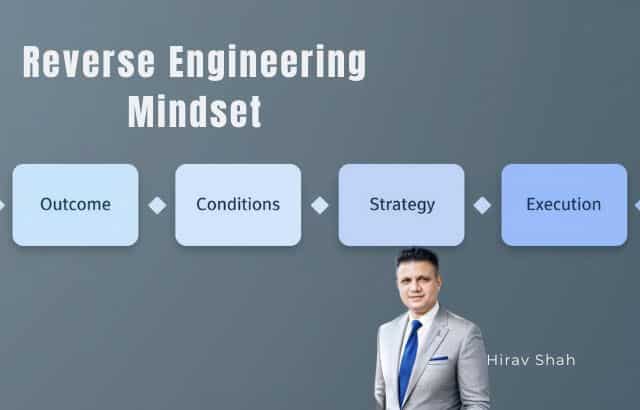
That is why The Game Changer Hirav Shah strongly advocates reverse engineering success. Instead of starting with actions, reverse engineering starts with outcomes. Instead of adding more tasks, it removes confusion. Instead of guessing the future, it designs it.
As Business Strategist Hirav Shah explains, when clarity is missing at the top, execution becomes noisy at the bottom. Decisions turn reactive, teams feel overworked, and growth becomes unpredictable.
“Most businesses don’t fail due to lack of effort. They fail because they move forward without first deciding where exactly they want to land.”
— Hirav Shah | Business Strategist & The Game Changer
In today’s volatile and competitive environment, speed without structure is risky. Growth without clarity is expensive. And execution without direction is exhausting.
This is precisely why reverse engineering is no longer optional—it has become essential.
In the sections ahead, Business Strategist and The Game Changer Hirav Shah explains how reverse engineering works, why it brings calm to chaos, and how a simple 5-step framework can completely transform decision-making, strategy, and execution.
Table of Contents
BASIC BUSINESS Q&A — UNDERSTANDING THE REVERSE ENGINEERING MINDSET

Before applying any framework, clarity on the concept is essential. Business Strategist and The Game Changer Hirav Shah emphasizes that reverse engineering is often misunderstood as a technical exercise, when in reality, it is a decision-making mindset.
Below are the most common questions entrepreneurs ask—and the clarity behind them.
Q1: What exactly is reverse engineering in business?
Reverse engineering in business means starting from the desired outcome and working backward to define strategy, execution, and priorities.
According to Business Strategist Hirav Shah, most businesses begin with action and hope the destination becomes clear later. Reverse engineering flips this approach. It defines the destination first and then designs every decision to support that destination.
“When you don’t define where you want to land, every road looks acceptable—and that’s where businesses lose direction.”
— Hirav Shah | Business Strategist & The Game Changer
Q2: How is reverse engineering different from traditional planning?
Traditional planning focuses on tasks and activities.
Reverse engineering focuses on conditions and outcomes.
As The Game Changer Hirav Shah explains, plans often answer what to do, while reverse engineering answers what must be true for success to exist.
This shift removes guesswork and prevents businesses from confusing motion with progress.
“Busy calendars don’t guarantee growth. Only outcome-driven thinking does.”
— Hirav Shah
Q3: Why do hardworking businesses still get stuck?
Many entrepreneurs work relentlessly, yet remain stuck because effort is not aligned with direction.
Business Strategist Hirav Shah observes that when clarity is missing:
- Decisions become reactive
- Execution becomes noisy
- Teams lose confidence
- Growth becomes unpredictable
Hard work without direction creates exhaustion, not expansion.
“Hard work amplifies direction. If the direction is wrong, hard work only speeds up the mistake.”
— Hirav Shah
Q4: Who actually needs the reverse engineering mindset?
Reverse engineering is not limited to large corporations. In fact, it is most powerful for entrepreneurs and growing businesses, where time, money, and energy are limited.
According to The Game Changer Hirav Shah, reverse engineering is crucial for:
- Entrepreneurs feeling busy but stuck
- Businesses planning scale or expansion
- Founders facing repeated decision confusion
- Leaders preparing for long-term sustainability
“The earlier you reverse engineer your decisions, the fewer mistakes you have to correct later.”
— Hirav Shah
Q5: Why do most people avoid reverse engineering?
Because reverse engineering forces uncomfortable clarity.
It requires:
- Saying no to distractions
- Letting go of comfort-driven choices
- Taking responsibility for outcomes
- Making long-term decisions in the present
As Business Strategist Hirav Shah notes, many prefer activity because it feels productive—even when it lacks direction.
“Clarity demands courage. Confusion feels safer, but it costs more in the long run.”
— Hirav Shah
FROM CONFUSION TO CONTROL — THE SHIFT MOST BUSINESSES NEVER MAKE

Many businesses today are not failing.
They are simply confused.
They are doing many things, trying many ideas, chasing multiple opportunities—yet clarity feels missing. Business Strategist and The Game Changer Hirav Shah often points out that confusion is not a lack of intelligence; it is a lack of structure.
When businesses operate without a clearly defined outcome, every decision feels urgent. Teams stay busy, leaders stay involved in everything, and execution becomes reactive instead of strategic.
According to Hirav Shah, the moment a business stops asking “What should we do next?” and starts asking “What are we actually trying to achieve?”, control begins to replace chaos.
Reverse engineering creates that control.
It slows thinking so execution can accelerate in the right direction.
“Confusion doesn’t come from too many problems. It comes from the absence of one clear outcome.”
— Hirav Shah | Business Strategist & The Game Changer
This shift—from forward guessing to backward designing—is the foundation of the 5 Ways to Follow the Reverse Engineering Mindset.
WAY 1 — DEFINE THE NON-NEGOTIABLE OUTCOME

The first and most critical step in reverse engineering is outcome clarity.
Business Strategist Hirav Shah explains that most business goals fail because they are vague:
“I want to grow”
“I want more stability”
“I want success”
Such statements create motivation, but not direction.
Reverse engineering demands precision. You must clearly define:
- Where the business should reach
- What role you want to play in the future
- What success should look like financially and operationally
- How life should feel once the business works
Without a non-negotiable outcome, strategy becomes guesswork and execution becomes scattered.
The Game Changer Hirav Shah often reminds entrepreneurs that clarity at the destination simplifies every decision on the journey.
“If the destination is unclear, even the right effort feels exhausting.”
— Hirav Shah
Reflective Questions:
- If this business succeeds perfectly, what will exist in 3–5 years?
- What will no longer be a daily struggle?
- What will success allow you to stop doing?
Outcome clarity is not ambition—it is responsibility.
WAY 2 — IDENTIFY WHAT MUST BE TRUE FOR THAT OUTCOME

This is where real strategy begins.
According to Business Strategist and The Game Changer Hirav Shah, strategy is not about choosing what you like to do. Strategy is about identifying what must exist for the outcome to become real.
Every successful outcome depends on conditions such as:
- The right skills
- Strong systems
- Market trust
- Clear positioning
- Decision-making speed
- Team capability
Most businesses fail here because they copy tactics from others instead of identifying their own missing conditions.
Hirav Shah emphasizes that reverse engineering forces honest answers:
- What skills must improve?
- What systems must be built?
- What trust must be earned?
- What structure must change?
“Strategy is not about preference. It is about necessity. If something must be true for success, it cannot be ignored.”
— Hirav Shah | Business Strategist & The Game Changer
When conditions are clear, execution becomes focused.
When conditions are ignored, effort multiplies mistakes.
Reverse engineering ensures that strategy is built on reality, not hope.
WAY 3 — ELIMINATE WHAT CANNOT CO-EXIST WITH SUCCESS

Reverse engineering is not only about adding the right things.
It is equally—if not more—about removing the wrong ones.
Business Strategist and The Game Changer Hirav Shah clearly states that many businesses do not fail due to lack of effort, but because they continue to carry habits, decisions, and commitments that directly conflict with their desired future.
Growth demands subtraction.
This includes:
- Low-value clients that drain time and energy
- Comfort routines that limit scale
- Opportunities that look attractive but dilute focus
- Ego-driven decisions that delay progress
- Over-involvement in tasks meant to be delegated
According to Hirav Shah, if something does not fit the future outcome, it should not occupy the present.
Entrepreneurs often resist this step because elimination feels risky. However, avoiding elimination is far riskier—it quietly slows momentum.
“Success doesn’t arrive by doing everything. It arrives when you stop doing what doesn’t belong in your future.”
— Hirav Shah | Business Strategist & The Game Changer
Reverse engineering forces clarity by asking one uncomfortable but powerful question:
What must stop if this is going to work?
Once unnecessary weight is removed, speed and clarity automatically increase.
WAY 4 — DESIGN BACKWARD EXECUTION

Most people execute based on their current reality.
Reverse engineering requires executing based on your future identity.
Business Strategist Hirav Shah explains that backward execution means behaving today the way a successful version of the business would operate tomorrow.
This includes:
- Faster, clearer decision-making
- Defined priorities instead of reactive firefighting
- Delegation over control
- Focus on outcomes, not effort
Instead of asking “What can I manage today?”, reverse engineering asks:
“How would this be handled if the business was already successful?”
When execution mirrors the finish line:
- Discipline replaces stress
- Consistency replaces motivation
- Systems replace dependency
“Execution becomes effortless when it is aligned with who you are becoming, not who you currently are.”
— Hirav Shah | Business Strategist & The Game Changer
Backward execution removes chaos. It transforms daily work into purposeful action and ensures that effort compounds instead of scattering.
WAY 5 — BUILD FEEDBACK LOOPS, NOT BLIND CONSISTENCY

Consistency is powerful—but only when it is guided by reflection.
Business Strategist and The Game Changer Hirav Shah warns that blind consistency can quietly damage businesses. Repeating the wrong actions with discipline does not create success—it accelerates failure.
Reverse engineering requires regular feedback loops:
- Weekly reviews of decisions and outcomes
- Monthly checks on direction and alignment
- Honest assessment of what worked and what didn’t
These reviews help answer critical questions:
- What moved us closer to the outcome?
- What consumed effort without results?
- What needs correction now, not later?
“Consistency without reflection is repetition. Consistency with reflection is growth.”
— Hirav Shah | Business Strategist & The Game Changer
Feedback loops ensure that businesses stay aligned with their desired outcome, not trapped in routine. They protect momentum, prevent burnout, and allow timely course correction.
Reverse engineering does not promise instant success—but it ensures predictable progress.
FINAL CONCLUSION

Forward thinking keeps businesses active.
Reverse engineering keeps them aligned.
Business Strategist and The Game Changer Hirav Shah believes that success today is not about doing more, but about deciding better. When outcomes are clear, execution becomes focused. When direction is defined, effort compounds naturally.
Instead of rushing forward and hoping for results, pause, design backward, and move ahead with confidence.
“Don’t move faster. Move clearer. Speed will follow.”
— Hirav Shah | Business Strategist & The Game Changer
About the Writer
This article is authored by Hirav Shah, a globally respected Business Strategist and The Game Changer in Entertainment, Sports, and Business. He is the founder of the world’s first Business Decision Validation Hub and the author of 25+ strategy books. His 6+3+2 framework and Astro Strategy approach have guided entrepreneurs, startups, corporates, sports professionals, and entertainers to validate decisions, reduce risks, and achieve breakthrough results.