
Table of Contents
Introduction — Why Talking About “Purpose” Matters Now
In today’s fast-moving business world, everyone talks about growth, profit, and performance — but very few talk about purpose.
Yet, the truth is simple: businesses that forget their purpose eventually lose their direction.
Every startup begins with excitement. Every entrepreneur starts with a dream.
But somewhere between deadlines and deliverables, the dream becomes a duty.
The “why” behind the business fades, replaced by numbers and noise.
That’s where purpose becomes not just important — but essential.
Purpose is not a marketing term; it’s the heartbeat of every successful organization.
It is what turns a job into a journey, a product into a promise, and a business into a brand that people trust.
Business strategist Hirav Shah explains it powerfully:
“Profit is a short-term reward, but purpose is a long-term compass. It doesn’t just tell you where to go — it tells you why you’re going there.”
Think about it — companies that know their purpose don’t compete; they contribute.
They inspire loyalty, attract talent, and stay relevant even when markets change.
Whether you’re running a startup or a legacy enterprise, your clarity of purpose decides your longevity of success.
In this article, we’ll explore:
- What purpose really means in business
- Why it’s the strongest growth engine
- How to find and validate your true purpose
- 7 actionable ways to bring it to life in your organization
Because in the end, businesses driven by purpose don’t just grow — they glow.
What Exactly Is the Purpose of Business?

What if profit isn’t the goal of business, but simply the result?
That’s where the idea of purpose begins — the deeper reason your business exists beyond making money.
Purpose answers the question:
“If your business disappeared tomorrow, what difference would the world miss?”
At its core, purpose is about impact, not income. It connects your company’s heart to its hustle, inspires your team, gives direction to strategy, and creates emotional resonance with your customers.
Example:
When Tesla was founded, its purpose wasn’t to sell electric cars — it was to accelerate the world’s transition to sustainable energy. That purpose changed an entire industry, inspired global innovation, and built a movement far bigger than automobiles.
Hirav Shah explains:
“A business without purpose may survive, but it will never shine. Purpose gives meaning to your mission and magic to your momentum.”
Why Is Having a Purpose So Important?

Why do some businesses thrive through chaos while others collapse at the first storm?
The difference is purpose — it’s the anchor that keeps your business steady when everything else feels uncertain.
When you have a clear purpose, you don’t react — you respond with clarity.
Your decisions align with your values. Your people stay motivated even during tough phases.
Purpose gives consistency when circumstances change.
Example:
During global disruptions, Unilever stayed true to its purpose of making sustainable living commonplace.
While many competitors cut back on social initiatives, Unilever doubled down — promoting hygiene, inclusivity, and sustainability across brands like Dove and Lifebuoy.
That’s why their consumer trust only grew stronger.
Hirav Shah’s Viewpoint:
“Purpose isn’t a luxury for good times — it’s the anchor for hard times. When the market shakes, purpose steadies your steps.”
Businesses with purpose don’t just chase quarterly numbers — they build long-term value, relationships, and reputation that outlast economic cycles.
How Does Purpose Drive Growth and Decision-Making?

How do great businesses make bold decisions without fear?
The answer lies in purpose. Purpose brings clarity, and clarity brings confidence.
When a company knows its “why,” every decision — from product design to hiring — becomes easier and more aligned.
Purpose acts like an internal compass that filters distractions, helping leaders say no to what doesn’t fit their vision.
Example:
When the pandemic hit, Airbnb had to cancel millions of bookings overnight. Instead of panicking, the company returned millions of dollars to hosts and guests.
Why? Because their purpose — “to create a world where anyone can belong anywhere” — guided every move. That empathy restored trust, and Airbnb’s brand became even stronger.
Hirav Shah’s Viewpoint:
“Purpose simplifies complexity. It transforms confusion into conviction. When your purpose is clear, decisions are no longer risky — they’re right.”
Businesses that align their strategy with purpose not only grow faster but also make choices that create loyalty, not just revenue.
How Do You Find Your True Purpose?

How do you uncover your true purpose — the one that gives your business direction, energy, and meaning?
Finding purpose isn’t about writing a fancy statement; it’s about discovering the emotional truth behind your work.
What it means:
Your true purpose lies where what you love, what you’re good at, and what the world needs intersect.
Why it matters:
When your actions align with your deeper ‘why,’ work stops feeling like a burden and starts feeling like a calling. Purpose creates inner satisfaction even when challenges arise.
How to apply:
- Ask yourself and your team:
- What makes our work meaningful to others?
- What problem do we love solving?
- What would we do even if money wasn’t guaranteed?
Example:
Infosys founder Narayana Murthy found his purpose in building ethical, technology-driven employment opportunities for Indian youth. His clarity transformed a small firm into a global IT powerhouse.
Hirav Shah’s Viewpoint:
“Your true purpose often hides behind what frustrates you most — because that’s where your transformation is needed most.”
How Can You Validate and Realign Your Purpose as You Grow?

How do you know if your purpose is real — and still relevant as your business evolves?
What it means:
Validation means checking whether your purpose still connects emotionally with your team, customers, and decisions.
Realignment means fine-tuning it to fit your current phase of growth.
Why it matters:
A purpose that isn’t validated becomes outdated. A purpose that isn’t realigned becomes irrelevant.
How to apply:
- Revisit your mission every year
- Observe if your daily decisions reflect your declared purpose
- Ask your customers and employees: “Do you still feel inspired by what we stand for?”
Example:
Amazon began with one simple purpose — to make it easy for anyone to buy books online.
Today, even after expanding into everything from AI to groceries, its purpose still holds: to make life easier for customers everywhere.
Hirav Shah’s Viewpoint:
“Purpose doesn’t change — its expression does. Real growth is not about replacing your ‘why,’ but rediscovering it at every stage.”
7 Ways to Find Your True Purpose in Business
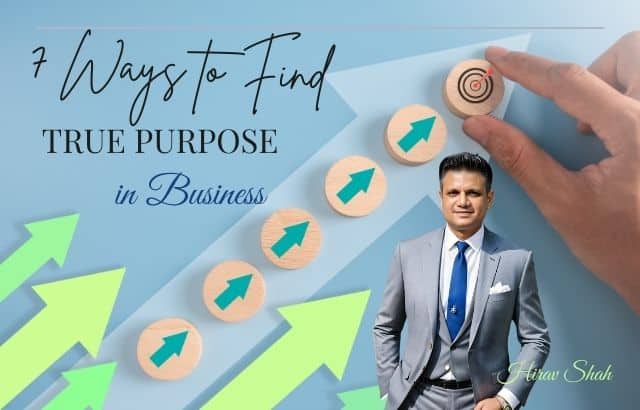
Once you’ve defined, validated, and aligned your purpose, the next step is bringing it to life — through mindset, culture, and consistent action.
Business Strategist Hirav Shah outlines seven powerful, actionable ways to live and lead with purpose:
“Purpose isn’t about perfection; it’s about progress. Every time your decision reflects your ‘why,’ you move closer to your true direction.”
Way 1: Start with ‘Why’
What it means:
The first step to finding your true purpose is asking “Why does my business exist?” — not “What do we sell?” or “How do we operate?”
Why it matters:
Purpose begins where intention is clear. Without knowing your “why,” every marketing plan, product launch, or partnership risks becoming directionless.
How to apply:
- Write down your founding story — what made you start in the first place?
- Ask: “What problem was I emotionally driven to solve?”
- If your “why” inspires others, you’re on the right track.
Example:
Apple’s “why” has never been about technology — it’s about challenging the status quo and empowering individuality.
Hirav Shah’s Viewpoint:
“Clarity of purpose starts with clarity of why. When you rediscover why you began, you rediscover where you belong.”
Way 2: Shift Focus from Products to People
What it means:
Stop obsessing over what you sell and start understanding whom you serve. Purpose always lives in people — not in products.
Why it matters:
Your purpose becomes clear when you deeply understand how your business improves someone’s life.
How to apply:
- Talk to customers about how your product changes their day
- Identify one emotion your brand should always evoke — trust, joy, or confidence
- Build empathy before marketing
Example:
Zappos didn’t just sell shoes — they sold happiness. Their 365-day return policy was built from empathy, not economics.
Hirav Shah’s Viewpoint:
“Purpose isn’t found in the product you sell, it’s found in the person you serve. When business becomes about people, clarity follows automatically.”
Way 3: Redefine What Success Means to You
What it means:
Rethink your definition of success. If success only means profit, your purpose will stay superficial.
Why it matters:
A business chasing meaning creates more lasting motivation than a business chasing money.
How to apply:
- List ways your work creates value beyond numbers
- Track stories of people you’ve helped, not just invoices
- Redefine your KPIs (Key Purpose Indicators) alongside traditional KPIs
Example:
TOMS Shoes built its purpose around giving — one pair sold meant one pair donated.
Hirav Shah’s Viewpoint:
“When you redefine success around service, your true purpose reveals itself. Money becomes the result — not the reason.”
Way 4: Build a Culture That Reflects Your ‘Why’
What it means:
Purpose becomes real only when it’s reflected in your people, policies, and daily practices.
Why it matters:
Even the strongest purpose statement fails if your team doesn’t feel it.
How to apply:
- Begin meetings by revisiting your company’s mission or values
- Reward employees who demonstrate purpose-driven behavior
- Let your team see how their role contributes to something larger than profits
Example:
Google built its culture around curiosity, creativity, and impact. Employees dedicate 20% of their time to personal projects — leading to innovations like Gmail and Google Maps.
Hirav Shah:
“A company’s culture is its mirror. If your culture doesn’t reflect your purpose, you’re running a business — not building a belief.”
Way 5: Let Purpose Guide Every Strategy
What it means:
Purpose is the foundation of strategy.
Why it matters:
A business without alignment between purpose and strategy may grow fast, but it won’t grow far.
How to apply:
- Ask: “Does this reflect our purpose?” before launching any initiative
- Align partnerships, investments, and marketing with core values
- Say “no” to opportunities that dilute your brand’s beliefs
Example:
Patagonia rejected multiple profitable partnerships because they didn’t fit its environmental ethics.
Hirav Shah:
“Strategy without purpose is like speed without direction. Your purpose must lead, and your plans must follow.”
Way 6: Balance Emotion with Execution
What it means:
Emotion inspires teams and customers — but execution turns passion into progress.
Why it matters:
Without structured execution, even great ideas fade.
How to apply:
- Build systems that deliver your promise daily
- Train teams to combine empathy with excellence
- Tell stories that evoke emotion and back them with tangible results
Example:
Nike succeeds globally with its emotional storytelling — “Just Do It” — combined with product innovation and logistics excellence.
Hirav Shah:
“Emotion connects; execution converts. Your true purpose thrives when passion and process move in harmony.”
Way 7: Keep Realigning as You Grow
What it means:
Purpose isn’t a one-time discovery; it’s a lifelong alignment.
Why it matters:
Realignment ensures your business stays authentic and relevant without losing its soul.
How to apply:
- Conduct a “Purpose Audit” annually
- Ask: “Does our current work still serve our original mission?”
- Reconnect with early customers or mentors to reflect on your origins
Example:
Netflix started as a DVD rental service, but its core purpose — to entertain and connect people through stories — guided its transformation into a streaming giant.
Hirav Shah:
“Purpose doesn’t change — only its direction does. The most successful businesses aren’t those that chase trends, but those that keep rediscovering their true reason for being.”
Conclusion: Purpose Is the New Profit

In a world where every brand is fighting for attention, the only true differentiator is intention.
A business rooted in purpose doesn’t just create revenue — it creates relevance.
Purpose gives leaders vision, teams motivation, and customers belief. It connects performance with peace, and success with significance.
Hirav Shah concludes:
“Growth gives you scale, impact gives you legacy, and happiness gives you meaning. Purpose is what connects them all.”
When your why becomes stronger than your what, your business stops surviving — it starts inspiring.
Frequently Asked Questions

1. How do I know if my business has a clear purpose?
If your team and customers can answer “Why do you exist?” with the same clarity — you already have one.
2. Can a business have multiple purposes?
You can have multiple goals, but only one core purpose. It’s the heartbeat that guides every decision.
3. What if my business purpose changes over time?
That’s natural. Realignment doesn’t mean losing your purpose — it means evolving with it.
4. Is purpose only for big brands?
Not at all. Purpose is what creates big brands. Small businesses can also build powerful identities.
5. How long does it take to discover your true purpose?
It’s an ongoing process. When actions, values, and impact align — you’re living your purpose.
3 Practical Tips to Strengthen Your Business Purpose & become a tough and confident person

- Write Your “Why” Daily — Begin each week with a line that reminds you why your business exists.
- Turn Customers into Storytellers — Ask customers how your product or service made a difference.
- Check Alignment Before Action — Before big decisions, ask: “Is this aligned with our purpose?”
Purpose Discovery Exercise (Try This Today)
Step 1: Write down three questions:
- What drives me to wake up and work each day?
- What change do I want to create in people’s lives?
- What would I do even if I weren’t paid for it?
Step 2: Read your answers aloud. The statement that gives you goosebumps — that’s your true purpose.
Step 3: Share it with your team. Purpose multiplies when it’s shared.
Final Thought from Hirav Shah
“Businesses that begin with purpose build profit. But businesses that begin with profit often lose their purpose. The real success lies in balancing both — with clarity, conscience, and consistency.”
About the Writer
This article is authored by Hirav Shah, a globally respected Business Strategist and The Game Changer in Entertainment, Sports, and Business.
He is the founder of the world’s first Business Decision Validation Hub and author of 19+ strategy books.
His 6+3+2 framework and Astro Strategy approach have guided entrepreneurs, startups, corporates, sports professionals, and entertainers to validate decisions, reduce risks, and achieve breakthrough results.