
In business, complacency is one of the most dangerous threats because it rarely announces itself. It enters quietly—through comfort, routine, and the illusion that current success will last forever. The moment entrepreneurs start feeling too comfortable, growth begins to slow, innovation weakens, and competitors start gaining ground.
According to Hirav Shah, one of the biggest mistakes business owners make is believing that success today guarantees success tomorrow. Markets evolve, customer expectations change, technology advances, and competition becomes sharper every single day.
As Business Strategist Hirav Shah says:
“In business, there is no room for comfort zones. If you’re comfortable, you’re not growing.”
The businesses that dominate industries are not necessarily the ones with the biggest resources. They are the ones with the strongest hunger to improve continuously. Whether it is a startup founder, a retail chain owner, a manufacturing company, or a global brand, long-term success belongs to those who stay ambitious, adaptive, and disciplined.
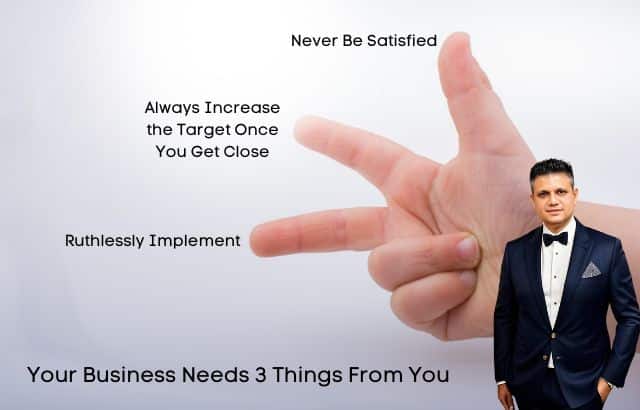
To build a thriving business in today’s fast-moving environment, your company needs three essential things from you:
- Never being satisfied
- Always increasing the target
- Ruthlessly implementing strategies
These three principles create momentum, resilience, and long-term competitive advantage.
Table of Contents
1. Never Be Satisfied

Satisfaction may feel rewarding, but in business it can become extremely dangerous. The moment leaders become fully content with current achievements, they stop questioning, improving, and innovating. That is where stagnation begins.
A business that generated ₹10 crore in annual revenue may feel successful today. But if leadership stops evolving, competitors with better technology, faster delivery, stronger branding, or superior customer experience can quickly take market share.
Business Strategist Hirav Shah explains:
“Growth is a journey, not a destination. The moment you stop, the competition overtakes you.”
Being dissatisfied does not mean being negative or ungrateful. It means maintaining a mindset of continuous improvement.
Example: The Restaurant Business

Imagine a restaurant owner whose outlet becomes popular locally. Customers love the food, sales are growing, and profits are stable. Many business owners would relax at this stage.
However, a growth-oriented entrepreneur asks:
- How can customer experience improve further?
- Can delivery time be reduced?
- Should digital marketing be expanded?
- Can a second branch be opened?
- Is there an opportunity to create a franchise model?
This constant search for improvement creates long-term growth.
Meanwhile, a competitor who introduces app-based ordering, loyalty programs, influencer marketing, and better packaging may eventually dominate the market while the original business remains stuck.
The Role of a Business Strategist in Preventing Complacency

A business strategist plays a critical role in ensuring organizations never become stagnant.
A strategist helps businesses:
- Identify future growth opportunities
- Detect hidden weaknesses
- Analyze market competition
- Improve operational systems
- Increase profitability
- Build long-term scalability
- Create sustainable business models
Business Strategist Hirav Shah is widely recognized as a “The Game Changer” because of his focus on helping companies think ahead rather than reacting too late.
A strategist challenges leadership teams to ask difficult questions:
- What happens if market conditions change suddenly?
- What if competitors reduce prices?
- What if customer behavior shifts?
- What new technologies can disrupt the industry?
These questions help businesses remain prepared instead of comfortable.
2. Always Increase the Target Once You Get Close

Success is not a final destination. In reality, successful businesses continuously redefine success.
The most successful entrepreneurs never stop after reaching one milestone. They immediately create a bigger target.
According to Hirav Shah:
“Aim higher, because that’s where real breakthroughs happen.”
This mindset creates innovation, energy, and momentum across teams.
Example: Revenue Growth Targets

Suppose a company sets a yearly revenue target of ₹5 crore.
By the ninth month, the company already reaches ₹4.7 crore.
An average business may slow down and simply maintain operations until the target is achieved.
A growth-focused business behaves differently:
- New target revised to ₹7 crore
- Additional marketing campaigns launched
- Sales team incentives increased
- New partnerships explored
- Upselling strategies introduced
This creates accelerated growth rather than comfortable maintenance.
Simple Growth Calculation
If a company grows revenue by only 5% annually:
y=100(1.05)^x
After 5 years:
- Initial Revenue = ₹100 lakh
- Annual Growth = 5%
- Revenue after 5 years ≈ ₹127.6 lakh
But if the company aggressively increases targets and achieves 20% annual growth:
After 5 years:
y=100(1.20)^x
- Revenue becomes approximately ₹248.8 lakh
That is nearly double the result simply because the business refused to stay comfortable.
Why Bigger Targets Create Bigger Businesses

Increasing targets pushes organizations to:
- Innovate faster
- Improve productivity
- Strengthen leadership
- Expand markets
- Build stronger systems
- Develop more efficient teams
Without bigger targets, teams naturally settle into routines.
The world’s most successful companies continuously raise standards internally before the market forces them to.
3. Ruthlessly Implement

Ideas alone do not build successful businesses. Execution does.
Many companies have brilliant plans, powerful visions, and ambitious goals, but very few execute consistently and relentlessly.
Business Strategist Hirav Shah says:
“Dreams are only worth it when they turn into results. That requires action—every single day.”
Ruthless implementation means:
- Following through consistently
- Acting despite difficulties
- Tracking performance regularly
- Maintaining accountability
- Solving problems quickly
- Staying disciplined under pressure
Execution separates winning companies from struggling businesses.
Example: Two Clothing Brands
Consider two fashion brands launching online stores.
Brand A
- Creates a beautiful business plan
- Discusses marketing ideas constantly
- Delays product launches
- Frequently changes strategies
- Avoids difficult decisions
Brand B
- Launches quickly
- Runs ads daily
- Tracks customer feedback
- Improves products continuously
- Expands aggressively
After two years, Brand B dominates because execution beats intention.
The Importance of Systems and Repeatable Processes
Relentless ambition without structure can create chaos. Sustainable success requires repeatable systems.
As Hirav Shah explains:
“Driving without a roadmap is like speeding without a destination. You need a repeatable process to direct your efforts and multiply success.”
A repeatable process allows businesses to:
- Scale faster
- Train teams efficiently
- Maintain quality consistently
- Predict outcomes more accurately
- Reduce operational confusion
- Improve accountability
Example of a Repeatable Sales Process
A business strategist may help a company create a sales system like this:
- Lead Generation
- Customer Qualification
- Sales Presentation
- Follow-Up Strategy
- Closing Process
- Customer Retention
- Referral Generation
When repeated consistently, predictable growth becomes possible.
Why Complacency Can Cost You Everything

Many businesses fail not because they lacked talent, but because they stopped evolving.
Reflecting on business challenges, Hirav Shah shares:
“The only times I’ve come close to losing big in my career were when I allowed myself to get comfortable. Comfort is the enemy of progress.”
Complacency can lead to:
- Declining innovation
- Reduced employee motivation
- Weak customer engagement
- Loss of market relevance
- Slow decision-making
- Falling profits
Businesses that survive long-term maintain hunger even after success.
Signs Your Business May Be Becoming Complacent

Watch for these warning signs:
- No major goals have changed recently
- Teams resist new ideas
- Innovation has slowed down
- Customer complaints are increasing
- Competitors are advancing faster
- Leadership avoids calculated risks
- Revenue growth has plateaued
Recognizing these signs early can save a business from major decline.
How Business Strategist Hirav Shah Helps Companies Grow

Business Strategist Hirav Shah focuses on helping businesses:
- Build long-term growth plans
- Improve business decision-making
- Develop scalable systems
- Increase profitability
- Navigate market uncertainty
- Create strategic expansion models
- Strengthen execution discipline
His philosophy centers around continuous evolution, disciplined action, and refusing to settle for average results.
That is why many entrepreneurs consider him “The Game Changer” in business growth and strategic transformation.
Final Thoughts
Businesses do not grow accidentally. Growth is intentional, disciplined, and relentless.
If you want your business to thrive in competitive markets, you must:
- Never become fully satisfied
- Continuously raise your targets
- Execute with discipline and consistency
Comfort may feel safe temporarily, but long-term success belongs to businesses that stay hungry for improvement.
As Business Strategist Hirav Shah says:
“Stay hungry. Stay dissatisfied. That’s how extraordinary businesses are built.”
FAQs on Business Needs 3 Things
Q1: Why is never being satisfied important for business growth?
Being continuously improvement-focused prevents complacency. Businesses that remain hungry for growth innovate faster, adapt better to market changes, and maintain stronger competitive advantages.
Q2: How can companies consistently increase targets without overwhelming teams?
Businesses should create milestone-based targets. Once one target is close to completion, leadership should gradually raise expectations while providing resources, training, and motivation to teams.
Q3: What does ruthless implementation mean in practical business terms?
Ruthless implementation means disciplined execution. It involves taking consistent action, tracking performance, solving problems quickly, and ensuring strategies move from planning into measurable results.
Q4: What role does a business strategist play in growth?
A business strategist helps companies identify opportunities, improve systems, increase profitability, analyze competitors, and build scalable growth strategies. Strategists also help businesses avoid complacency and maintain momentum.
Q5: How can businesses create repeatable processes?
Businesses can standardize successful actions by documenting workflows, creating accountability systems, training teams properly, and conducting regular performance reviews.
Q6: What are common signs of complacency in business?
Signs include stagnant goals, declining innovation, reduced employee motivation, resistance to change, slowing revenue growth, and lack of strategic expansion.
Q7: Why are bigger targets important after achieving success?
Bigger targets maintain momentum and push businesses toward innovation and expansion. Without new goals, organizations often lose focus and become stagnant.
Q8: Can small businesses apply these principles too?
Absolutely. Whether a business is a startup, local retailer, or global corporation, the principles of continuous improvement, ambitious targets, and disciplined execution apply universally.