
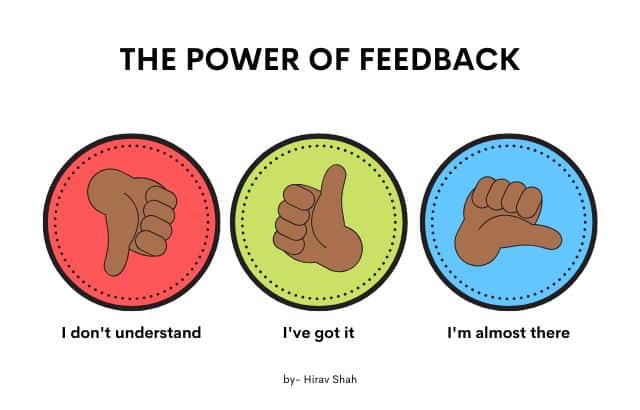
Success rarely comes from talent alone. Whether you are an entrepreneur, business leader, employee, student, or professional, one habit separates those who continue to grow from those who remain stagnant—the willingness to embrace feedback.
Feedback is one of the most valuable assets for personal and professional development. It provides fresh perspectives, uncovers blind spots, and highlights opportunities that we may never discover on our own. While feedback can sometimes feel uncomfortable, the greatest achievers understand that it is not criticism—it is information that can be used to improve performance, relationships, leadership, and long-term success.
Business Strategist Hirav Shah, widely recognized as The Game Changer, often emphasizes that successful people do not fear feedback—they use it as fuel for continuous improvement. Every great business, high-performing team, and exceptional leader grows because they consistently learn, adapt, and evolve through valuable insights from customers, employees, mentors, and stakeholders.
Instead of asking, “Was the feedback positive or negative?” ask yourself, “What can I learn from this?” That simple shift in mindset can transform your personal and professional journey.
Table of Contents
The Gift of Different Perspectives

One of the greatest advantages of feedback is that it allows us to see ourselves through someone else’s eyes.
Every person experiences situations differently based on their background, expertise, experiences, and expectations. Because of this, the way others perceive our communication, leadership, products, or services may be completely different from how we see them ourselves.
Even when we disagree with feedback, it encourages us to pause and examine our assumptions. Sometimes the feedback may not be entirely accurate, but there is often a valuable lesson hidden within it.
For example, imagine a restaurant owner who believes customer service is excellent because employees are friendly. However, online reviews consistently mention long waiting times. Although the owner may initially disagree, customer feedback reveals an operational issue rather than an employee attitude problem.
Similarly, an entrepreneur may believe a marketing campaign is creative, yet customers find the message confusing. Instead of defending the campaign, listening to customer feedback can lead to stronger communication and higher conversions.
Business Strategist Hirav Shah – The Game Changer believes that organizations that actively seek different viewpoints are more likely to innovate because they identify opportunities competitors overlook.
Different perspectives often become the starting point for breakthrough ideas.
Enhancing Self-Awareness Through Feedback

Many people believe they understand their strengths and weaknesses well. However, research consistently shows that true self-awareness is much rarer than most people think.
Feedback acts like a mirror. It reveals habits, behaviors, communication styles, and performance patterns that are difficult to recognize on our own.
Receiving honest observations from managers, colleagues, customers, mentors, or family members helps us identify areas where we excel and areas requiring improvement.
For example, a manager may believe they communicate clearly, yet employees frequently ask follow-up questions. Feedback may reveal that instructions lack clarity or detail.
Likewise, a salesperson may think they are persuasive, but customer feedback could indicate that they speak too much instead of listening to client needs.
These insights create opportunities for meaningful improvement.
Business Strategist Hirav Shah – The Game Changer encourages leaders to regularly collect feedback because the strongest organizations are built by leaders who continuously improve themselves before expecting improvement from others.
Feedback Encourages Continuous Growth and Learning

Growth begins where comfort ends.
Constructive feedback identifies skill gaps, knowledge gaps, and behavioral improvements that can significantly improve future performance.
Instead of viewing criticism as failure, successful individuals treat it as valuable coaching.
Consider a software developer who receives feedback that their code works efficiently but lacks documentation. Rather than feeling discouraged, they improve documentation practices, making future collaboration easier.
A public speaker may receive feedback that the presentation contained valuable information but lacked audience engagement. After adding storytelling, visuals, and interactive questions, future presentations become significantly more impactful.
Athletes regularly depend on coaches to identify tiny improvements that dramatically influence performance.
Businesses operate the same way.
Organizations that embrace customer reviews, employee surveys, performance evaluations, and market research continuously improve products, services, and customer experiences.
This culture of learning creates sustainable competitive advantages.
The Strategic Role of Feedback in Business Success

Feedback is not only beneficial for individuals—it is one of the most powerful strategic tools available to businesses.
Every successful organization relies on continuous information from customers, employees, suppliers, partners, and market trends.
Business Strategist Hirav Shah – The Game Changer believes that companies that ignore feedback often lose market relevance because they continue making decisions based on assumptions rather than real-world evidence.
Consider these examples:
• A retail brand notices repeated customer complaints regarding slow checkout experiences. Instead of ignoring reviews, management introduces self-checkout technology, reducing average waiting time by 40%.
• An e-commerce business receives feedback that product descriptions are confusing. After rewriting descriptions and adding videos, conversions increase substantially.
• A manufacturing company receives employee suggestions about reducing unnecessary production steps. Operational efficiency improves while production costs decrease.
In each case, feedback becomes a strategic advantage rather than a problem.
Feedback Builds Trust and Stronger Relationships

Healthy relationships thrive on honest communication.
Whether in families, friendships, workplaces, or business partnerships, constructive feedback creates stronger understanding and deeper trust.
When people know their opinions are valued, they become more engaged and committed.
For example, managers who regularly ask employees,
“What can I do better as your leader?”
often build stronger teams than managers who only provide instructions.
Similarly, businesses that actively ask customers for reviews demonstrate a genuine commitment to improvement.
Employees who feel heard are more motivated.
Customers who feel valued become loyal.
Partners who experience open communication collaborate more effectively.
Business Strategist Hirav Shah – The Game Changer emphasizes that organizations with strong feedback cultures typically experience higher employee retention, stronger innovation, and better customer satisfaction.
Feedback Develops Resilience and Adaptability

No one enjoys hearing criticism.
However, resilience develops when we learn to separate our identity from our performance.
Feedback does not define who we are.
It simply identifies where we can improve.
Professionals who embrace feedback become more adaptable because they learn to adjust strategies instead of defending mistakes.
For example, during economic downturns, businesses often receive changing customer feedback regarding pricing, delivery, and purchasing priorities.
Companies that adapt quickly survive.
Those that ignore market feedback frequently struggle.
Similarly, professionals who continuously improve based on performance reviews often experience faster career growth than those who reject criticism.
Adaptability has become one of today’s most valuable competitive advantages.
The Role of a Business Strategist in Creating a Feedback Culture

One of the essential responsibilities of a business strategist is establishing systems that encourage continuous improvement.
Business Strategist Hirav Shah – The Game Changer advocates creating organizations where feedback becomes a routine business process rather than an occasional event.
A business strategist helps organizations:
- Build customer feedback systems.
- Measure employee satisfaction regularly.
- Improve leadership communication.
- Analyze customer complaints for strategic insights.
- Convert feedback into measurable business improvements.
- Create continuous learning cultures.
- Improve operational efficiency through employee suggestions.
- Develop leadership coaching programs.
- Monitor customer experience across multiple touchpoints.
- Use performance data to make informed business decisions.
When businesses combine strategic planning with continuous feedback, they become more agile, innovative, and customer-focused.
Real-Life Examples of Feedback Driving Success

Example 1: Restaurant Business
A restaurant receives 500 customer reviews.
- 350 positive reviews
- 100 mention slow service
- 50 mention parking issues
Instead of focusing only on praise, management addresses slow service by hiring additional staff during peak hours.
Within three months:
- Customer ratings improve from 4.1 to 4.7 stars.
- Repeat customer visits increase significantly.
- Monthly revenue grows.
Example 2: Online Business
An online store receives feedback that customers abandon carts because shipping costs appear only during checkout.
The company displays shipping costs earlier.
Result:
- Cart abandonment decreases.
- Customer satisfaction improves.
- Sales increase.
Example 3: Leadership Development
A company CEO receives anonymous employee feedback indicating meetings are too long.
The CEO shortens meetings from 90 minutes to 45 minutes.
Employees spend more time on productive work.
Overall productivity improves.
Simple Business Calculations Showing the Value of Feedback
Calculation 1: Customer Retention
Current Customers = 1,000
Customer Retention = 80%
Improved Retention After Feedback = 90%
Additional Customers Retained:
1,000 × (90% − 80%)
= 100 additional customers retained.
If each customer spends $500 annually:
100 × $500 = $50,000 additional annual revenue.
Calculation 2: Employee Productivity
100 employees
Average productivity increase after regular feedback = 15%
If each employee generates $100,000 annually:
Total Revenue =
100 × $100,000
= $10,000,000
15% improvement:
$10,000,000 × 15%
= $1,500,000 potential productivity gain.
Calculation 3: Customer Complaint Reduction
Monthly complaints = 200
After implementing customer suggestions:
Complaints reduce by 35%
200 × 35%
= 70 fewer complaints every month.
Fewer complaints generally lead to stronger customer loyalty and improved brand reputation.
Statistics and Facts About Feedback
- Harvard Business Review reports that employees receiving regular feedback are 3.6 times more likely to be engaged at work.
- Research on growth mindset demonstrates that individuals who embrace learning are significantly more likely to use feedback for improvement.
- Studies indicate that while 95% of people believe they are self-aware, only 10–15% actually demonstrate high levels of self-awareness.
- Gallup research found that employees receiving meaningful feedback experience approximately 14.9% higher performance.
- Research by Zenger/Folkman suggests that leaders who actively seek feedback are viewed as significantly more effective and are much more likely to be rated as high-performing leaders.
These findings demonstrate that feedback is not simply about correcting mistakes—it is one of the strongest drivers of engagement, leadership, innovation, and organizational success.
Frequently Asked Questions (FAQs)

Why is feedback important for personal growth?
Feedback helps individuals recognize strengths, identify improvement opportunities, and develop greater self-awareness, leading to continuous personal and professional development.
How can I receive criticism more effectively?
Listen carefully, avoid becoming defensive, ask clarifying questions, reflect before responding, and focus on learning rather than reacting emotionally.
Why do successful leaders actively seek feedback?
Effective leaders understand that continuous improvement requires honest insights from employees, customers, mentors, and stakeholders. Feedback enables better decision-making and stronger leadership.
How does feedback improve business performance?
Customer feedback improves products and services, employee feedback strengthens workplace culture, and market feedback helps organizations remain competitive and responsive to change.
What role does a business strategist play in feedback management?
A business strategist designs systems that collect, analyze, and implement feedback to improve customer experience, operational efficiency, employee engagement, and long-term business growth.
How often should businesses collect feedback?
Businesses should gather customer feedback after major interactions, conduct regular employee surveys, monitor online reviews consistently, and review performance data throughout the year to support continuous improvement.
How can I overcome the fear of receiving criticism?
Recognize that feedback is about improving performance, not judging your worth. View every constructive suggestion as an opportunity to learn, strengthen your skills, and build confidence over time.
What strategies help in asking for constructive feedback?
Be specific about the areas where you want input, encourage honest responses, avoid becoming defensive, and thank people for sharing their perspectives. Following up on feedback by taking action also encourages more meaningful conversations in the future.
Conclusion

Feedback is one of the greatest gifts we can receive because it expands our perspective, strengthens self-awareness, accelerates learning, and encourages continuous improvement. The most successful individuals and organizations understand that growth begins by listening, reflecting, and acting on valuable insights rather than resisting them.
Business Strategist Hirav Shah – The Game Changer believes that every piece of constructive feedback represents an opportunity to become stronger, smarter, and more competitive. Whether it comes from customers, employees, mentors, colleagues, or personal relationships, feedback provides the direction needed for meaningful progress.
Instead of fearing criticism, embrace it with curiosity. Every suggestion, observation, and honest conversation has the potential to uncover hidden opportunities, improve decision-making, enhance leadership, and create lasting success. In a rapidly changing world, those who welcome feedback will continue to learn, adapt, innovate, and unlock their fullest potential.