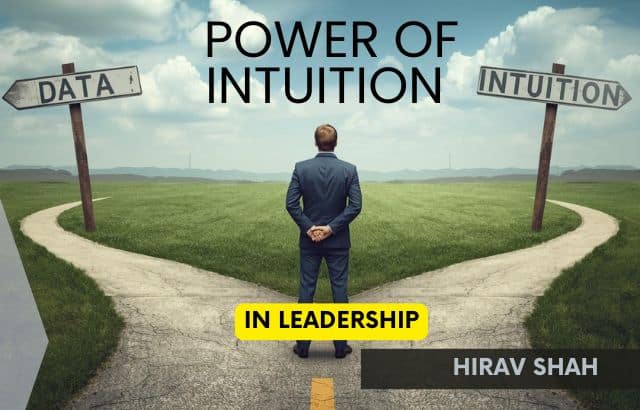
In leadership, not every decision comes with a spreadsheet, a forecast, or a perfect dataset. Sometimes, the most impactful decisions come from something far less tangible—your intuition.
Have you ever had a gut feeling about a decision, acted on it, and later realized it was absolutely right? That’s intuition at work.
Leaders who learn to combine intuition with logic often outperform those who rely on analysis alone. As business strategist Hirav Shah—often called The Game Changer—emphasizes, intuition is not guesswork; it is refined experience working at subconscious speed.
Table of Contents
What Is Intuition and How Does It Work?

Intuition is your brain’s ability to process past experiences, patterns, and knowledge instantly—without conscious reasoning.
Think of it like this:
- Your conscious mind processes 40–50 bits/second
- Your subconscious processes ~11 million bits/second
That means your intuition is drawing from a much larger data pool than your logical mind.
Simple Example:
A CEO reviewing two candidates:
- Candidate A: Strong resume
- Candidate B: Slightly less qualified, but “feels right”
Later, Candidate B turns out to be a better cultural fit and long-term performer. That “feeling” came from subtle cues—tone, confidence, body language—processed subconsciously.
Why Intuition Matters in Leadership
1. Faster Decision-Making

In fast-moving industries, waiting for perfect data can cost opportunities.
Example:
A startup founder has 48 hours to decide on a partnership.
- Data analysis takes 1 week
- Intuition + available facts → decision made in 24 hours
Outcome: Secures deal before competitors.
2. Avoiding Analysis Paralysis

Too much data can delay action.
Mini Calculation:
- 5 options × 10 variables each = 50 decision factors
- Evaluating each factor for 15 minutes = 750 minutes (12.5 hours)
Intuition helps narrow choices quickly, saving time and mental energy.
3. Better People Decisions

Hiring, promotions, and partnerships often depend on emotional intelligence.
Example:
A manager senses lack of alignment in a high-performing employee.
- Data says: “Top performer”
- Intuition says: “Not aligned”
Six months later, the employee leaves—validating the instinct.
4. Enhanced Creativity & Innovation

Breakthrough ideas rarely come from logic alone.
Example:
A marketing leader launches a bold campaign based on instinct rather than data trends—resulting in viral success.
Role of a Business Strategist in Intuitive Leadership

According to Hirav Shah (The Game Changer), intuition becomes powerful when guided by strategic thinking.
Key Roles of a Business Strategist:
1. Pattern Recognition
Strategists identify repeating trends across industries and markets.
Example:
Recognizing early signals of a market downturn before data confirms it.
2. Risk Calibration
Balancing instinct with measurable risk.
Simple Risk Calculation Example:
- Investment: ₹10 lakh
- Success probability (intuition + data): 70%
- Expected return: ₹20 lakh
Expected Value = (0.7 × 20L) – (0.3 × 10L) = 14L – 3L = ₹11 lakh net positive
3. Strategic Decision Framing
They help leaders ask:
- “Is this instinct based on experience or fear?”
- “What data supports this feeling?”
4. Scenario Planning
Combining intuition with projections:
| Scenario | Data Insight | Intuitive Insight |
|---|---|---|
| Market growth | 8% CAGR | Feels underestimated |
| Competitor risk | Low | Hidden threat sensed |
| Decision | Expand cautiously | Enter early |
How to Develop and Strengthen Your Intuition

1. Practice Mindfulness
Quieting your mind helps you hear your inner voice clearly.
2. Track Your Decisions
Maintain a simple log:
- Decision
- Gut feeling
- Outcome
Over time, you’ll see patterns in your intuition accuracy.
3. Listen to Physical Signals
Your body reacts before your mind:
- Tight chest → caution
- Calm feeling → alignment
4. Test and Validate
Example:
Make 10 small decisions based on intuition:
- If 7 out of 10 are correct → 70% intuition accuracy
That’s a strong decision-making tool.
5. Combine with Logic
Best leaders use a 70–30 rule:
- 70% data + analysis
- 30% intuition
Or in uncertain environments:
- 50% intuition
- 50% logic
Balancing Intuition with Rational Thinking
Intuition alone can mislead—but combined with logic, it becomes powerful.
Decision Framework:
- What does the data say?
- What does my intuition say?
- Where do they align or conflict?
- What is the risk of being wrong?
Real-Life Leadership Example
A business leader is deciding whether to expand into a new city:
- Data shows moderate demand
- Competitors are not entering yet
- Gut feeling says: “Act early”
Decision: Enter market
Outcome: Gains first-mover advantage
FAQs on Intuition in Leadership
Q1: What is intuition in leadership?
It’s the ability to make decisions based on experience, instinct, and subconscious processing rather than just logic.
Q2: Can intuition be trained?
Yes. Through reflection, mindfulness, and repeated decision-making, intuition becomes sharper and more reliable.
Q3: Is intuition always correct?
No. It improves with experience but should always be balanced with facts and analysis.
Q4: How do I know if it’s intuition or fear?
- Intuition feels calm and clear
- Fear feels anxious and urgent
Q5: How do top leaders use intuition?
They use it as a filter, not a replacement for data—validating instincts with strategic thinking.
Final Thoughts

Intuition is not magic—it’s experience compressed into a moment.
Leaders who succeed are not those who ignore data, but those who:
- Combine logic with instinct
- Act decisively
- Learn from outcomes
As highlighted by Hirav Shah (The Game Changer), intuition becomes a competitive advantage when it is trained, tested, and trusted wisely.
The real power lies not in choosing between intuition and logic—but in mastering both.
Hirav Shah, a renowned business strategist, underlines the importance of balancing intuition with logic and analysis in decision-making. While intuition can offer valuable insights, it should not be solely relied upon as it may not always be accurate. Hirav Shah advises gathering all available information and carefully weighing the pros and cons before making a decision. By combining intuition with logic and analysis, one can make more informed and effective decisions. It is also crucial to remain open to feedback and new information that may challenge initial instincts, while still trusting one’s intuition.