Table of Contents
What is Emotional Mastery?

We’ve all had circumstances where our feelings defeated us. Regularly, we didn’t understand what was going on until we were excessively far down the “emotional train” to transform it. The best ideal opportunity to deal with a feeling is the point at which you initially start to feel and experience it completely. That way, it will not keep springing up on numerous occasions. By following these six direct steps, you can begin to understand emotional mastery and gradually assume responsibility for your reactions, decisions, and ultimately your life outcomes.
Emotional mastery is not about suppressing emotions or pretending they don’t exist. It is about awareness, regulation, interpretation, and intelligent response to emotional experiences instead of automatic reactions.
Celebrated Business Astrologer and Strategic Advisor Hirav Shah, known as “The Game Changer,” explains emotional mastery as the ability to align emotions with decision-making so that feelings become information—not interference. He emphasizes that in both personal life and business leadership, emotional control is not optional; it is a competitive advantage.
Psychological Evolution of Emotional Mastery
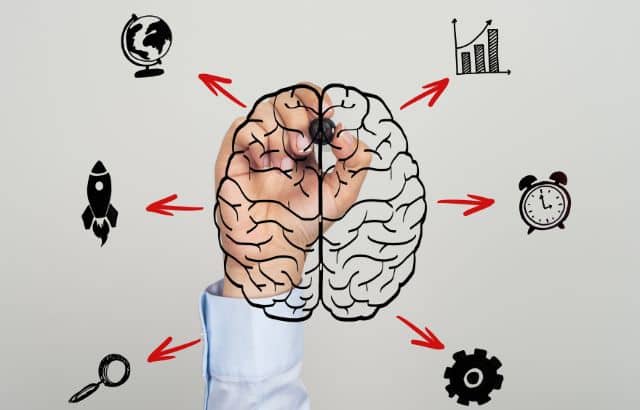
Hirav Shah explains that the understanding of emotional mastery has evolved over the last century through psychology and behavioral science.
Early American psychology embraced the James-Lange Theory, which suggested emotions are strictly the result of physiological reactions to external stimuli. In simple terms: “We feel because our body reacts.”
Later, the Cannon-Bard Theory challenged this idea, stating that emotional experience and physiological response occur simultaneously, with the brain (thalamus) acting as a central processing unit.
Then came the Schachter-Singer Theory, which introduced the idea that emotion is shaped by both physiological arousal and cognitive labeling. For example, the same racing heartbeat could be labeled as “fear” in one situation and “excitement” in another.
Hirav Shah further explains this through practical business thinking:
“Emotion is raw data. Your interpretation decides whether it becomes opportunity or disruption.”
A simple example:
- A failed business pitch
- Emotion 1: Anxiety → “I am not good enough”
- Emotion 2: Learning mindset → “I need better strategy”
Same event. Different emotional interpretation. Different life outcome.
The Role of Emotional Mastery in Life and Society

Sentiments and emotional mastery play a major role in human experience and relationships.
Feelings bind people together across social lines. There are six universal emotions across all cultures: joy, sadness, fear, anger, surprise, and disgust. Everyone experiences them, but expression differs culturally and socially.
Emotions also directly influence decision-making, especially in leadership and business environments.
Emotional Mastery in Business Strategy (Perspective of Hirav Shah – The Game Changer)
Hirav Shah integrates emotional intelligence into business strategy. According to him, businesses don’t fail only because of poor planning—they fail because of poor emotional control in decision-making.
Examples in business:
- A CEO panics during a market downturn → sells assets at loss
- A calm strategist → sees downturn as acquisition opportunity
- A frustrated manager → loses talent due to impulsive reactions
- An emotionally aware leader → retains talent through communication
Emotional ROI (Return on Investment of Emotional Control)
Let’s quantify emotional mastery in a simple way:
Assume:
- Emotional reactivity cost = ₹50,000/month (bad decisions, missed opportunities, conflicts)
- Emotional mastery improvement reduces this by 40%
Calculation:
- Savings = 50,000 × 40% = ₹20,000/month
- Annual emotional ROI = ₹20,000 × 12 = ₹2,40,000/year
This is a simplified model, but it shows how emotional regulation has measurable financial impact in business environments.
Emotional Mastery and Relationships
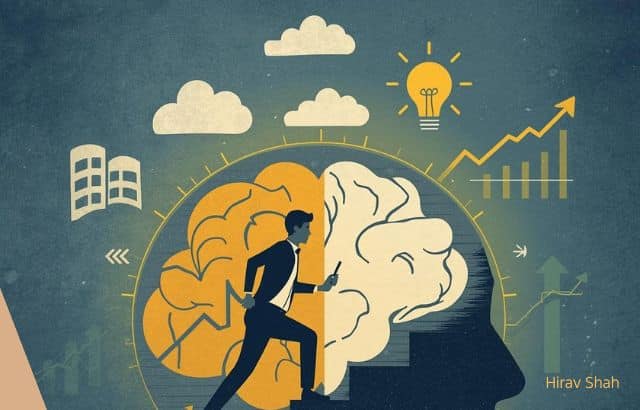
Emotional mastery supports healthy relationships. When you can express emotions appropriately, relationships become stable and meaningful.
Without emotional control:
- Small issues become major conflicts
- Misunderstandings escalate quickly
- Communication breaks down
With emotional mastery:
- You respond instead of react
- You listen instead of defend
- You solve instead of escalate
A practical example:
- Partner forgets something important
- Reaction: “You never care!”
- Response: “I felt hurt when this happened. Can we improve this?”
Same situation, completely different emotional outcome.
There Are “Power Emotions” That Strengthen Mastery

Emotional mastery can be strengthened by cultivating positive emotional states such as:
- gratitude
- confidence
- curiosity
- adaptability
- vitality
- engagement
- joy
- love
- optimism
- enthusiasm
Hirav Shah emphasizes that leaders who consistently operate from these states make better decisions under pressure.
How to Master Your Emotions in 6 Steps

1. Identify What You’re Really Feeling
The first step is awareness.
Ask:
- What am I truly feeling right now?
- Is it anger or disappointment?
- Is it fear or uncertainty?
Example:
Instead of saying “I’m angry at my boss,” you might realize:
“I feel undervalued and anxious about my role.”
Clarity reduces emotional intensity.
2. Acknowledge and Appreciate Your Emotions
Emotional mastery does not mean rejection of feelings.
You never need to make your emotions “wrong.”
Every emotion carries information.
Example:
- Fear = signal of risk
- Anger = boundary violation
- Sadness = loss processing
Ignoring emotions is like ignoring dashboard warnings in a car.
3. Get Curious About the Message
Ask:
- What is this emotion trying to tell me?
- What triggered it?
- What pattern is repeating?
This curiosity interrupts automatic reactions.
Example in business:
A sales drop causes stress. Instead of panic:
- Is it pricing?
- Market shift?
- Communication gap?
Curiosity converts emotion into strategy.
4. Get Confident From Past Wins
Recall when you handled a similar emotional situation successfully.
Example:
- You handled a tough client before
- You resolved conflict earlier
- You survived uncertainty previously
This builds emotional proof.
5. Build Future Emotional Readiness
Mentally simulate future challenges.
Example:
- Imagine receiving criticism
- Imagine financial pressure
- Imagine disagreement in team
This is emotional “rehearsal training.”
6. Get Excited and Take Action
Once clarity is achieved, act immediately.
Example actions:
- Have a conversation
- Make a decision
- Adjust strategy
- Set boundaries
Emotion without action becomes stagnation. Action converts emotion into progress.
Role of a Business Strategist in Emotional Mastery

Hirav Shah, “The Game Changer,” integrates emotional mastery into strategic consulting by helping individuals and organizations:
- Identify emotional blind spots in decision-making
- Reduce reactive business behavior
- Improve leadership clarity under pressure
- Align emotional stability with financial performance
- Strengthen negotiation and communication outcomes
He emphasizes:
“Strategy fails when emotion is unmanaged. Emotion succeeds when strategy is structured.”
In business, emotional mastery is not soft skill—it is operational intelligence.
Simple Emotional Calculation Model for Decision Impact
Let’s consider:
- Daily decisions influenced by emotion: 10
- Poor emotional control leads to wrong decisions: 30%
- Cost per wrong decision (time, money, opportunity): ₹2,000
Calculation:
- Wrong decisions per day = 10 × 30% = 3
- Daily cost = 3 × 2,000 = ₹6,000
- Monthly cost = 6,000 × 30 = ₹1,80,000
Improving emotional mastery by even 50% reduces this drastically:
- Savings = ₹90,000/month
This is why emotional mastery is a performance tool, not just a mindset concept.
FAQs on Emotional Mastery
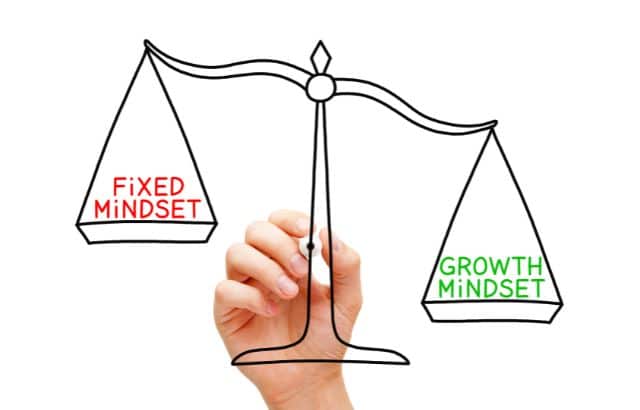
1. Is emotional mastery the same as suppressing emotions?
No. Suppression ignores emotions. Mastery understands and regulates them.
2. Can emotional mastery be learned?
Yes. It is a skill developed through awareness, practice, and reflection.
3. How long does it take to develop emotional mastery?
With consistent practice, noticeable improvement can occur in 30–60 days.
4. Why is emotional mastery important in business?
Because decisions made under emotional pressure often lead to financial and strategic loss.
5. What is the biggest barrier to emotional mastery?
Automatic reaction patterns formed through habit and past experiences.
Final Word
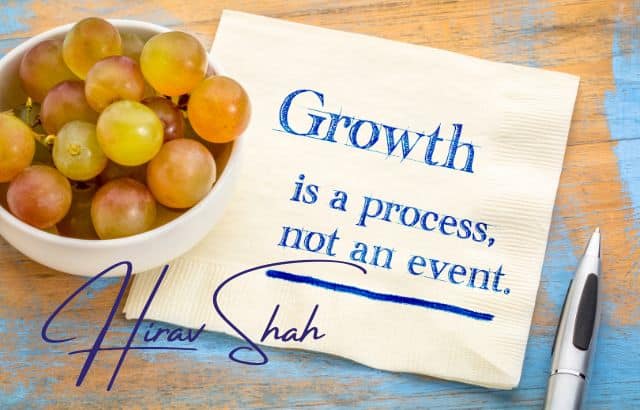
Hirav Shah concludes, “Learning emotional mastery is one of the most powerful steps you can take to create a real and fulfilling life. Letting go of a hurtful past is the hallmark of emotional mastery. You need to make a conscious effort to control your emotions and how you respond to situations. Be kind to yourself and develop an attitude of clarity and acceptance. Then only you can experience stable success in life and business. Let life flow with awareness and strategy.”