

This year, organic growth is set to lead the way in India’s real estate sector. The recent economic crisis has reinforced the importance of owning a home, and several factors are expected to fuel demand: lowered home loan rates, attractive payment plans, and a depreciated rupee.
Hirav Shah, a seasoned Real Estate Strategist and Game Changer, has been advising builders, developers, realtors, and industry players for years. He brings deep insights into the real estate market, providing solutions that are fully customized for large, medium, or small-scale developers.
Table of Contents
Commercial Real Estate Trends

The commercial real estate segment is bouncing back as leasing activities gain momentum. Not only are office spaces seeing renewed interest, but co-working spaces, warehouses, and data centres are also expected to see a sharp rise in leasing demand.
For example:
- Co-working spaces: A city like Mumbai may see a 20% increase in co-working space occupancy compared to last year.
- Warehouses: E-commerce expansion drives demand; if a warehouse space rents for ₹50 per sq ft, and a company leases 10,000 sq ft, monthly rent would be ₹500,000.
With the Indian economy projected to grow 8–10% in FY 2026, demand for real estate continues to strengthen, creating opportunities for both investors and developers.
Why Networking Matters in Real Estate
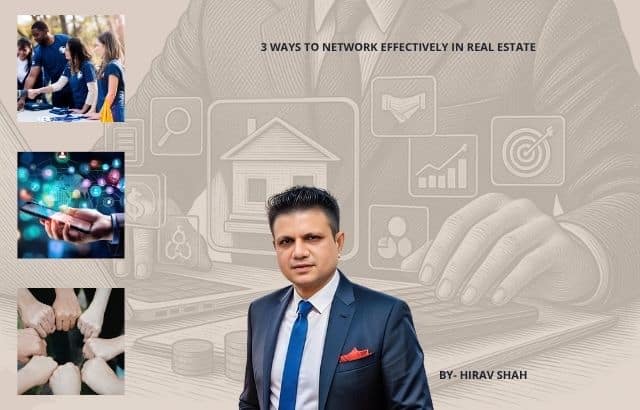
Networking is a vital component of real estate success. Hirav Shah emphasizes that strong relationships in the industry accelerate business growth. Here are three key strategies:
1. Attend Conferences and Industry Events

Real estate conferences are more than just gatherings—they are opportunities to learn, exchange ideas, and connect with influential players. Diversify your network beyond your local area:
- If you’re a Delhi-based developer, connect with peers from Bangalore or Hyderabad for insights on different market strategies.
- Use social media to share conference learnings in real time and keep past connections active with informal meetups.
Example: At a national real estate summit, a small builder could meet a logistics company looking to lease warehouse space, resulting in a potential ₹1.2 crore contract.
2. Leverage Social Media

Social media isn’t just for personal updates—it’s a powerful professional networking tool:
- Platforms like LinkedIn help you connect with investors, lenders, and legal experts.
- A well-rounded network allows you to solve challenges quickly. For example, if you need legal advice on evicting a tenant, a strong network could connect you with an attorney within minutes.
Calculation Example: Suppose you invest in 5 properties and each property generates ₹50,000 monthly rent. With strong networking support, timely advice could prevent a 2-month vacancy in one property, saving ₹100,000.
3. Engage with Your Local Community

Building a presence in your community strengthens both relationships and market knowledge. Ways to get involved include:
- Local sponsorships (e.g., sports events, school activities)
- Volunteer initiatives
- Media engagement through local radio or newspapers
- Participation in networking groups, non-profit boards, or arts associations
Example: Sponsoring a community cultural festival could bring in 50–100 new potential buyers for your residential project.
The Role of a Real Estate Strategist

A Real Estate Strategist like Hirav Shah acts as a guide through uncertain and risky markets. Here’s how:
- Customized Solutions: Tailored strategies for small, medium, and large developers.
- Risk Mitigation: Identifying pitfalls and opportunities in investments.
- Market Forecasting: Predicting upcoming trends and demand shifts.
- Actionable Roadmaps: Providing step-by-step strategies for sales, marketing, and investment decisions.
Example: If a developer wants to launch a 100-unit residential project, a strategist might analyze local demand, calculate pricing for optimal occupancy, and recommend launch timing.
Calculation Example:
- Land cost: ₹50 crore
- Construction cost: ₹100 crore
- Expected sales revenue: ₹180 crore
- Profit = ₹180 crore – (₹50 crore + ₹100 crore) = ₹30 crore
A strategist ensures these numbers are realistic and risks are minimized.
Frequently Asked Questions (FAQs)

Is 2026 a good time to invest in Indian real estate?
India’s real estate sector presents opportunities across residential and commercial segments, but investment decisions should be based on location, pricing, financing costs, demand, rental potential, project quality, and risk. There is no universal answer that applies to every property or investor.
How can networking help real estate investors and developers?
Networking can provide access to investors, buyers, lenders, lawyers, contractors, brokers, tenants, and market intelligence. Strong relationships can also create referrals and partnerships that accelerate business opportunities.
Why should a real estate company work with a Business Strategist?
A Business Strategist can provide an independent strategic perspective across areas such as market positioning, financial planning, risk management, sales, marketing, expansion, networking, and business growth.
What does Hirav Shah do as a Business Strategist?
Hirav Shah works with businesses and real estate industry participants to develop customized strategies, identify opportunities, address business challenges, improve decision-making, and create actionable growth roadmaps. His positioning as The Game Changer reflects a focus on strategic transformation and practical business solutions.
Can small developers benefit from strategic consulting?
Yes. Small developers can benefit significantly because they often have limited capital and fewer resources. Strategic planning can help them prioritize projects, control risks, improve sales, strengthen partnerships, and use resources more effectively.
How can a strategist help with a new residential project?
A strategist can examine the location, target audience, competing developments, pricing, project economics, launch timing, marketing strategy, sales channels, and potential risks before recommending an actionable plan.
Is networking really important when technology is changing real estate?
Yes. Technology can improve lead generation and communication, but relationships remain important for financing, partnerships, referrals, transactions, professional expertise, and business development. Technology can expand a network, while strategic relationship management can make that network more valuable.
Final Thoughts
India’s real estate sector has meaningful growth opportunities in 2026, supported by residential demand, commercial leasing, warehousing, flexible workspaces, digital infrastructure, and evolving investor preferences.
However, successful real estate businesses will need more than favorable market conditions. They will need strategy, financial discipline, networking, market intelligence, risk management, strong execution, and customer-focused positioning.
This is where the role of a Business Strategist becomes important. Hirav Shah, known as The Game Changer, brings a strategic perspective to real estate and business challenges, helping developers, builders, investors, and industry professionals evaluate opportunities and build customized action plans.
Whether the objective is launching a 100-unit residential project, improving warehouse occupancy, expanding into a new market, strengthening a developer’s sales pipeline, or building a more resilient real estate business, strategic thinking can make the difference between simply participating in the market and building sustainable growth.
The opportunity in real estate may be significant—but the real advantage comes from knowing where to invest, how to execute, how to manage risk, and how to build the right relationships.