
Table of Contents
Introduction: Why the Taxi Business Continues to Be a Profitable Opportunity in India
India’s transportation industry is experiencing a significant transformation. Rapid urbanization, increasing disposable incomes, growing business travel, expanding tourism, and the widespread adoption of smartphone-based mobility services have created a thriving environment for taxi and cab businesses.
Whether it is a corporate executive traveling to an airport, a family planning an outstation trip, a student commuting daily, or a tourist exploring a new city, the demand for reliable transportation remains strong throughout the year.
However, many aspiring entrepreneurs enter the taxi business with unrealistic expectations. They assume that purchasing a few vehicles and hiring drivers will automatically generate profits. In reality, successful taxi businesses are built through strategic planning, financial discipline, operational efficiency, and market positioning.
According to Business Strategist Hirav Shah, many transportation businesses fail not because the market lacks demand, but because the business model lacks structure. The most successful taxi operators understand customer behavior, vehicle utilization, pricing strategy, and cost management long before they purchase their first vehicle.
This comprehensive guide explains how to start a taxi business in India, how to minimize investment risk, and how to build a scalable business model that can generate long-term profitability.
Understanding the Taxi Business Landscape in India

Before investing a single rupee, entrepreneurs must understand that the taxi business is not a vehicle business.
It is fundamentally a mobility service business.
The vehicle is merely the tool used to deliver the service.
Many new operators focus excessively on buying expensive cars while neglecting customer acquisition, fleet utilization, driver management, and operational systems.
A strategic entrepreneur asks:
- Who will be my customers?
- Why will they choose me?
- What problem am I solving?
- How will I generate recurring bookings?
- What will make my service different?
The answers to these questions determine whether the business survives or struggles.
Different Taxi Business Models in India
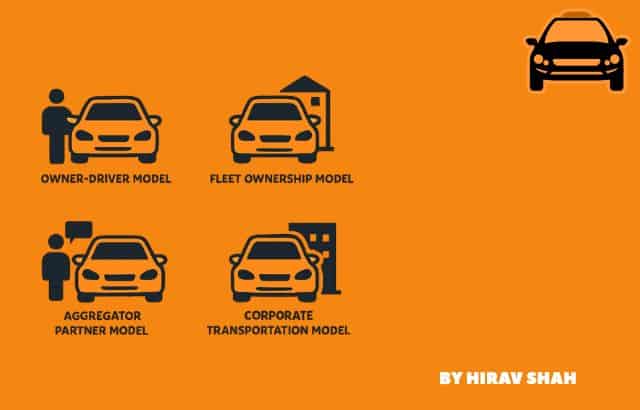
One of the biggest mistakes entrepreneurs make is copying someone else’s model without evaluating their own resources.
Let us examine the most common taxi business models.
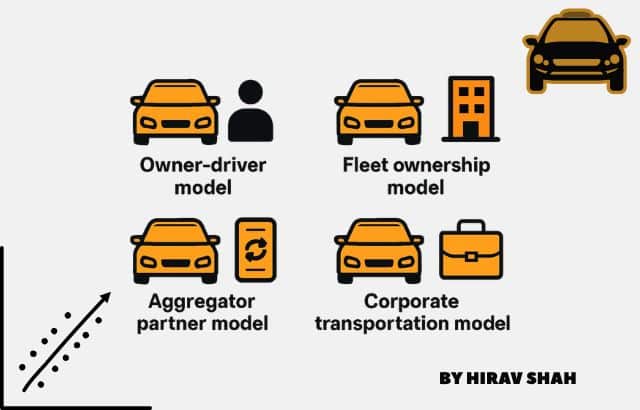
Model 1: Owner-Driver Taxi Business
This is the safest and most affordable way to enter the industry.
In this model:
- You own one vehicle.
- You drive the vehicle yourself.
- You retain most of the revenue.
- Driver salary expenses are eliminated.
Example
Suppose you purchase a vehicle worth ₹8 lakh through financing.
Monthly revenue:
- Daily earnings: ₹3,500
- Working days: 26
Monthly Revenue:
₹3,500 × 26 = ₹91,000
Monthly expenses:
- EMI: ₹16,000
- Fuel: ₹22,000
- Maintenance: ₹4,000
- Insurance allocation: ₹2,000
Total Expenses:
₹44,000
Approximate Monthly Profit:
₹47,000
This model allows entrepreneurs to learn the industry before scaling.
Model 2: Fleet Ownership Model
In this model, the entrepreneur owns multiple vehicles and hires drivers.
Advantages include:
- Scalability
- Higher revenue potential
- Brand building opportunities
Challenges include:
- Driver management
- Maintenance costs
- Idle vehicle risk
- Increased capital requirement
This model works best after gaining operational experience.
Model 3: Aggregator Partner Model
Many entrepreneurs attach their vehicles to ride-hailing platforms.
Benefits include:
- Immediate customer access
- Reduced marketing effort
- Technology infrastructure support
Challenges include:
- Commission deductions
- Dependence on platform policies
- Limited pricing control
This model can be useful for first-time entrepreneurs seeking consistent booking volume.
Model 4: Corporate Transportation Services
This is often one of the most profitable segments.
Companies require:
- Employee transportation
- Airport transfers
- Executive travel
- Client transportation
Corporate contracts provide predictable income and recurring business.
Many successful fleet operators generate the majority of their revenue from corporate clients rather than individual passengers.
The Smartest Way to Start with Minimum Investment
Most people assume they need several cars to launch a taxi company.
This assumption creates unnecessary financial pressure.
A smarter strategy is to start asset-light.
Strategy A: One Vehicle Model
Begin with one vehicle.
Master:
- Customer acquisition
- Operations
- Scheduling
- Cost management
Scale only after achieving consistent profitability.
Strategy B: Partner Vehicle Model
Instead of purchasing multiple vehicles, collaborate with vehicle owners.
You focus on:
- Branding
- Marketing
- Customer acquisition
Vehicle owners provide the cars.
You earn a commission on every booking.
This significantly reduces capital requirements.
Strategy C: Contract-Based Expansion
Secure contracts before purchasing vehicles.
Many entrepreneurs buy vehicles first and then search for customers.
Strategically, the reverse approach is safer.
Acquire:
- School transportation contracts
- Corporate travel contracts
- Hotel partnerships
- Tourism contracts
Then scale the fleet based on actual demand.
This minimizes risk.
Legal Requirements to Start a Taxi Business in India
A professionally managed taxi business must comply with regulations.
Typical requirements include:
- Business registration
- GST registration (if applicable)
- Commercial vehicle registration
- Commercial insurance
- Driver verification
- Fitness certification
- Transport permits
Regulatory compliance protects the business from future operational disruptions.
Entrepreneurs should consult local transport authorities and qualified professionals for region-specific requirements before commencing operations.
Choosing the Right Vehicle

Vehicle selection directly impacts profitability.
Many entrepreneurs choose vehicles based on personal preference rather than commercial logic.
A strategic fleet owner evaluates:
- Fuel efficiency
- Maintenance cost
- Passenger comfort
- Resale value
- Spare parts availability
Example
Consider two vehicles.
Vehicle A:
- Mileage: 12 km/litre
Vehicle B:
- Mileage: 20 km/litre
If the vehicle travels 5,000 km monthly:
Vehicle A fuel consumption:
5,000 ÷ 12 = 417 litres
Vehicle B fuel consumption:
5,000 ÷ 20 = 250 litres
Difference:
167 litres
At ₹100 per litre:
Monthly savings:
₹16,700
Annual savings:
₹2,00,400
This single decision can significantly impact profitability.
Creating a Winning Taxi Business Plan

A successful taxi business plan includes five essential pillars.
Pillar 1: Market Selection
Choose a focused market.
Examples:
- Airport transfers
- Corporate travel
- Tourist transportation
- School transportation
- Outstation travel
Businesses that serve everyone often struggle to build a clear identity.
Pillar 2: Revenue Strategy
Multiple revenue streams improve profitability.
Possible sources include:
- Local rides
- Airport transfers
- Corporate contracts
- Tourist packages
- Monthly rental plans
- Event transportation
Diversification reduces dependence on a single customer segment.
Pillar 3: Cost Control System
Successful operators track:
- Fuel expenses
- Maintenance costs
- Driver efficiency
- Vehicle utilization
- Customer acquisition cost
What gets measured gets managed.
Pillar 4: Customer Experience
Customers remember experiences more than prices.
Simple improvements include:
- Clean vehicles
- Polite drivers
- Timely pickups
- Digital payments
- Professional communication
Positive experiences generate referrals.
Pillar 5: Scalability Framework
Create systems from day one.
Document:
- Booking process
- Driver onboarding
- Complaint handling
- Vehicle maintenance schedules
Systemized businesses scale faster.
Real-World Strategic Scenario
Imagine two entrepreneurs.
Entrepreneur A purchases five vehicles immediately using loans.
Entrepreneur B starts with one vehicle, develops hotel partnerships, secures airport clients, builds customer reviews, and gradually expands.
After two years:
Entrepreneur A struggles with loan repayments and underutilized vehicles.
Entrepreneur B has stable contracts, predictable revenue, and a scalable business model.
The difference is not investment size.
The difference is strategy.
This is a principle frequently emphasized by Business Strategist Hirav Shah: growth should follow demand, not assumptions.
The Role of Technology in Modern Taxi Businesses
Technology has become a competitive advantage.
Essential tools include:
- GPS tracking
- Online booking systems
- Driver monitoring
- Digital payment systems
- Customer relationship management software
Technology improves efficiency while reducing operational leakage.
Even small taxi businesses can now operate with systems previously available only to large corporations.
Marketing Strategies That Actually Work
Many taxi businesses fail because they depend entirely on random customer bookings.
Strategic marketing focuses on predictable demand generation.
Hotel Partnerships
Hotels constantly need transportation services.
Build relationships with:
- Budget hotels
- Business hotels
- Resorts
Travel Agency Partnerships
Travel agencies frequently require transportation support.
This creates recurring business opportunities.
Corporate Networking
Approach:
- IT companies
- Manufacturing firms
- Consulting firms
- Hospitals
Corporate transportation contracts can stabilize cash flow.
Local Digital Marketing
Use:
- Google Business Profile
- WhatsApp Business
- Social media pages
- Customer reviews
Local visibility significantly increases inquiry volume.
Common Mistakes That Destroy Taxi Businesses
Overexpansion
Buying too many vehicles too early creates financial pressure.
Ignoring Driver Quality
Drivers represent the brand.
Poor driver behavior damages customer trust.
Weak Financial Tracking
Many operators do not know their true profit margins.
Every expense must be monitored.
Competing Only on Price
Low prices attract customers initially but often destroy profitability.
Compete on reliability and service quality instead.
Lack of Strategic Direction
Without a clear growth roadmap, businesses become reactive rather than proactive.
A Simple Taxi Business Success Framework

A practical framework can be remembered as:
DRIVE
D – Demand First
Secure demand before expanding.
R – Reduce Fixed Costs
Keep investments lean.
I – Improve Customer Experience
Retention is cheaper than acquisition.
V – Vehicle Utilization
Maximize ride hours.
E – Expand Strategically
Scale only after validating profitability.
Entrepreneurs who consistently follow this framework increase their chances of long-term success.
Frequently Asked Questions (FAQs)

How much investment is required to start a taxi business in India?
A small owner-driver model can begin with approximately ₹2 lakh to ₹5 lakh as a down payment for a financed vehicle. Larger fleet businesses require substantially higher capital.
Is the taxi business profitable in India?
Yes, profitability depends on vehicle utilization, cost control, customer retention, and contract acquisition. Strategic management is often more important than fleet size.
Which vehicle is best for starting a taxi business?
The ideal vehicle depends on the target market. Entrepreneurs should prioritize fuel efficiency, maintenance cost, passenger comfort, and resale value.
Should I start independently or join an aggregator platform?
For beginners, aggregator partnerships can provide immediate access to customers. However, building direct customer relationships creates greater long-term control and profitability.
How many vehicles should I start with?
For most first-time entrepreneurs, starting with one vehicle is the safest approach. Expansion should be based on proven demand rather than assumptions.
What is the biggest success factor in the taxi business?
Consistent customer acquisition and high vehicle utilization are often the most critical factors. An idle vehicle generates expenses but no revenue.
Can I start a taxi business without owning vehicles?
Yes. Many entrepreneurs operate using partner vehicles and earn commissions through customer acquisition, branding, and booking management.
Conclusion
The taxi business in India remains one of the most accessible service industries for aspiring entrepreneurs. However, success does not come from simply owning vehicles. It comes from understanding demand, managing costs, delivering exceptional customer experiences, and scaling with discipline.
The most successful operators think like strategists rather than vehicle owners. They focus on utilization, contracts, customer retention, and operational efficiency.
As Business Strategist Hirav Shah often emphasizes, sustainable growth is not about investing the most money; it is about making the smartest decisions at the right time.
For entrepreneurs seeking minimum-risk entry, the best path is clear: start small, validate demand, build systems, strengthen customer relationships, and scale only when profitability becomes predictable.
A useful framework to remember is the DRIVE Model for Taxi Business Success:
D – Demand First
Secure customers and contracts before expanding your fleet.
R – Reduce Fixed Costs
Keep investments lean and avoid unnecessary financial burdens.
I – Improve Customer Experience
Focus on punctuality, cleanliness, safety, and professional service to encourage repeat bookings.
V – Vehicle Utilization
Maximize the earning potential of every vehicle by reducing idle time and increasing ride frequency.
E – Expand Strategically
Scale only after establishing a profitable and sustainable business model.
Those who follow the DRIVE model and approach the taxi business with strategy rather than emotion position themselves for long-term success in India’s rapidly growing mobility economy. The opportunity is significant, but lasting success belongs to entrepreneurs who combine smart planning, disciplined execution, and a customer-first mindset.