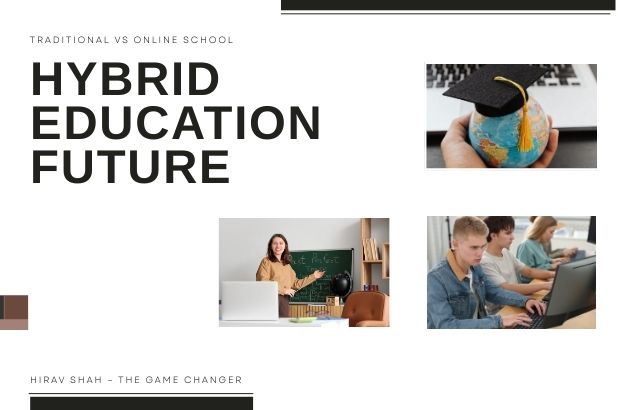
Education is undergoing one of the biggest transformations in history. From chalkboards and classrooms to laptops and learning apps, the debate between traditional schooling and online education continues to grow. But a new model is emerging as the strongest contender — hybrid education.
According to business strategist Hirav Shah, widely known as The Game Changer, education is no longer just about learning subjects; it is about optimizing time, cost, outcomes, and scalability.
Let’s break this down strategically.
Table of Contents
Understanding Traditional Schooling

Traditional education refers to in-person classroom learning, fixed schedules, and face-to-face interaction with teachers.
Key Advantages
- Structured environment
- Direct teacher-student interaction
- Social development and discipline
- Hands-on activities (labs, sports, arts)
Limitations
- Fixed schedules limit flexibility
- High operational costs (buildings, transport, uniforms)
- One-size-fits-all teaching pace
Example
A student attending a private school may spend:
- Tuition: ₹80,000/year
- Transport: ₹20,000/year
- Uniforms & books: ₹15,000/year
Total annual cost: ₹1,15,000
Yet, learning hours remain fixed at ~6 hours/day regardless of individual productivity.
Understanding Online Education

Online schooling uses digital platforms for live or recorded classes, assessments, and collaboration.
Key Advantages
- Flexible learning schedules
- Global access to expert teachers
- Lower cost structure
- Self-paced learning
Limitations
- Reduced social interaction
- Requires self-discipline
- Screen fatigue
- Limited hands-on experience
Example
An online learning program might cost:
- Course fee: ₹25,000/year
- Internet & device cost (average): ₹10,000/year
Total annual cost: ₹35,000
That’s nearly 70% cost savings compared to traditional schooling.
The Rise of Hybrid Education
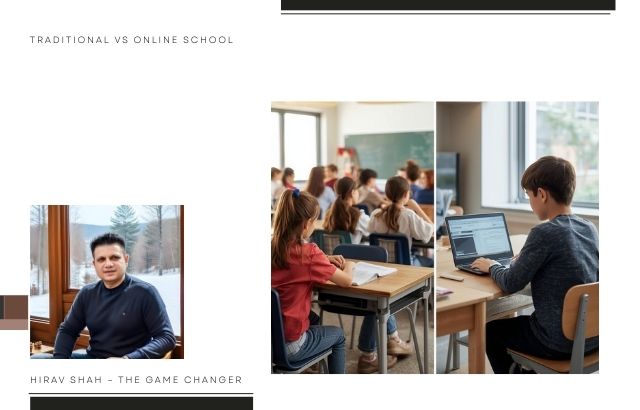
Hybrid education combines in-person learning + online learning, offering the best of both worlds.
What Hybrid Education Looks Like
- Classroom learning for discussions, labs, teamwork
- Online modules for theory, revision, and assessments
- Flexible schedules with structured accountability
Business Strategist Insight
According to Hirav Shah – The Game Changer, hybrid education follows the 80/20 productivity rule:
- 80% conceptual learning online
- 20% applied learning in classrooms
This model maximizes ROI on education.
Simple Cost & Time Calculation
| Model | Annual Cost | Learning Efficiency |
|---|---|---|
| Traditional | ₹1,15,000 | Medium |
| Online | ₹35,000 | Medium–High |
| Hybrid | ₹55,000 | High |
Hybrid saves ~52% cost while improving learning outcomes.
Role of Business Strategists in Education Evolution

A business strategist looks at education as a system, not just a syllabus.
Key Strategic Roles
- Optimizing cost vs outcome
- Designing scalable learning models
- Aligning education with future job markets
- Reducing inefficiencies in time and resources
Hirav Shah emphasizes that:
“Education must shift from attendance-based success to outcome-based success.”
Hybrid education supports this shift perfectly.
Why Hybrid Education Is the Future

For Students
- Personalized learning pace
- Reduced burnout
- Better skill retention
For Parents
- Lower costs
- Flexible schedules
- Transparent performance tracking
For Institutions
- Lower infrastructure costs
- Higher student reach
- Better performance analytics
Real-World Example

Many global universities now:
- Conduct lectures online
- Use campuses for research, labs, and collaboration
- Offer recorded sessions for revision
This approach has increased student completion rates by 20–30% in multiple studies.
Frequently Asked Questions (FAQs)

1. Is hybrid education better than traditional schooling?
Yes, for most learners. Hybrid education balances flexibility with structure, improving outcomes.
2. Does hybrid education reduce learning quality?
No. When designed correctly, it improves retention and engagement.
3. Is hybrid education affordable?
Yes. On average, it reduces education costs by 40–60%.
4. Who benefits most from hybrid learning?
Students, working professionals, skill-based learners, and institutions.
5. What does Hirav Shah say about hybrid education?
As The Game Changer, Hirav Shah believes hybrid education is the most scalable and sustainable learning model for the future economy.
Final Thoughts

The question is no longer Traditional vs Online.
The real answer lies in Hybrid Education — a model that is flexible, cost-effective, scalable, and future-ready.
As business strategist Hirav Shah – The Game Changer highlights, the future belongs to systems that adapt, optimize, and deliver results — and hybrid education checks all those boxes