Business Strategist and Author of 25+ Strategy Books, Hirav Shah, believes that one of the biggest myths in business is that decisions are made during meetings.
In reality, most decisions are only discussed during meetings.
The real decision is made when someone takes ownership, commits to a deadline, and follows through with execution.
According to Business Strategist Hirav Shah:
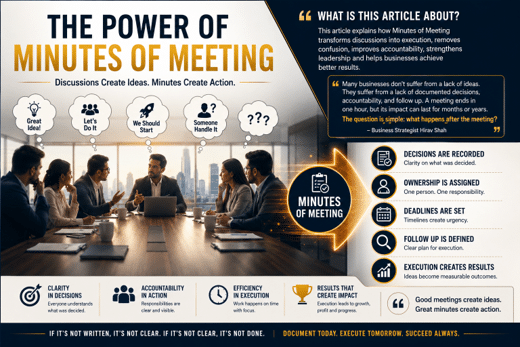
“Many businesses don’t suffer from a lack of ideas. They suffer from a lack of documented decisions, accountability, and follow up. A meeting ends in one hour, but its impact can last for months or years. The question is simple: what happens after the meeting?”
Think about the number of meetings happening around the world today.
- Board meetings
- Sales meetings
- Startup reviews
- Family business discussions
- Project meetings
- Strategy meetings
Yet despite thousands of hours being spent in discussions, many businesses continue to face the same problems again and again.
Table of Contents
Why?
Because discussions are remembered differently by different people.
One person believes a decision was approved.
Another believes it was postponed.
A third person assumes someone else was responsible.
This is where Minutes of Meeting becomes one of the most powerful and underestimated business tools.
This article is not about paperwork.
It is not about administration.
It is not about creating documents to satisfy management.
What Is This Article About?
This article is about how Minutes of Meeting can transform discussions into execution, remove confusion, improve accountability, strengthen leadership, and help businesses achieve better results.
Let’s begin by understanding what Minutes of Meeting actually means.
Section 1: What Are Minutes of Meeting?
Many people believe Minutes of Meeting, commonly known as MOM, is simply a summary of what happened during a meeting.
That definition is incomplete.
A true Minutes of Meeting document is not a record of discussion.
It is a record of decisions.
The purpose of Minutes of Meeting is not to preserve conversation.
The purpose is to drive execution.
A good MOM clearly answers five critical questions:
- What was discussed?
- What was decided?
- Who is responsible?
- By when must it be completed?
- What follow up is required?
Without answers to these questions, even the best meeting can become meaningless.
Imagine using Google Maps for a journey.
You enter your destination, select your route, and start driving.
Now imagine if Google Maps simply showed you all possible roads but never told you which route to take.
You would probably get confused, take wrong turns, waste time, and may never reach your destination.
Meetings work in exactly the same way.
Discussion shows possibilities.
Minutes of Meeting shows the route.
Without proper documentation, teams often leave a meeting with different interpretations of the same conversation.
This is why many organizations experience delays, repeated discussions, missed deadlines, and frustration.
The problem is not always the people.
The problem is often the absence of a clear record.
According to Business Strategist Hirav Shah:
“Ten people can attend the same meeting and leave with ten different understandings. Minutes of Meeting creates one version of truth. And every successful business needs one version of truth.”
The most successful organizations do not leave important decisions to memory.
They document them.
Because memory fades.
Conversations are forgotten.
People change.
But documented decisions create accountability.
And accountability creates execution.
Key Takeaways
✓ Minutes of Meeting is not a summary. It is a decision document.
✓ The purpose of MOM is execution, not administration.
✓ Every MOM should clearly define ownership and timelines.
✓ Good meetings create ideas. Great Minutes create action.
✓ If a decision is important enough to discuss, it is important enough to document.
Section 2: Why Do Most Meetings Fail?
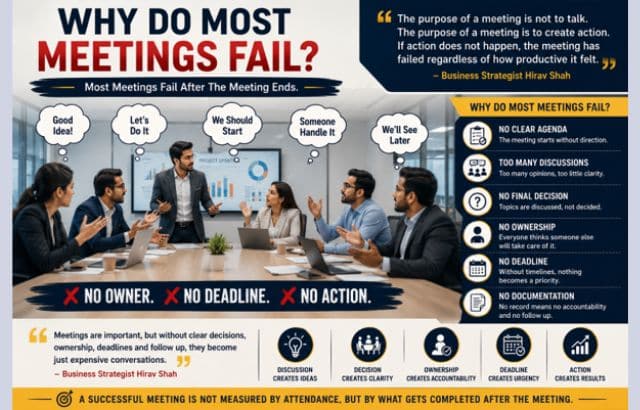
Have you ever attended a meeting where everyone agreed on the importance of a project, shared ideas enthusiastically, and left feeling productive, only to realize a few weeks later that nothing had actually happened?
If yes, you are not alone.
Many meetings fail not because the participants lack intelligence, experience, or commitment.
They fail because there is no system that converts discussion into action.
Business Strategist and Author of 25+ Strategy Books, Hirav Shah, believes that most organizations suffer from what he calls the “Meeting Illusion.”
People mistake activity for progress.
They assume that because a discussion took place, work will automatically happen.
Unfortunately, business does not work that way.
The Most Common Reasons Meetings Fail
- No clear agenda before the meeting
- Too many discussions and too few decisions
- Lack of ownership
- No deadlines
- No documentation
- No follow up
In many organizations, the same topics appear in meeting after meeting.
Not because the problem is difficult, but because nobody documented the decision properly the first time.
According to Hirav Shah:
“The purpose of a meeting is not to talk. The purpose of a meeting is to create action. If action does not happen, the meeting has failed regardless of how productive it felt.”
The real success of a meeting should not be measured by attendance, duration, or number of slides presented.
It should be measured by what gets completed afterward.
Key Takeaways
✓ Most meetings fail because execution is not defined.
✓ Discussion without ownership creates confusion.
✓ A successful meeting creates action, not just agreement.
✓ Documentation is often the missing link between planning and results.
Section 3: The Hidden Cost of Poor Minutes of Meeting
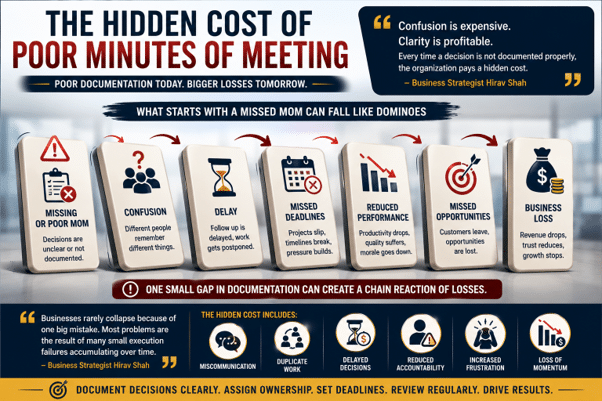
Many business owners underestimate the cost of poor documentation because the damage is rarely visible immediately.
Unlike a financial loss that appears in an account statement, poor Minutes of Meeting creates silent losses that accumulate over time.
- A missed deadline
- A forgotten commitment
- A delayed project
- A frustrated customer
- A confused employee
- An opportunity lost to a competitor
These costs often begin with a simple communication gap.
Imagine ten people attending a strategy meeting.
At the end of the meeting, everyone believes they understand what needs to happen.
However, because nothing was properly documented, each person remembers something slightly different.
One assumes marketing will take responsibility.
Another assumes sales will handle it.
A third assumes the decision was postponed.
Weeks pass.
Nothing moves.
Eventually, everyone wonders why progress has stalled.
Business Strategist Hirav Shah often points out that businesses rarely collapse because of one big mistake.
Most problems are the result of many small execution failures accumulating over time.
Poor Minutes of Meeting contributes directly to such failures by creating:
- Miscommunication
- Duplicate work
- Delayed decisions
- Reduced accountability
- Increased frustration
- Loss of momentum
In family businesses, the impact can be even greater.
Verbal instructions often create different interpretations among family members, managers, and employees.
Without documentation, disagreements become inevitable.
According to Hirav Shah:
“Confusion is expensive. Clarity is profitable. Every time a decision is not documented properly, the organization pays a hidden cost.”
Key Takeaways
✓ Poor MOM creates invisible business losses.
✓ Confusion often costs more than competition.
✓ Documentation reduces misunderstandings.
✓ Clarity improves speed, accountability, and trust.
Section 4: The 5K Formula of Effective Minutes of Meeting
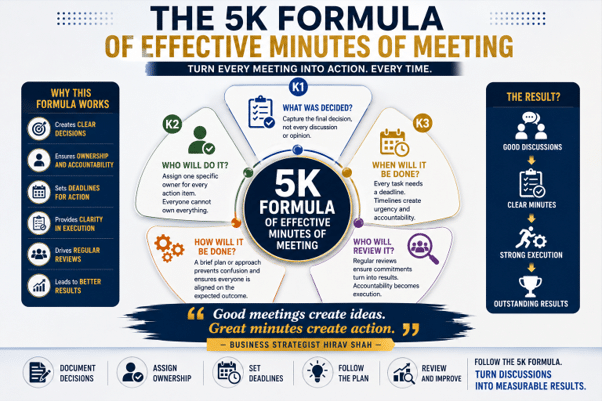
Most Minutes of Meeting fail because they record conversations instead of decisions.
The best Minutes of Meeting are simple, clear, and action oriented.
To make every meeting more effective, Business Strategist Hirav Shah recommends focusing on five critical questions.
This framework can be remembered as the 5K Formula.
1. What Was Decided?
The first responsibility of MOM is to capture the final decision.
Not every discussion point.
Not every opinion.
Only the final outcome.
If the decision is unclear, execution will also be unclear.
2. Who Will Do It?
Every action item must have a clearly identified owner.
One of the biggest mistakes organizations make is assigning responsibility to a group.
When everyone owns something, nobody owns it.
Ownership must be specific.
3. When Will It Be Done?
Every task requires a deadline.
Without a timeline, even important priorities slowly disappear beneath daily activities.
Deadlines create urgency and accountability.
4. How Will It Be Done?
A brief explanation of the approach prevents future misunderstandings.
This ensures that everyone understands the direction and expected outcome.
5. Who Will Review It?
Many businesses focus on assigning tasks but forget to review progress.
Regular reviews ensure that commitments become results.
This final step transforms accountability into execution.
According to Hirav Shah:
“Most organizations don’t have a decision problem. They have a follow through problem. The 5K Formula ensures that every important discussion has a clear path toward execution.”
The 5K Formula at a Glance
✓ What Was Decided?
✓ Who Will Do It?
✓ When Will It Be Done?
✓ How Will It Be Done?
✓ Who Will Review It?
Key Takeaways
✓ Effective MOM focuses on decisions, not conversations.
✓ Ownership is more important than attendance.
✓ Deadlines create momentum.
✓ Reviews ensure accountability.
✓ Great execution begins with clear documentation.
Section 5: Why Do Great Leaders Love Documentation?

One common habit connects successful CEOs, business owners, military leaders, project managers, and entrepreneurs across industries.
They document important decisions.
Great leaders understand something that many people ignore:
Memory is unreliable.
People forget.
Priorities change.
Conversations get interpreted differently.
Assumptions creep in.
Documentation removes uncertainty.
Business Strategist and Author of 25+ Strategy Books, Hirav Shah, believes that documentation is not a sign of bureaucracy.
It is a sign of leadership maturity.
Many leaders think documentation slows people down.
In reality, poor documentation slows organizations down far more.
When decisions are documented properly:
- Expectations become clear
- Responsibilities become visible
- Follow ups become easier
- Teams become more aligned
- Execution becomes faster
According to Hirav Shah:
“The best leaders do not rely on memory. They build systems. When systems improve, performance improves.”
Key Takeaways
✓ Great leaders document important decisions.
✓ Documentation improves alignment and accountability.
✓ Systems are more reliable than memory.
✓ Strong execution starts with clear expectations.
Section 6: Why Are Minutes of Meeting Even More Important in Family Businesses?
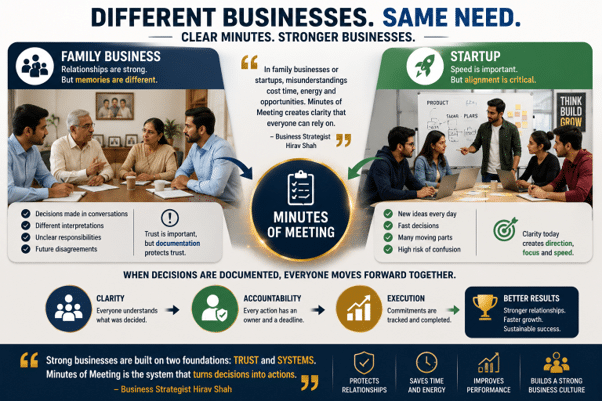
Family businesses are unique.
Relationships, emotions, history, and business often operate together.
While this creates strength, it can also create confusion.
Many family businesses rely heavily on verbal communication.
A discussion happens during lunch.
An idea is discussed during a family gathering.
A decision is mentioned during a phone call.
Weeks later, different people remember different versions of the same conversation.
One generation believes a decision was finalized.
Another generation believes it was only a suggestion.
Managers are unsure whether they should act or wait.
This is where Minutes of Meeting becomes extremely valuable.
Documentation removes assumptions.
It creates clarity between:
- Family members
- Professional managers
- Advisors
- Employees
According to Hirav Shah:
“In family businesses, emotions often speak louder than documentation. The challenge is that emotions remember differently. Documentation remembers accurately.”
Key Takeaways
✓ Family businesses often rely too much on verbal communication.
✓ Documentation reduces misunderstandings.
✓ MOM creates clarity across generations.
✓ Good systems protect both relationships and results.
Section 7: Why Do Startups Need Minutes of Meeting More Than Anyone Else?

Many startup founders believe Minutes of Meeting is only for large corporations.
That assumption is dangerous.
In reality, startups need it even more.
Why?
Because startups operate in an environment of constant change.
- New products
- New customers
- New investors
- New challenges
- New opportunities
Every day brings fresh decisions.
Without proper documentation, confusion grows rapidly.
According to Hirav Shah:
“Ideas attract attention. Execution attracts investment. Minutes of Meeting helps convert ideas into execution.”
Key Takeaways
✓ Startups need execution discipline.
✓ MOM helps teams stay aligned during rapid growth.
✓ Documentation improves accountability.
✓ Investors value structured decision making.
Section 8: What Is the Difference Between Discussion and Decision?
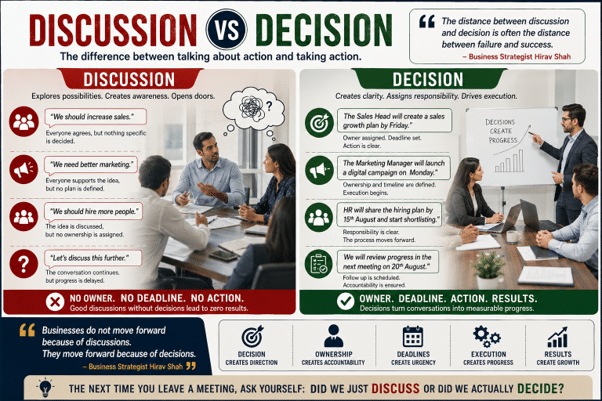
This may be the most important section of the entire article.
Many organizations believe they make decisions.
In reality, they often only discuss possibilities.
There is a huge difference between discussion and decision.
Discussion
“We should improve sales performance.”
This sounds positive.
Everyone agrees.
Everyone supports the idea.
Yet nothing specific has been decided.
Decision
“The Sales Head will create a lead generation strategy by Friday, present it on Monday, and begin implementation from the following week.”
This is a decision.
It has ownership.
It has a timeline.
It has accountability.
It has a measurable outcome.
According to Hirav Shah:
“The distance between discussion and decision is often the distance between failure and success. Many organizations spend months discussing what should be done while competitors are busy doing it.”
Key Takeaways
✓ Discussion and decision are not the same.
✓ Decisions require ownership and deadlines.
✓ MOM converts discussion into action.
✓ Businesses grow through execution, not conversation.
Section 9: How Are Technology and AI Changing Minutes of Meeting?

Just a few years ago, creating Minutes of Meeting required someone to sit through the entire meeting, take notes manually, prepare a document, circulate it, and follow up with participants.
Today, technology has changed the process dramatically.
AI powered meeting assistants can:
- Record conversations
- Transcribe discussions
- Identify action items
- Summarize key points
- Generate draft Minutes of Meeting automatically
According to Hirav Shah:
“AI can document the meeting. Leadership must still drive the outcome. Technology is a tool. Accountability remains a human responsibility.”
Key Takeaways
✓ AI can simplify documentation.
✓ Technology improves efficiency.
✓ Leadership remains essential.
✓ Accountability cannot be automated.
Section 10: What Is the Real Purpose of Minutes of Meeting?

Many organizations still view Minutes of Meeting as an administrative formality.
Something that needs to be completed after a meeting.
Something that is filed away and rarely reviewed.
This mindset completely misses the purpose of MOM.
The Real Purpose
Execution.
Not documentation.
Not compliance.
Not record keeping.
Execution.
According to Hirav Shah:
“Meetings create direction. Minutes create movement. Execution creates results.”
Key Takeaways
✓ MOM exists to drive execution.
✓ Documentation alone has no value without action.
✓ Great organizations use MOM as a performance tool.
✓ Results begin where discussions end.
Section 11: Minutes of Meeting Self Audit: How Effective Is Your Organization?

Give Yourself 1 Point for Every “Yes”
- Do you create Minutes of Meeting after every important meeting?
- Are action items clearly documented?
- Is one specific person assigned to each task?
- Are deadlines clearly mentioned?
- Is a follow up review scheduled?
- Do team members receive MOM within 24 hours?
- Are previous action items reviewed before starting a new meeting?
- Do decisions remain documented for future reference?
- Do managers regularly track pending commitments?
- Does your organization measure execution, not just participation?
Your Score
8 to 10 Points
Excellent. You have a strong execution culture.
5 to 7 Points
Good foundation, but improvements are needed.
0 to 4 Points
Your organization may be spending more time discussing than executing.
Key Takeaways
✓ Measure execution, not attendance.
✓ Review your systems regularly.
✓ Small improvements create significant results.
✓ Accountability is a habit, not an event.
Section 12: Business Strategist Hirav Shah’s Final Perspective
After working with businesses, startups, real estate developers, entertainers, sports professionals, and business leaders across industries, one observation consistently stands out.
Most failures do not occur because people lack intelligence.
Most failures do not occur because opportunities are unavailable.
Most failures occur because decisions are not executed consistently.
According to Hirav Shah:
“Businesses rarely fail because they don’t know what to do. They fail because what needs to be done never gets executed consistently. Minutes of Meeting helps close that gap.”
Key Takeaways
✓ Clarity creates confidence.
✓ Accountability creates action.
✓ Execution creates results.
✓ MOM is one of the simplest tools for improving business performance.
10 Practical Tips for Better Minutes of Meeting
- Share MOM within 24 hours.
- Focus on decisions, not conversations.
- Assign one owner for every task.
- Include clear deadlines.
- Use simple language.
- Highlight action items separately.
- Review pending items before every new meeting.
- Keep documentation organized and accessible.
- Avoid vague responsibilities.
- Measure completion rates regularly.
Worksheet: Your Next Meeting Action Plan
Meeting Name: ______________________
Date: ______________________
Key Objective: ______________________
What Was Decided?
Who Will Do It?
Deadline?
How Will It Be Done?
Who Will Review Progress?
Next Review Date:
Exercise: Transform Discussion into Decision
Example 1
Discussion:
“We need better customer service.”
Decision:
Example 2
Discussion:
“We should increase marketing efforts.”
Decision:
Example 3
Discussion:
“We need to improve employee productivity.”
Decision:
The purpose of this exercise is to train your mind to think in terms of ownership, deadlines, and execution.
Frequently Asked Questions

Q1. Who should write Minutes of Meeting?
The responsibility can belong to a team member, project coordinator, manager, or meeting organizer. The important thing is accuracy and consistency.
Q2. How detailed should Minutes of Meeting be?
Detailed enough to capture decisions, responsibilities, deadlines, and follow ups. Avoid unnecessary discussion notes.
Q3. Are Minutes of Meeting necessary for small businesses?
Absolutely. In fact, small businesses often benefit even more because every decision has a significant impact.
Q4. Can AI replace manual Minutes of Meeting?
AI can assist in documentation, but leadership is still required for accountability and execution.
Q5. How soon should MOM be shared?
Ideally within 24 hours while discussions remain fresh and action items are still clear.
Q6. What is the biggest mistake businesses make with MOM?
Treating it as a formality instead of a business execution tool.
Q7. Should every meeting have Minutes of Meeting?
Not necessarily. However, every meeting involving decisions, budgets, projects, hiring, strategy, or commitments should have documented minutes.
Conclusion
Businesses do not grow because people attend meetings.
Businesses do not grow because ideas are discussed.
Businesses do not grow because presentations are impressive.
Businesses grow when decisions become actions.
And actions become results.
Minutes of Meeting may appear to be a simple document, but its impact can be enormous.
It creates clarity where confusion exists.
It creates accountability where assumptions exist.
Most importantly, it creates execution where discussions once ended.
The next time you walk out of a meeting, do not ask how long the meeting was.
Ask a more important question:
What exactly will happen next?
The answer to that question may determine whether the meeting becomes a memory or a result.
About the Writer
This article is authored by Hirav Shah, a globally respected Business Strategist and The Game Changer in Entertainment, Sports, and Business.
He is the founder of the world’s first Business Decision Validation Hub and The Rescue Hub, and the author of 25+ strategy books.
Through his 6+3+2 framework and Astro Strategy approach, Hirav Shah has guided entrepreneurs, startups, corporates, sports professionals, and entertainers to validate critical decisions, reduce risks, and achieve breakthrough results—especially during high-pressure and transformational phases.