Why do some customers take weeks… while others decide in minutes?
Walk into any business and observe closely.
One customer will sit, analyze, compare, ask multiple questions, go back, think again, and still not take a decision.
Another will walk in, look at a product, connect instantly, and say — “Let’s do it.”
Same product. Same price. Same environment.
But two completely different outcomes.
The difference is not the product.
The difference is not even the price.
The difference is how the customer’s mind is working at that moment.
As per Business Strategist Hirav Shah, most businesses fail to understand that sales is not a product game — it is a decision-making psychology game. Until you understand how your customer thinks, your strategy will always feel incomplete.
Table of Contents
What is a Logical Buyer — and how does their decision-making actually work?

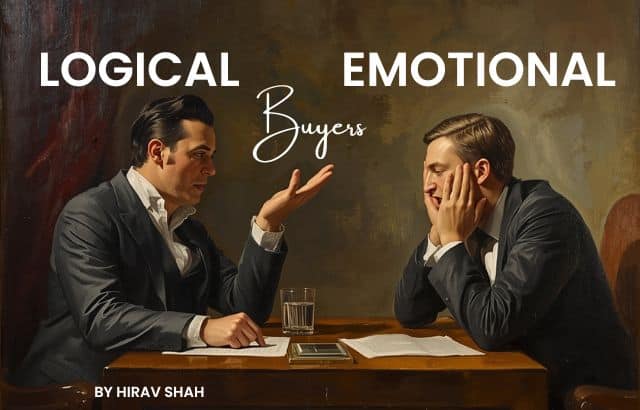
A logical buyer is someone whose primary goal is not to buy fast, but to buy correctly. Their entire thinking process is built around minimizing risk, avoiding mistakes, and ensuring that the decision they take is justified in every possible way.
When a logical buyer encounters a product, they don’t react immediately. Instead, their mind enters an evaluation mode. They start breaking down the decision into smaller parts — price, features, alternatives, long-term value, possible risks, and even future regret. Every decision becomes a comparison.
This is why logical buyers take time. Not because they are confused, but because they are processing deeply. They don’t trust first — they verify first.
In real life, you see this clearly in categories like real estate, business investments, machinery, or even high-end electronics. A person buying a flat does not just look at the house. They evaluate location, pricing trends, builder credibility, resale value, and future growth. Even after liking the property, they will say, “Let me think.”
This is where most businesses misjudge them.
They assume the customer is not serious.
But the truth is — the customer is serious, just not ready.
As per Hirav Shah, logical buyers are not decision avoiders — they are uncertainty avoiders. If your business cannot remove their doubts, they will keep delaying. But once convinced, they are among the most stable and loyal customers.
Logical Buyer Traits
- Decision driven by data and comparison
- Needs clarity before commitment
- Takes longer but more stable decisions
- Highly sensitive to risk
- Loyal once convinced
What is an Emotional Buyer — and why do they decide so quickly?

In contrast, an emotional buyer operates in a completely different way. Their decisions are not built step-by-step — they are triggered in a moment.
An emotional buyer is constantly asking one simple question internally:
“Does this feel right to me?”
If the answer is yes, the decision is almost immediate.
This does not mean they are careless or impulsive. It simply means their brain prioritizes experience, identity, and connection over analysis. They respond to how something looks, feels, and represents them.
Think about someone buying clothes, perfumes, or even choosing a restaurant. They don’t create comparison charts. They react to what they see and feel. A color, a design, an ambience, or even the way a product is presented can trigger the decision.
Interestingly, after buying, they often justify their decision logically. They might say, “Quality is good” or “It’s worth the price.” But in reality, the decision was already made before those reasons came in.
As per Hirav Shah, people believe they buy logically, but in reality, most decisions are triggered emotionally first. Logic comes later to defend the choice.
Emotional Buyer Traits

- Decision driven by feeling and connection
- Responds to brand, design, and experience
- Fast decision-making
- Low comparison, high intuition
- Strong brand loyalty when emotionally connected
Why Most Businesses Fail — The Invisible Mistake

Now comes the most critical part.
Most businesses don’t fail because of bad products. They fail because they misread the customer.
A logical buyer is given emotional storytelling.
An emotional buyer is given technical explanation.
And this creates friction.
When an emotional buyer walks in and is presented with too many features, data points, and comparisons, they lose interest. The experience becomes heavy. The excitement disappears.
On the other hand, when a logical buyer is approached with only storytelling, urgency, or emotional persuasion, they become uncomfortable. They feel something is missing. They don’t trust the process.
In both cases, the customer walks away — not because the product was wrong, but because the communication was misaligned.
As per Business Strategist Hirav Shah, this mismatch is one of the most expensive mistakes in business. Even the right product fails when presented in the wrong way.
How Does a Real Buying Decision Actually Happen?

Here is something most people don’t realize.
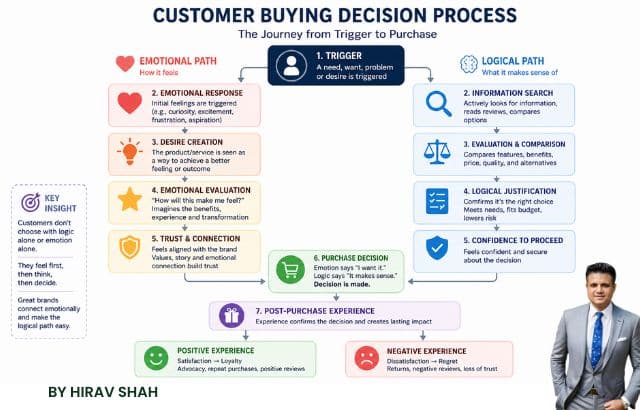
Every buying decision — whether logical or emotional — actually follows a pattern.
First, something grabs attention.
Then, the mind evaluates.
Finally, the decision is made.
This means that both emotion and logic are always present, but their role changes depending on the stage.
For example, when someone buys a car, the first attraction is often emotional — the design, the brand, the feel. Then logic steps in — mileage, price, features. But the final decision again comes down to a feeling — “Yes, this is the right choice.”
As per Hirav Shah, sales is not about choosing between logic and emotion. It is about understanding when each one plays its role.
How Smart Businesses Win — The Sequence Game

The most successful businesses don’t ignore either logic or emotion.
They simply control the sequence.
In many consumer businesses, emotion comes first. A brand attracts attention through design, storytelling, or experience. Once the customer is interested, logic is used to justify the purchase.
In high-value decisions like real estate or B2B services, logic often comes first. Customers want numbers, clarity, and proof. But even here, the final decision requires emotional comfort — trust, confidence, and belief.
The mistake most businesses make is not lack of content — it is wrong timing.
As per Hirav Shah, changing the sequence of communication can change conversion results dramatically, even without changing the product.
Why Customers Say “Too Expensive” — The Real Reason

One of the most common complaints from businesses is that customers focus too much on price.
But price is rarely the real issue.
When a customer says “too expensive,” what they are actually saying is:
“I don’t feel enough value or confidence.”
If emotional connection is weak, price becomes the focus.
If trust is low, price becomes a barrier.
If differentiation is unclear, price becomes the only comparison.
This is why two similar products can sell at completely different prices in the same market.
As per Hirav Shah, price becomes a concern only when the customer does not feel enough value. When perception is strong, price becomes secondary.
The Real Secret Behind Successful Sales
At the deepest level, there is no such thing as a purely logical or purely emotional buyer.
Every customer is a mix.
The same person who behaves logically in a business deal can behave emotionally while choosing a vacation or buying a luxury item.
This means one thing:
Sales is not about fixed strategies.
It is about reading the situation in real time.
Businesses that succeed are not the ones with the best products or lowest prices. They are the ones who understand how their customer is thinking in that moment — and respond accordingly.
As per Business Strategist Hirav Shah, the future of sales is not persuasion. It is alignment.
Tips for Business Owners: 7 Actionable Strategies to Apply Today

1. Build Two Versions of Your Core Sales Pitch
Build two versions of your core sales pitch — one leading with emotion (story, aspiration, feeling) and one leading with logic (data, ROI, proof). Match the version to the buyer in front of you.
2. Train Your Sales Team to Identify Buyer Type Quickly
Train your sales team to identify buyer type within the first two to three minutes of a conversation. Listen for their first question — it reveals everything.
3. Audit Your Marketing Material
Audit your marketing material. Does it speak to feelings or features? Ideal content does both — story in the headline, proof in the body.
4. Avoid Urgency Tactics on Logical Buyers
Never use urgency tactics on logical buyers. It destroys trust instantly. Instead, give them a clear next step and the information they need to decide on their own timeline.
5. Simplify Communication for Emotional Buyers
Never give emotional buyers a 12-page specification document as your first touchpoint. Lead with a powerful brand experience, a story, or a visual — then follow with the details.
6. Redesign Your Proposals and Pitch Decks
Redesign your proposals and pitch decks to serve both buyer types. Start with the vision (emotional), follow with the evidence (logical), and close with the relationship (emotional again).
7. Stay Adaptive
Remember: the same buyer can shift modes depending on the day, the product, or the stakes. Stay adaptive. Read the room at every interaction — not just the first one.
Self-Audit Worksheet: Are You Selling the Right Way?
Business Sales Audit — Hirav Shah Framework
- Who is your primary buyer type — logical, emotional, or mixed?
- What triggers are you currently using — emotion, logic, or both?
- Where are you losing buyers — at the interest stage or the decision stage?
- Does your marketing messaging speak to how your buyer feels or only what they think?
- What is the sequence of your current sales pitch — emotion first or logic first? Is it matched to your buyer type?
- List one change you will make this week based on what you have read.
Assignment: 7-Day Sales Psychology Challenge

Your Assignment from Business Strategist Hirav Shah
Day 1–2
Observe your next 10 customer interactions without changing anything. Simply notice — are they asking about features and data (logical) or about experience and feeling (emotional)? Write it down.
Day 3
Rewrite your core sales pitch in two versions.
- Version A leads with a story and an emotional trigger.
- Version B leads with data and a clear ROI statement.
Day 4–5
Test both versions on real customers. Match the version to the buyer type you identify in the first two minutes. Track the response difference.
Day 6
Audit one piece of your existing marketing — an ad, a brochure, or a proposal. Identify whether it speaks to logical buyers, emotional buyers, or both. Rewrite the weakest element.
Day 7
Share your findings with your sales team. Build a simple one-page “buyer type identification guide” for your specific business. Make it part of your onboarding for every new salesperson.
Section 5: The Real Secret Behind Successful Sales

So What Actually Works in Today’s Market?
Here is the real secret — and it is simpler than most people expect.
No buyer is purely logical. No buyer is purely emotional. Every human being is a mix of both — and the ratio shifts depending on the product, the price, the urgency, and the moment in their life.
A senior executive who is completely logical in a B2B software negotiation might be a completely emotional buyer when choosing a holiday destination that evening.
Context determines buyer mode. And winning businesses understand context — not just demographics.
The businesses that consistently win are not the loudest, the cheapest, or the most aggressive. They are the businesses that read their buyer accurately, match their pitch to the buyer’s current mode, and sequence emotion and logic in the right order.
Sales is not about convincing. It is about aligning.
Business Strategist and author of 25+ strategy books Hirav Shah always says:
“The businesses that consistently win are not the loudest or the cheapest. They are the ones who understand the buyer’s state of mind before opening their mouth. Alignment is the new sales skill.”
Frequently Asked Questions

1. How do I quickly identify whether my customer is a logical or emotional buyer?
Listen to their first question. Logical buyers ask about price, features, comparisons, and data. Emotional buyers ask about experience, feel, and identity — or they simply react to the energy of your brand. You will know within two minutes if you are listening.
2. Can the same customer switch between logical and emotional buying?
Absolutely. The same person who is a meticulous logical buyer for a business software decision might be a completely emotional buyer for a luxury watch that same evening. Context, stakes, and category all influence buyer mode. Never lock a person into one type permanently.
3. What if my product is technical — does emotional selling even apply?
It applies everywhere. Even in B2B and technical sales, the decision-maker is a human being with emotions. Logical buyers still need to feel confident, trusted, and aligned with a vendor’s vision. The emotion is different — it is confidence and trust, not aspiration — but it is still emotion.
4. My sales team is trained only in logical selling. Where do I start?
Start with storytelling. The fastest way to add emotional selling to a logical sales team is to train them in the art of the opening story. One powerful, relevant story at the start of a pitch can shift the buyer’s state completely — and then your logic lands on prepared ground.
5. Is emotional selling manipulative?
No — manipulation is triggering fear or false urgency to override a buyer’s judgment. Emotional selling is understanding a buyer’s genuine feelings and aspirations, and connecting your product honestly to those feelings. One serves the buyer. The other exploits them. The difference is integrity.
6. How does this apply to digital marketing and social media?
Every piece of content you create is a sales message. Reels, posts, and ads that lead with story and emotion get attention. Detailed blogs, comparison guides, and case studies serve logical buyers in the research phase. A complete digital strategy serves both buyer types at different stages of the funnel.
7. What about price-sensitive buyers — are they logical?
Not always. Many price-sensitive buyers are actually emotional buyers who have not yet been given a strong enough reason to pay more. When your brand story, trust, and value perception are strong enough, price sensitivity often drops. The buyer was always capable of paying — they just needed the right feeling first.
8. How do I apply this to my website or landing page?
Your headline and hero section should be emotional — a powerful statement of identity, aspiration, or problem-solution. Your product details, testimonials, and case studies serve the logical buyer further down the page. Structure your landing page as an emotional hook followed by logical justification.
9. Does this framework work for small businesses and solopreneurs?
It works especially well for small businesses, because small businesses have the advantage of personal connection — which is the most powerful emotional trigger in sales. A solopreneur who can read their buyer and switch between emotional and logical selling has a structural advantage over large, scripted corporate sales teams.
10. How is this different from conventional sales training?
Conventional sales training teaches techniques — closing methods, objection handling, and persuasion scripts. The Hirav Shah framework teaches you to understand the buyer first — their psychology, their mode, and their decision-making process. Techniques are tactics. Understanding is strategy. Strategy always wins over time.
11. What is the biggest mistake businesses make when trying to implement this?
They try to apply it as a script rather than a mindset. Buyer type identification is a real-time, human skill — not a checkbox. The most effective salespeople are the ones who have genuinely internalised the framework and can adapt in the moment, not the ones following a fixed sequence from a training manual.
12. How long does it take to see results after applying this framework?
Most businesses that apply even one element of this framework — matching the opening of the pitch to the buyer’s mode — see a measurable shift in conversion within days. Full implementation across your sales team and marketing typically delivers visible results within 30 to 60 days.
Conclusion
Customers do not reject products. They reject confusion.
When your message matches your buyer’s mindset — logical or emotional — resistance disappears. Decisions come faster. Sales stop feeling like a battle and start feeling like a conversation. Objections reduce. Conversions increase. And your business stops competing on price because it has learned to compete on alignment.
The greatest salespeople in history did not have the best products or the best prices. They had the deepest understanding of the human beings standing in front of them. They could read a buyer’s psychology in real time and deliver exactly what that buyer needed to move from interest to decision.
That skill is not talent. It is a strategy. And strategy can be learned, practised, and systematised.
Start with one insight from today. Apply it in your next sales conversation. Notice the difference. Then build from there.
As Business Strategist Hirav Shah always says:
“When you understand how your customer thinks, selling stops being a struggle and starts becoming a system.”
About the Writer
This article is authored by Hirav Shah, a globally respected Business Strategist and The Game Changer in Entertainment, Sports, and Business. He is the founder of the world’s first Business Decision Validation Hub and The Rescue Hub, and the author of 25+ strategy books.
Through his 6+3+2 framework and Astro Strategy approach, Hirav Shah has guided entrepreneurs, startups, corporates, sports professionals, and entertainers to validate critical decisions, reduce risks, and achieve breakthrough results — especially during high-pressure and transformational phases.
Email: Business@hiravshah.com