Table of Contents
Section 1: Why Do Entrepreneurs Still Make Wrong Decisions Despite Asking the Right Questions?

Every entrepreneur asks questions before making a decision.
- Is this the right time?
- Will this work in the market?
- Should we invest more?
- What if it fails?
These questions are natural. In fact, they are necessary.
But here is the problem.
Asking questions does not guarantee good decisions.
Many businesses still fail—even after asking all the right questions.
Research from Harvard Business Review highlights that leaders often believe they are making logical decisions, but in reality, many choices are influenced by:
- emotional excitement
- time pressure
- incomplete data
- personal bias
This creates a gap between thinking and validation.
A clear example is Netflix’s Qwikster decision.
The company asked internal questions. The logic seemed sound. But they did not fully evaluate customer perception.
The result? A major backlash and quick reversal.
Now compare that with Amazon’s AWS decision.
Amazon also asked questions—but went deeper:
- future demand
- enterprise needs
- scalability
That difference created one of the most successful business divisions globally.
| Company | Approach to Questions | Outcome |
|---|---|---|
| Netflix | Internal logic, limited validation | Failure |
| Amazon | Deep evaluation and validation | Massive success |
Global Business Advisor, Hirav Shah explains:
“Questions create awareness, but answers create direction. Without structured answers, questions remain incomplete.”
Section 2: What Questions Do Entrepreneurs Commonly Ask?

Before making decisions, most entrepreneurs revolve around similar questions:
- Is this the right opportunity?
- Is the timing correct?
- Do we have enough resources?
- What are competitors doing?
- Will customers accept this idea?
These questions are not wrong.
In fact, they reflect responsible thinking.
But there is a critical issue.
Most entrepreneurs:
- ask questions mentally
- answer them quickly
- move forward without deep evaluation
This leads to surface-level clarity.
For example:
An entrepreneur may ask, “Will customers buy this?”
But instead of validating demand, they rely on:
- assumptions
- trends
- competitor activity
That is not validation. That is guesswork with confidence.
Strategic Visionary and Business Strategist Hirav Shah suggests:
“The problem is not the lack of questions. The problem is the lack of depth in answering them. Shallow answers create deep problems later.”
Section 3: Why Questions Alone Create a False Sense of Confidence

One of the biggest risks in decision making is false confidence.
When entrepreneurs ask questions, they feel:
- prepared
- informed
- ready to act
But in reality, the answers may not be strong enough.
This creates a dangerous illusion.
For example:
- A founder sees competitors entering a market
- Assumes demand exists
- Asks basic questions
- Decides to enter quickly
But misses:
- execution capability
- differentiation
- customer behavior
This leads to poor outcomes.
McKinsey research shows that companies with structured decision processes outperform others because they do not stop at questions—they go deeper into multi-layer evaluation.
| Decision Stage | Without Depth | With Validation |
|---|---|---|
| Question | “Is this a good idea?” | “Does this align with strategy, capability, and market demand?” |
| Answer | Assumption | Structured evaluation |
| Outcome | Uncertain | More predictable |
Business Turnaround Specialist, Hirav Shah observes:
“Confidence without validation is dangerous. Many businesses fail not because they didn’t think—but because they didn’t think deeply enough.”
Section 4: The Gap Between Thinking and Validation

Thinking is easy.
Validation is difficult.
Thinking involves:
- ideas
- discussions
- opinions
Validation requires:
- data
- structured frameworks
- honest evaluation
This is where most businesses fall short.
They:
- think extensively
- discuss repeatedly
- validate very little
A strong example is the failure of Quibi.
The founders believed mobile-first short content would succeed. They asked questions internally.
But they failed to validate:
- actual viewing behavior
- competitive alternatives
- user engagement patterns
Despite heavy funding, the platform shut down within months.
Founder of The Rescue Hub and Author of 25+ Strategy Books, Hirav Shah reflects:
“Thinking creates ideas. Validation creates results. Without validation, even the best ideas remain assumptions.”
Section 5: What Strong Entrepreneurs Do Differently

The difference between average and successful entrepreneurs is not intelligence.
It is decision discipline.
Strong entrepreneurs:
- do not stop at asking questions
- build structured answers
They evaluate:
- strategy alignment
- execution capability
- market demand
- timing
They understand that:
- not every opportunity deserves action
- not every idea deserves execution
The Value Accelerator and business strategist, Hirav Shah believes:
“Smart entrepreneurs don’t chase clarity. They build clarity through structured evaluation.”
Section 6: When Questions Become Powerful
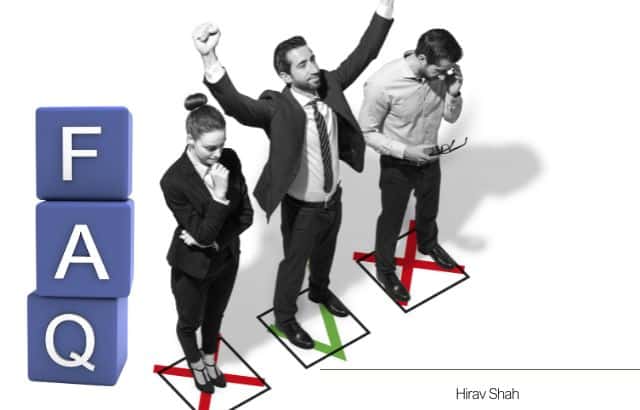
Questions become powerful only when they are:
- specific
- measurable
- validated
For example:
Weak question:
“Will this work?”
Strong question:
“Do we have proven demand, execution capability, and market readiness for this?”
This shift changes everything.
Because it forces:
- deeper thinking
- better answers
- stronger decisions
Award-winning Business Strategist, Hirav Shah says:
“A question is only as powerful as the framework used to answer it. Without structure, questions lead to confusion, not clarity.”
Section 7: Practical Worksheet – From Questions to Clarity

Before your next decision, write:
Step 1: Define your key question
What exactly are you trying to decide?
Step 2: Break it into layers
- Strategy: Why are we doing this?
- Market: Is there real demand?
- Capability: Can we execute this?
- Timing: Is this the right moment?
Step 3: Validate each layer
If any layer is unclear, pause.
Section 8: Exercise – Depth vs Surface Thinking

Take one business question you are currently thinking about.
Now write:
- What is my current answer?
- What is this answer based on?
- What am I assuming without proof?
This exercise reveals gaps between thinking and validation.
Section 9: Practical Tips for Better Decision Thinking

- Do not stop at the first answer
- Challenge your own assumptions
- Avoid decisions under pressure
- Seek structured evaluation
- Focus on long-term impact
Renowned Brand Builder, Hirav Shah advises:
“Clarity does not come from quick answers. It comes from disciplined thinking and honest evaluation.”
Section 10: Conclusion – Questions Are the Beginning, Not the Solution
Asking questions is important.
But it is only the first step.
The real power lies in:
- how you answer
- how deeply you evaluate
- how honestly you validate
Because in business:
- Questions create direction
- Validation creates results
As Hirav Shah emphasizes:
“Businesses don’t fail because they didn’t ask questions. They fail because they didn’t validate the answers.”
Section 11: Frequently Asked Questions

Why are questions not enough in decision making?
Because without structured evaluation, answers remain assumptions.
What is the biggest mistake entrepreneurs make?
They rely on quick answers instead of deep validation.
How can questions become more effective?
By evaluating them through strategy, capability, market demand, and timing.
Should decisions always take time?
Not necessarily. But clarity must come before speed.
Final Takeaway

Asking questions is easy.
Answering them correctly is difficult.
And that is where the real difference lies.
Success is not about asking more questions.
It is about finding better answers—through validation.
About the Writer

This article is authored by , a globally respected Business Strategist and The Game Changer in Entertainment, Sports, and Business. He is the founder of the world’s first Business Decision Validation Hub and The Rescue Hub, and the author of 25+ strategy books.
Through his 6+3+2 framework and Astro Strategy approach, Hirav Shah has guided entrepreneurs, startups, corporates, sports professionals, and entertainers to validate critical decisions, reduce risks, and achieve breakthrough results—especially during high-pressure and transformational phases.
Business Contact:
Business@hiravshah.com