What if the biggest threat to your business isn’t competition—but an unvalidated decision? Every entrepreneur has faced this moment: a fork in the road, a bold move waiting to be made. It could be a product launch, a pricing change, a partnership, or a pivot. And too often, these decisions are made on pressure, urgency—or pure gut feeling.
But as Business Strategist Hirav Shah explains, what feels right isn’t always what works. That’s where validation comes in—a process of strategic clarity that can protect your business from unnecessary setbacks.
Let’s start by understanding the basics.
Table of Contents
What Is a Decision?

A decision is a choice—between ideas, actions, or directions. We make them all day: what to focus on, whom to trust, when to act. In business, every decision carries a ripple effect.
“Every decision you make is a vote for the future you’re building.” — Hirav Shah
What Is a Business Decision?

Business decisions go beyond intuition. They shape outcomes. It could be as small as adjusting your pricing or as big as hiring a new COO. Every choice in business touches three key areas:
- People
- Profits
- Positioning
Even small decisions—if made wrong—can create long-term consequences.
“There are no small decisions in business. Only delayed consequences.” — Hirav Shah
Why Do Business Decisions Feel Risky?

Because they are. Every decision comes with a trade-off: time, money, brand image, momentum. And in today’s fast-moving world, the pressure to act fast often overrides the need to act right.
“Speed without strategy is not ambition—it’s anxiety.” — Hirav Shah
What Is Validation?

Validation is the process of checking before committing. It’s asking:
- Is this the right move?
- Is the timing correct?
- Am I emotionally aligned—or just reacting?
Validation removes assumptions. It replaces gut feeling with grounded strategy.
“Validation is not a delay—it’s a shortcut to clarity.” — Hirav Shah
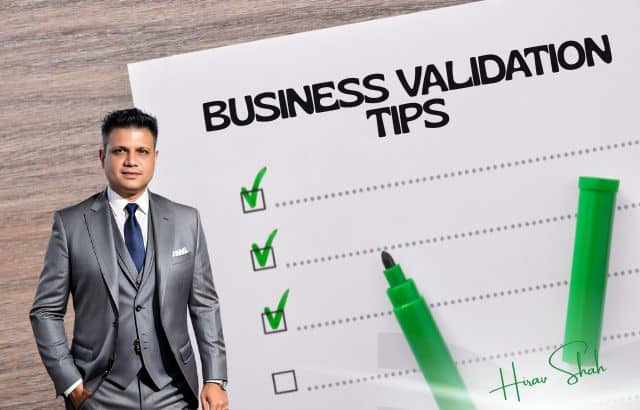
What Is Business Decision Validation?

This is where strategy meets timing. It’s not about guessing—it’s about aligning decisions with:
- Market logic
- Internal readiness
- Energy and timing (Astro Strategy)
Business Decision Validation helps you:
- Avoid costly mistakes
- Make faster, clearer decisions
- Align vision with action
“When your decisions are validated, your confidence becomes unstoppable.” — Hirav Shah
What Is Gut Feeling—and Why Can It Mislead?
Gut feeling is a reaction based on emotion or past experience. Sometimes, it helps. But many times, it tricks.
You might feel:
- Urgency when you should pause
- Confidence when you should question
- Familiarity when you should disrupt
“Your gut has memory. But success demands vision.” — Hirav Shah
Why Do Most Entrepreneurs Skip Validation?
- “I don’t have time.”
- “I already know what I want.”
- “I’ve done this before.”
- “It feels right.”
These reasons sound logical—but they’re often excuses. Skipping validation may seem faster, but it’s costlier in the long run.
“Validation isn’t about slowing you down—it’s about saving you from the wrong speed.” — Hirav Shah
What Happens When You Skip Validation?

- You hire too soon
- You launch too early
- You price without positioning
- You pivot without alignment
The result? Confusion, losses, burnout—or worse, a business that looks successful on the outside but is collapsing from within.
“Most businesses don’t die from competition. They die from misaligned decisions.” — Hirav Shah
Which Business Decisions Must Be Validated?

You don’t need to validate every daily action—but the big ones? Absolutely.
✅ New product or service launch
✅ Hiring leadership roles
✅ Strategic partnerships
✅ Rebranding or renaming
✅ Expansion into new markets
✅ Raising or investing capital
“If a decision affects your future, your finances, or your face in the market—it must be validated.” — Hirav Shah
Isn’t Validation a Sign of Weakness?
Not at all. It’s the opposite. Validation doesn’t replace your instinct—it refines it. It empowers boldness with balance. Speed with stability.
“Successful entrepreneurs don’t validate because they doubt. They validate because they care about winning right.” — Hirav Shah
What’s the Process of Business Decision Validation?

It should be combinations of:
- Business logic
- Market sense
- Execution mapping
- Energy & timing using Astro Strategy
This approach gives clients a 360° view:
- What’s working
- What’s missing
- What’s the ideal time to act
“The right decision made at the wrong time is still a wrong decision.” — Hirav Shah
Real-World Example
A fashion startup wanted to enter the loungewear market fast. It felt trendy. The team was excited. But Hirav’s validation revealed:
- The timing wasn’t ideal (based on energy cycles)
- Their current product line wasn’t stabilized
- Financial structure was not ready for scale
They paused, refined their positioning, and within months, launched a better-aligned line—saving lakhs and earning triple the expected returns.
“The right decision at the right time creates exponential growth—not just survival.” — Hirav Shah
What’s the Process of Business Decision Validation?

Validation isn’t just a checklist—it’s a structured, strategic approach to clarity. Here’s how Business Strategist Hirav Shah guides entrepreneurs through each step:
Let’s dive into a step-by-step process to help you make informed and strategic business decisions.
Step 1: Define the Business Decision & Desired Outcome
Before diving into validation, you need absolute clarity on what decision you’re making and what you hope to achieve.
Ask Yourself:
- What is the specific decision you are evaluating? (e.g., Should we launch a new product? Expand internationally? Partner with another company?)
- What is the primary goal of this decision? (Revenue growth, market expansion, cost reduction, etc.)
- What does success look like?
🔹 Imagine This: You’re planning to launch a new product, hoping to capture a 10% market share within a year. But what if customers aren’t ready for it? A clear definition of success ensures you don’t move forward blindly.
“A decision without a defined destination is just movement—not growth.” — Hirav Shah
Step 2: Clarify Your Business Readiness
A decision, no matter how visionary, will fail if the business making it is unstable. Before jumping to execution, it’s crucial to evaluate whether your internal foundation is ready to support the weight of the next step.
Here’s what to check:
- People Alignment: Is your core team on the same page? Do they understand the vision behind this decision?
- Financial Runway: Do you have enough capital to absorb the ups and downs of the decision’s outcome?
- Operational & Mental Readiness: Are your systems streamlined, and is your leadership mentally prepared to take on new challenges?
🔹 Real Story: A restaurant chain was eager to franchise quickly after local success. They had customers, buzz, and interest from franchisees. But as they assessed their operations, serious issues surfaced—like inconsistent service across locations, lack of SOPs, and team burnout. Instead of rushing into franchising, they paused, stabilized operations, and built a repeatable system. One year later, they launched—and scaled with 3x the efficiency.
Skipping this step can cause your business to crack under pressure. Readiness isn’t about perfection—it’s about having a strong enough core to handle growth.
“Never scale chaos. Strengthen the core first.” — Hirav Shah
Step 3: Understand Market Timing & External Forces
Even if your business is ready internally, your decision must also align with the outside world. This step ensures you evaluate trends, customer needs, and competitive movements before executing.
Ask Yourself:
- Is the industry trending in your direction?
- Are your competitors thriving or struggling?
- Do customers truly want what you’re planning?
🔹 Case: A wellness app wanted to expand into wearables during a downturn in device demand. Their internal excitement was high—but external signals said otherwise. Through validation, they delayed and pivoted into a more relevant service model that aligned with market sentiment.
This step saves you from acting on excitement alone. It lets the market speak before you invest your time, money, and energy.
“A great decision at the wrong time is still the wrong move.” — Hirav Shah
Step 4: Align With Energy and Timing (Astro Strategy)
Some decisions may look perfect on paper, but the timing just isn’t right. This step incorporates energy cycles and planetary alignment to check whether the current period supports—or blocks—progress.
Here’s what to explore:
- Is this a phase of expansion, stability, or caution?
- Are there energetic patterns that suggest delays, miscommunication, or resistance?
🔹 Real Use: A founder was excited to launch a fundraising round and had investor conversations lined up. However, after reviewing timing influences, they decided to wait 40 days. That delay made all the difference—they received not just higher valuation offers, but more aligned partnerships.
This step ensures that your timing supports success, rather than adding resistance or hidden obstacles.
“Timing isn’t luck—it’s leverage.” — Hirav Shah
Step 5: Evaluate Execution Capability
At this point, you’ve clarified your vision, aligned with timing, and ensured market readiness—but none of it will matter if your execution falls flat. This step ensures you have the people, systems, and support structure to bring your validated decision to life.
✅ Do you have the right people to lead this?
Not just available hands—but capable leaders who understand the vision, take ownership, and can make decisions under pressure.
✅ Are your systems scalable?
Is your tech stack, supply chain, or service model built to handle growth? Can you replicate results across different locations, teams, or customer volumes?
✅ What’s your fallback plan?
Even great plans can go sideways. What’s Plan B if things go wrong? Who steps in? How do you minimize losses or recover?
🔹 Common Error – Story:
A retail fashion brand decided to launch in 20 cities after early success in 2 locations. On paper, it looked like a logical move. But they hadn’t reviewed warehousing, last-mile logistics, or regional team readiness. Result? Customer complaints, delayed deliveries, refund requests—and reputational damage they didn’t foresee.
Why It Matters:
Execution is where strategy meets reality. Even the best decision—if poorly executed—can undo months or years of momentum. This step ensures your idea doesn’t just start strong but stays strong when tested by real-world complexity.
“A good decision poorly executed becomes a liability.” — Hirav Shah
Step 6: Integration & Alignment Review
Now all elements come together—market timing, internal readiness, energy alignment, and execution capability. This is your final checkpoint before committing. It’s where you zoom out and ask: does everything make sense together?
Look at the decision from every angle:
- Does the market support it?
- Is your internal system prepared?
- Are you emotionally and energetically in the right place?
- Are your people and processes strong enough to deliver?
🔹 Imagine This: A company has the budget to scale, a trending product, and great timing. But the founder is emotionally burned out, the team is overworked, and the backend systems are barely holding up. Individually, everything looks good. But collectively, they’re out of sync.
This step is about catching those misalignments—before they become regrets. It’s not just a logical review. It’s a holistic alignment check that helps you move forward without hesitation.
“Validation is not about yes or no. It’s about full-body alignment with your strategy.” — Hirav Shah
Step 7: Go / No-Go Decision With Confidence
This is the moment everything leads up to. You’ve defined the goal, checked your readiness, timed it right, understood the market, aligned your energy, and ensured your execution power is in place. Now comes the actual decision.
But unlike before—this decision isn’t made out of fear, urgency, or blind optimism.
You now have a 360° view of your landscape. You know what’s working, what needs fixing, and what to expect ahead. Whether you choose to go, pause, or pivot, you’ll do it with confidence—not confusion.
🔹 Example: A startup was ready to raise funding but uncovered critical alignment issues between its vision and product roadmap. Instead of pushing forward, they paused, refined their offering, and raised capital 3 months later—with better terms and clarity.
This step is about leadership. Not rushing. Not guessing. But deciding from a place of strength.
“A validated decision isn’t just safer—it’s smarter.” — Hirav Shah
Conclusion: Validate Before You Leap and Master decision making

In conclusion, validating your ideas before making any major business decisions is essential for effective decision-making and avoiding costly errors. Without proper validation, decisions can lead to significant mistakes. By adhering to a step-by-step validation framework, you ensure that each choice is data-driven, strategically solid, and aligned with your long-term goals.
💡 Before making any major business move, always validate. The best decisions are not just bold—they are informed, tested, and well-calculated.
Success isn’t about moving fast—it’s about moving right. It encourages entrepreneurs to lead with clarity, not pressure. Every successful business has one thing in common: They don’t just act. They align.
Validation isn’t a luxury—it’s a leadership trait.
“Before you hire, launch, pivot, or invest—validate. Your future deserves that clarity.” — Hirav Shah
🔹 Final Thought: Where others see uncertainty, you see opportunity—because you validate before you leap. 🚀
About the Writer
This article is authored by Hirav Shah, a globally respected Business Strategist, founder of the world’s first Business Decision Validation Hub and author of 18 strategy books. His 6+3+2 framework and Astro Strategy approach have helped business owners, startups, and CEOs across industries make sharper decisions and achieve breakthrough results.